

The UAE continues to strengthen its position as a favourable business destination for investment, entrepreneurship, and business setup. As more international investors pursue business setup in the UAE, understanding employment regulations becomes increasingly important.
One area that requires particular attention is employee termination. Whether a company is restructuring, reducing costs, or managing the departure of expatriate staff, employers must ensure that every termination is handled in accordance with UAE labour laws.
Failure to follow the correct procedures can result in labour disputes, compensation claims, delays in immigration processes, and reputational damage. For investors, a clear understanding of termination requirements is essential for legal compliance and effective workforce management.
This article explains the key rules, notice requirements, and other practical considerations surrounding employment termination in the UAE in 2026.
UAE Labour Law Termination Rules: The Legal Framework
Most private-sector employees in the UAE are governed by Federal Decree-Law No. 33 of 2021 Regarding the Regulation of Employment Relationships, as amended. However, employers should be aware that different jurisdictions may apply different employment regulations. These include:
- UAE mainland companies regulated by the Ministry of Human Resources and Emiratisation (MOHRE)
- Dubai International Financial Centre (DIFC)
- Abu Dhabi Global Market (ADGM)
Businesses involved in company formation in the UAE should determine which employment laws apply to their organization before initiating any termination process.
When Can an Employment Contract Be Terminated?
Under UAE law, employment contracts may be terminated under several circumstances. Common situations include:
- Mutual agreement between employer and employee
- Expiry of a fixed-term contract
- Employer-initiated termination with notice
- Employee resignation with notice
- Permanent closure of the business
- Insolvency or bankruptcy
- Death of the employee
- Permanent incapacity preventing work
- Exceptional economic circumstances affecting business continuity
In most cases, employment relationships end through a notice-based termination initiated by either the employer or employee. But they must ensure the termination is lawful, non-retaliatory, and compliant with statutory requirements.
Notice Period in UAE Labour Law: Resignation and Termination
Notice periods are one of the most important elements of lawful termination. Under UAE labour regulations, the minimum notice period is 30 days and the maximum notice period is 90 days. The exact notice period should be stated within the employment contract.
During the notice period:
- The employee remains employed
- Full salary and benefits continue
- Employment obligations remain in force
Employer Approaches to Notice Periods:
| Approach | Description |
|---|---|
| Working Notice | Require the employee to work during the notice period. |
| Garden Leave | Place the employee on garden leave if contractually permitted. |
| Shortened Notice | Mutually agree to shorten the notice period. |
| Payment in Lieu | Provide payment in lieu of notice. |
Note: If either party fails to comply with the agreed notice requirements, compensation equivalent to the notice period may become payable.
Employee Job Search Rights During the Notice Period
When an employer terminates a contract, employees are entitled to specific job search rights. This provision supports workforce mobility while maintaining compliance with UAE labour regulations:
- One unpaid working day per week
- Purpose: Seeking alternative employment
- Employee must provide at least three days’ advance notice
Termination During Probation Period in the UAE
Termination during probation follows separate rules. For employer termination during probation, an employer must provide at least 14 days’ written notice. If an employee resigns during probation, notice requirements vary depending on whether the employee intends to leave the UAE or plans to join another UAE employer.
Summary Dismissal Without Notice (Article 44 UAE Labour Law)
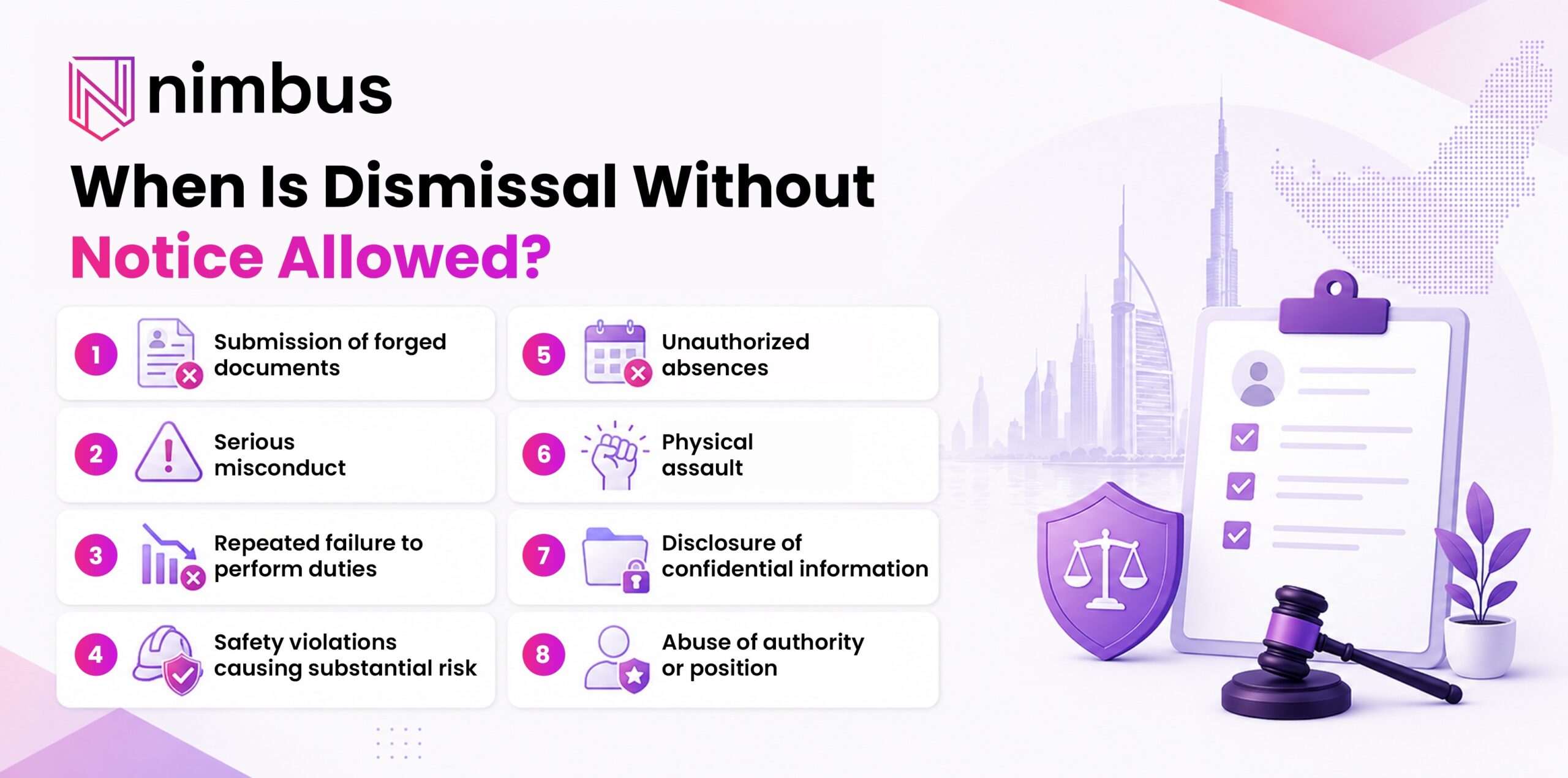
Summary dismissal without notice is permitted only under specific circumstances outlined by UAE labour law. Examples include:
- Submission of forged documents
- Serious misconduct
- Repeated failure to perform duties
- Safety violations causing substantial risk
- Unauthorized absences
- Physical assault
- Disclosure of confidential information
- Abuse of authority or position
Before dismissing an employee without notice, employers should conduct a formal investigation, issue a written decision, or maintain records for future reference. Proper documentation can significantly reduce the risk of disputes and legal challenges.
Arbitrary Dismissal & Unlawful Termination Protections
Not every termination is legally valid. A dismissal may be considered unlawful if it is linked to:
- Filing a complaint with MOHRE
- Pursuing a legitimate legal claim
- Exercising statutory employment rights
If a court determines that termination was unlawful, the employer may be ordered to pay compensation of up to three months’ wages. This compensation may be payable in addition to notice period compensation, end-of-service gratuity, and outstanding salary and benefits.
Employers should therefore maintain clear records demonstrating legitimate business or performance-related reasons for termination.
End of Service Gratuity Calculation UAE
One of the most significant financial obligations during termination is the end-of-service gratuity. Foreign full-time employees generally become eligible after completing at least one year of continuous service.
| Gratuity Component | Details & Calculation Rules |
|---|---|
| Standard Formula | First 5 years: 21 days of basic salary per year. After 5 years: 30 days of basic salary per year beyond the fifth year. (Proportional gratuity applies for partial years). |
| Maximum Cap | The total gratuity payment cannot exceed two years of the employee’s wage. |
| Calculation Basis | Must be based only on basic salary. Housing, transportation, and other non-basic allowances are strictly excluded. |
Businesses should ensure payroll systems accurately distinguish between basic salary and allowances.
Final Settlement Rules and Payout After Termination
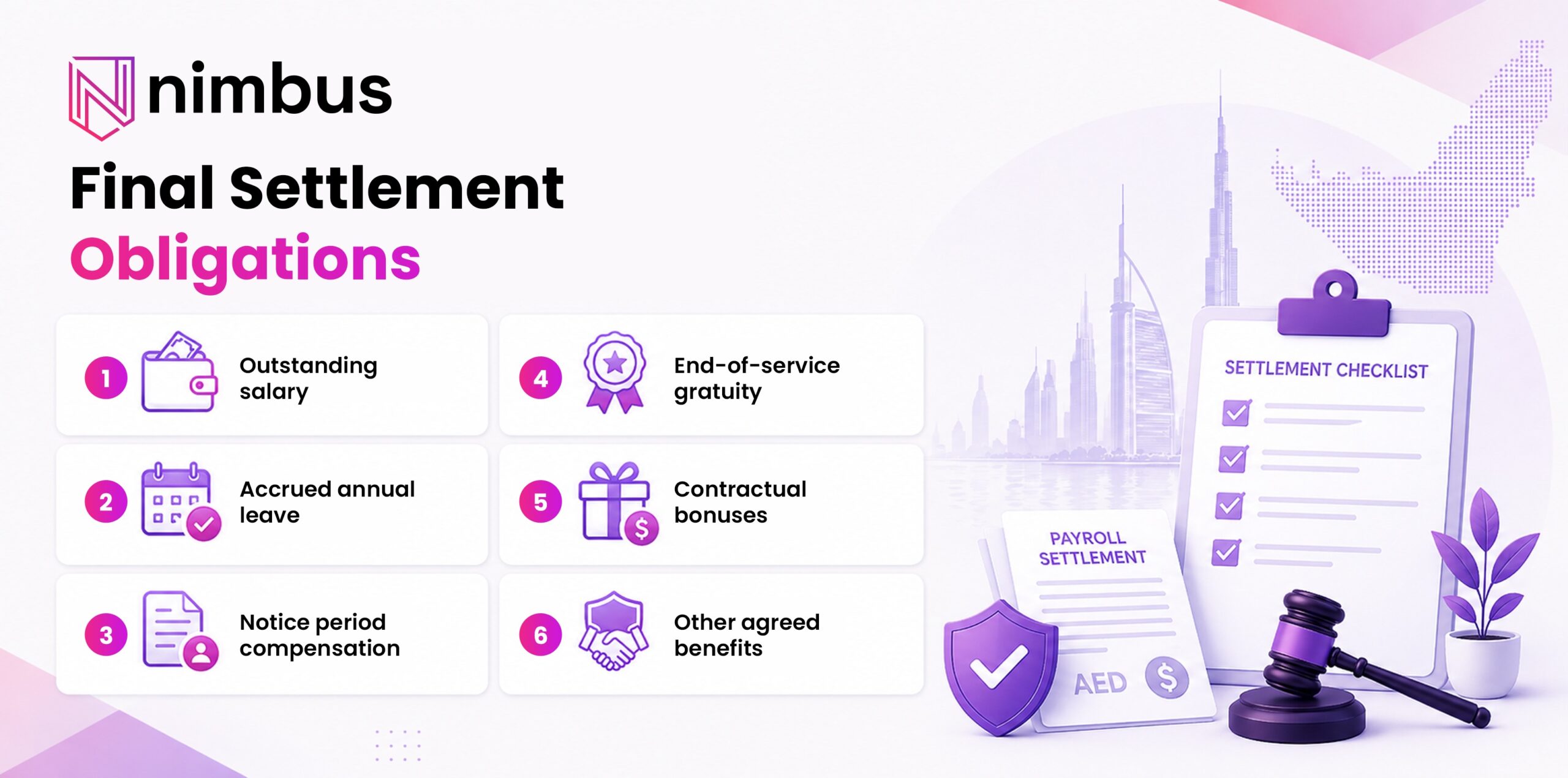
Employers must settle all employee entitlements within 14 days following contract termination. Final payments may include:
- Outstanding salary
- Accrued annual leave
- Notice period compensation
- End-of-service gratuity
- Contractual bonuses
- Other agreed benefits
Employers should provide a detailed final settlement statement to maintain transparency and minimize disputes.
UAE Visa Cancellation Rules After Termination
For expatriate employees, termination extends beyond payroll obligations. Employers must complete:
- Work permit cancellation
- Residence visa cancellation
- Immigration clearance procedures
Depending on the circumstances, employers may also need to cover repatriation expenses. Companies operating through UAE freezone setup or UAE mainland setup should ensure immigration processes align with their respective jurisdictional requirements.
Redundancy and Downsizing under UAE Labour Law
Business restructuring remains common across many industries. When implementing workforce reductions, employers should:
- Document commercial reasons
- Define objective selection criteria
- Apply decisions consistently
- Avoid discriminatory practices
Employee Offboarding Checklist & Data Security
Modern termination procedures must also address cybersecurity and information protection. Employers should establish a formal offboarding checklist covering:
- System Access & Property: Removal of access and company property recovery, including email accounts, cloud applications, financial systems, laptops, mobile devices, and storage devices.
- Confidentiality Protection: Reminding employees of confidentiality obligations and non-disclosure commitments.
Non-Compete Clauses Post-Termination in the UAE
UAE law permits reasonable non-compete provisions under certain circumstances. Restrictions must be:
- Necessary to protect legitimate business interests
- Limited in geographic scope
- Restricted to relevant activities
- Reasonable in duration
The maximum non-compete period under the federal framework is two years following employment termination. Businesses involved in company formation in the UAE often rely on carefully drafted non-compete clauses to protect customer relationships and proprietary information.
Conclusion: Navigating Employee Offboarding in the UAE
Employment termination in the UAE requires more than simply issuing a notice letter. Employers must comply with statutory notice periods, calculate gratuity correctly, settle final payments promptly, complete immigration formalities, and maintain proper documentation throughout the process.
As the UAE continues to attract global investors, maintaining strong HR compliance practices remains a critical part of business success. A structured, transparent, and legally compliant termination process protects employers from disputes and reinforces professional standards that contribute to organizational growth and reputation.
Comments are closed