

Starting a company is only one part of the business lifecycle. Knowing when and how to exit can be just as important. In Saudi Arabia, many foreign investors assume that if a company stops trading, compliance obligations automatically end.
In reality, an inactive company can continue to accumulate regulatory obligations, annual filing requirements, and financial penalties even if it generates no revenue.
Whether you are restructuring your business, pausing expansion, or permanently leaving the Saudi market, understanding the difference between liquidation and dormancy is essential.
Choosing the wrong approach can result in unnecessary carrying costs, suspended commercial registrations, tax issues, and delays if you decide to return to the Kingdom in the future. For businesses considering (or already operating) after a business setup in Saudi Arabia, having a structured exit strategy is just as important as the initial incorporation process.
This article explains the practical differences between liquidation and dormancy, outlines the latest compliance requirements, and highlights how businesses can minimize costs while remaining fully compliant.
Why Inactive Companies Still Have Compliance Obligations?
Many business owners mistakenly believe that simply stopping operations is enough to avoid ongoing regulatory requirements. Saudi Arabia’s regulatory framework does not work that way.
Even if your company has no employees or no active contracts, it may still be legally required to maintain certain registrations. Failure to do so can lead to escalating penalties and administrative restrictions that become increasingly expensive to resolve. In short, businesses must remain compliant until formal exit.
Financial Risks of Delaying Your Business Exit Strategy in KSA
Small compliance obligations of maintaining an inactive legal entity can quickly develop into significant liabilities. Some of the most common ongoing obligations include:
- Annual Commercial Registration (CR) confirmation
- Municipal licence maintenance
- Tax and VAT reporting with ZATCA
- Chamber of Commerce obligations
- Regulatory notifications
Ignoring these requirements often costs far more than formally liquidating or correctly maintaining a dormant company.
Commercial Registration (CR) Annual Confirmation in Saudi Arabia
One of the most significant regulatory changes requires companies to confirm their Commercial Registration every year. Since April 2025, annual confirmation is linked to the original Commercial Registration issuance date rather than the previous renewal system. If businesses fail to complete this requirement:
- The Commercial Registration may be suspended.
- Government portals may become inaccessible.
- Banking services may be affected.
- Participation in public tenders may be restricted.
- Continued non-compliance may ultimately lead to cancellation.
Regulators can also impose financial penalties that may reach SAR 50,000 depending on the duration and seriousness of the non-compliance.
Penalties for Suspended CR and Unresolved Liabilities
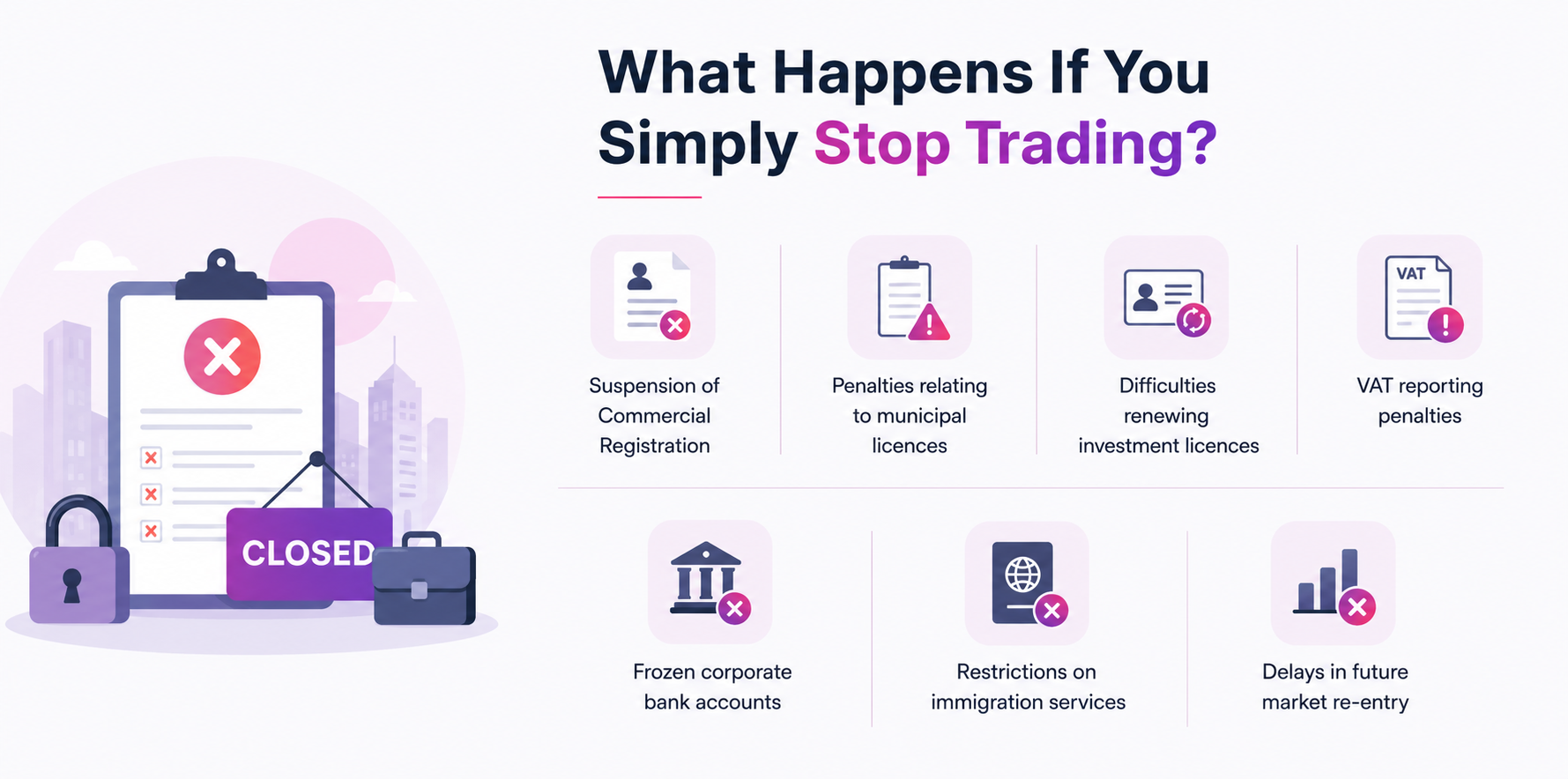
An inactive company that ignores regulatory obligations may face serious potential consequences including:
- Suspension of Commercial Registration
- Penalties relating to municipal licences
- Difficulties renewing investment licences
- VAT reporting penalties
- Frozen corporate bank accounts
- Restrictions on immigration services
- Delays in future market re-entry
These risks often create operational problems that require considerably more time and expense to resolve than proactive compliance management.
Business Exit Strategies in Saudi Arabia: Liquidation vs. Dormancy
Businesses that no longer wish to operate generally have two practical choices:
- Permanently close the company through liquidation
- Keep the company inactive through a managed dormancy strategy
Step-by-Step Company Liquidation Process in Saudi Arabia
Liquidation is the formal legal process of permanently dissolving a company. Once completed, the company ceases to exist and its registrations are cancelled. This option is generally appropriate for businesses that:
- Have completed their project
- No longer intend to operate in Saudi Arabia
- Want to eliminate future compliance obligations
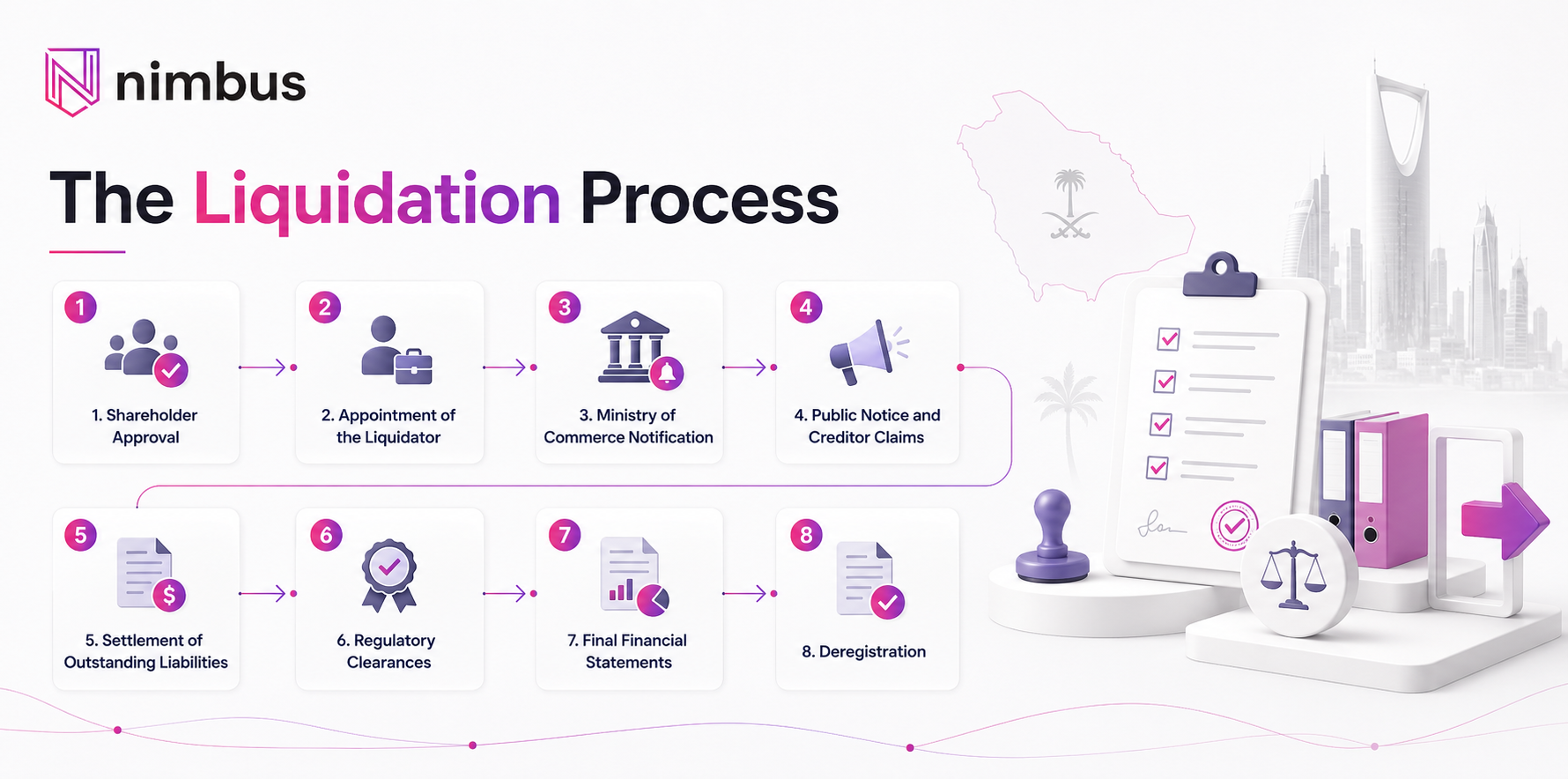
Although each case differs depending on company structure and industry, liquidation generally follows several key stages enlisted below.
-
Shareholder Approval
The shareholders approve the company’s dissolution and appoint a licensed liquidator through the appropriate corporate resolution.
-
Appointment of the Liquidator
The appointed liquidator assumes responsibility for:
- Company assets
- Financial records
- Creditor communications
- Regulatory filings
- Final reporting
The liquidator manages the process until completion.
-
Ministry of Commerce Notification
The company’s Commercial Registration is updated to reflect its liquidation status. This publicly confirms that the company is entering formal dissolution.
-
Public Notice and Creditor Claims
A liquidation announcement is published through the required government channels. Creditors are then given an opportunity to submit outstanding claims during a claim period of approximately 45 days following publication.
-
Settlement of Outstanding Liabilities
Before shareholders receive any remaining assets, the company must settle all outstanding obligations, including employees’ obligations, supplier invoices, and outstanding taxes.
-
Regulatory Clearances
Clearances are typically obtained from relevant authorities including ZATCA, Ministry of Human Resources and Social Development, and GOSI. Each authority confirms that no outstanding liabilities remain.
-
Final Financial Statements
The liquidator prepares liquidation-basis financial statements together with a final report documenting the completion of the process.
-
Deregistration
Once all approvals have been obtained, the Ministry of Commerce removes the company from the Commercial Register. The company legally ceases to exist.
Timeline for Securing a Company Dissolution Certificate
Straightforward solvent companies generally complete liquidation within three to six months. Several factors influence timing, including:
- Outstanding tax matters
- Employee settlements
- Regulatory approvals
- Accuracy of financial records
Complex ownership structures or unresolved disputes may extend the timeline.
Company Dormancy in Saudi Arabia: Managing Ongoing Obligations
Some businesses may wish to pause operations while preserving the legal entity for future use. Saudi Arabia does not currently offer an official dormant company status.
Instead, businesses create what is commonly referred to as a practical dormancy arrangement. Under this approach, the company stops commercial activity while continuing to satisfy essential regulatory obligations.
Dormancy, however, does not eliminate compliance responsibilities. Companies should continue to manage several core obligations, including:
- Annual Commercial Registration confirmation
- Appropriate VAT reporting
- Municipal licence requirements
- Employee and GOSI closure where necessary
- Maintenance of statutory records
Keeping these obligations current helps preserve the company for future reactivation.
Avoiding ZATCA, GOSI, and MoC Compliance Mistakes During Exit
Many avoidable penalties arise from misunderstandings rather than deliberate non-compliance. Some of the most common mistakes include:
- Assuming inactive companies have no reporting obligations
- Missing annual Commercial Registration confirmation deadlines
- Forgetting to notify ZATCA of inactivity
- Closing operations before settling employee liabilities
- Leaving corporate bank accounts unattended after operations stop
Addressing these issues early can prevent expensive corrective action later.
Expert Corporate De-Registration and Liquidation Services in KSA
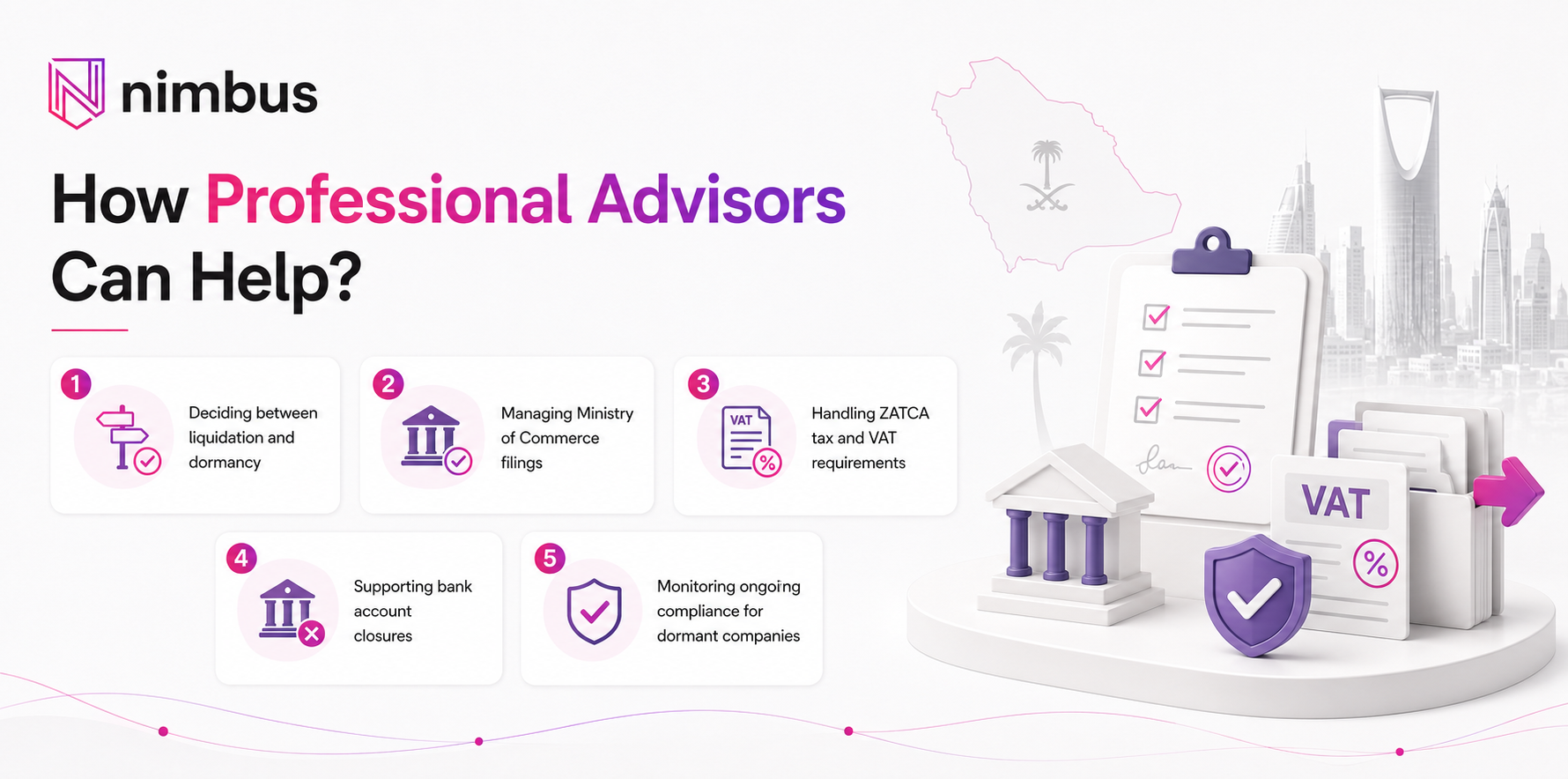
Exiting a company in Saudi Arabia involves multiple government authorities. Proper coordination significantly reduces delays and helps businesses avoid administrative bottlenecks. Experienced advisors can assist with:
- Deciding between liquidation and dormancy
- Managing Ministry of Commerce filings
- Handling ZATCA tax and VAT requirements
- Supporting bank account closures
- Monitoring ongoing compliance for dormant companies
Notable Points
Closing or pausing a company in Saudi Arabia should be treated with proper measures. Regulatory obligations continue until the correct legal process has been completed, and overlooking even a single compliance requirement can lead to several complications.
For companies that no longer intend to operate, liquidation provides a clean legal exit. For businesses expecting to resume activities later, a carefully managed dormancy strategy offers a practical alternative while preserving the corporate entity.
Obtaining professional guidance from experienced advisors can help you make the right decision with confidence while ensuring a smooth transition.

Comments are closed