


Transfer Pricing (TP) is one of the crucial parts of the UAE’s Corporate Tax framework. Once a concern for multinational groups, it is now an important consideration for businesses operating in the UAE.
The UAE has introduced Transfer Pricing rules based broadly on the OECD framework. These rules are particularly relevant to companies with related-party transactions, cross-border arrangements, intellectual property arrangements, and businesses operating through multiple UAE entities.
The introduction of the UAE Domestic Minimum Top-up Tax from financial years beginning on or after 1 January 2025 has added another layer of importance for large multinational groups.
The DMTT generally applies to UAE entities belonging to multinational groups with consolidated annual revenue of at least EUR 750 million in at least two of the four preceding financial years.
For businesses considering business setup in the UAE, TP should be considered when a company is being incorporated. For foreign investors, this article offers the basics of UAE’s TP rules.
UAE Transfer Pricing Regulations: A Comprehensive Guide
Transfer Pricing refers to the pricing of transactions between entities or persons that are connected through ownership, control, or other relationships. Examples include:
- Management and support services between group companies
- Royalty and intellectual property arrangements
- Shared-service arrangements
- Treasury and financing transactions
- Leasing arrangements between related entities
- Business restructuring transactions
The central principle is the arm’s length principle. In simple terms, a related-party transaction should be priced in a way that is consistent with what independent parties would have agreed to under comparable circumstances.
The UAE’s Transfer Pricing framework broadly follows the OECD Transfer Pricing Guidelines, while also containing UAE-specific rules and compliance requirements.
This is important for businesses completing UAE company formation because the commercial relationship between related entities needs to be supported by an appropriate pricing methodology, contractual arrangements, and evidence of the underlying services or transactions.
The Arm’s Length Principle in UAE Corporate Tax
Article 34 of the UAE Corporate Tax Law establishes the arm’s length principle for transactions and arrangements between related parties. The question is not simply whether an invoice has been issued or whether two companies have signed an agreement.
The taxpayer needs to consider whether the price and terms make commercial sense when compared with transactions between independent parties. For example, suppose a UAE subsidiary provides management services to its overseas parent company.
The UAE company may charge the parent company a management fee. However, the fee should be supported by:
- The actual services being provided
- The functions performed by the UAE company
- The assets used
- Comparable market information
- Appropriate contractual documentation
The same principle applies in the opposite direction. If the UAE company pays a related overseas entity for services, the business should be able to demonstrate that the services were actually received and that the amount paid is commercially supportable.
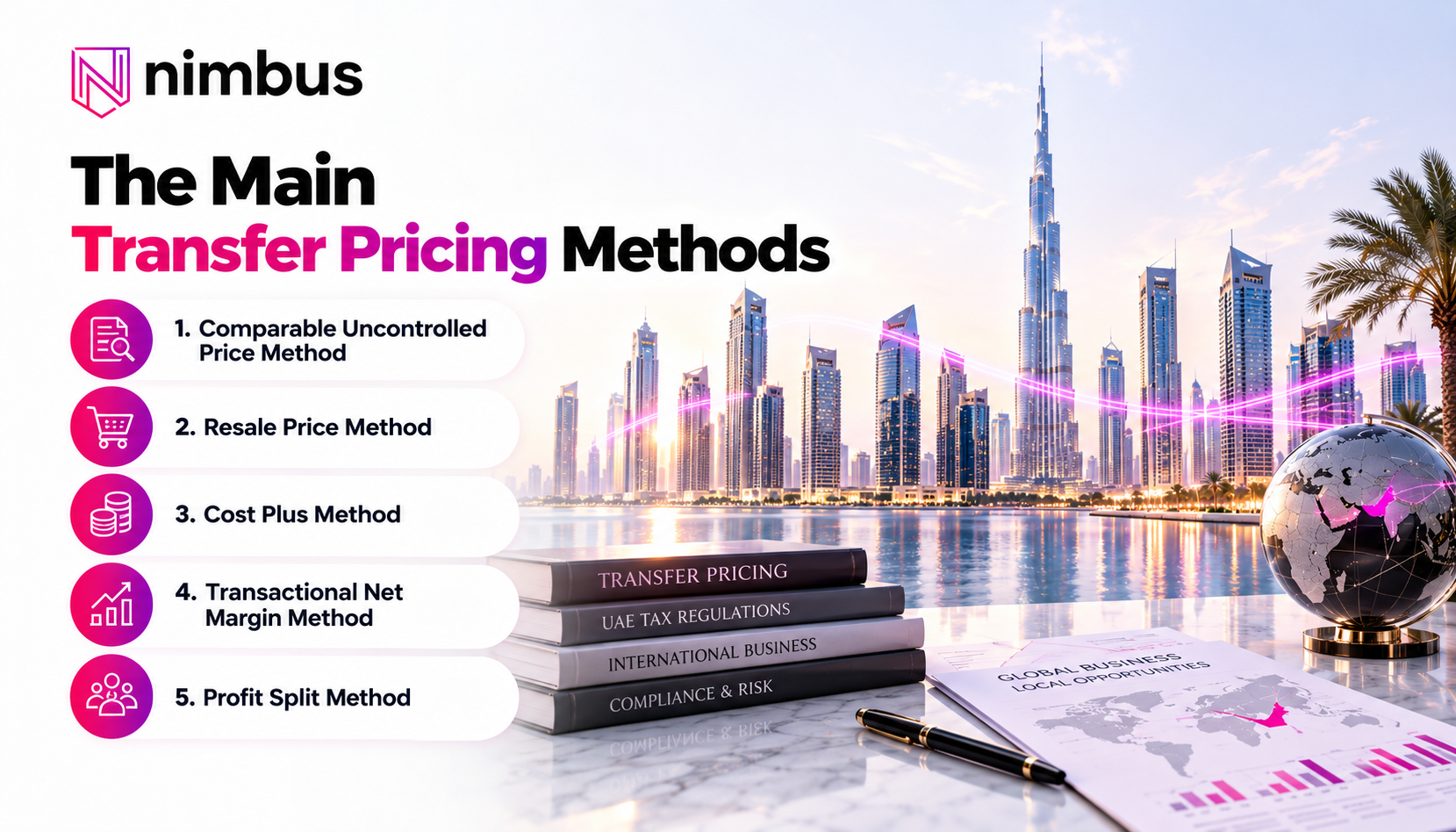
5 Approved Transfer Pricing Methods in the UAE
Selecting the right Transfer Pricing method is one of the most important parts of a Transfer Pricing analysis. The UAE framework recognises the five traditional OECD methods described below.
1. Comparable Uncontrolled Price Method
The Comparable Uncontrolled Price, or CUP, method compares the price charged in a controlled transaction with the price charged in a comparable transaction between independent parties. It can be particularly useful where reliable price information exists.
2. Resale Price Method
This method generally starts with the price at which a product is resold to an independent customer. An appropriate gross margin is then deducted to determine the arm’s length purchase price from the related party. It can be relevant for distributors that purchase products from group companies and resell them without significantly changing the products.
3. Cost Plus Method
Under the Cost Plus Method, the relevant costs incurred by the supplier are identified and an appropriate arm’s length mark-up is applied. This approach can be useful for routine manufacturing, support or service arrangements where the cost base and functions can be reliably identified.
4. Transactional Net Margin Method
The Transactional Net Margin Method, or TNMM, compares the net profit margin earned in a controlled transaction with the margins earned by comparable independent businesses. TNMM is frequently considered where reliable gross-margin information is difficult to obtain but operating-level financial information is available.
5. Profit Split Method
The Profit Split Method can be appropriate where both parties make significant and unique contributions or where the transactions are highly integrated. It may therefore be relevant for businesses involving valuable intellectual property, integrated operations or complex cross-border arrangements.
Rules for Related Party Transactions & Connected Persons
In the UAE’s Transfer Pricing rules, ‘Related Parties’ and ‘Connected Persons’ should not be treated as exactly the same concept. Article 36 deals with payments and benefits involving Connected Persons. Depending on the circumstances, Connected Persons can include:
- Individuals who directly or indirectly own or control a taxable person
- Directors and officers
- Individuals related to owners, directors or officers
- Partners in an unincorporated partnership
- Related Parties of the above persons
If a payment to a Connected Person is not at arm’s length, the corresponding Corporate Tax deduction may be restricted or denied, subject to the applicable rules.
Transfer Pricing Requirements for UAE Free Zone Companies
Free zone companies often assume that their preferential Corporate Tax treatment means Transfer Pricing is less important. That is not the case. A company should not simply select a free zone activity because it appears tax-efficient.
Its actual operations, people, assets, risks, contracts and income streams need to support the business model. A Qualifying Free Zone Person must satisfy the relevant conditions to benefit from the 0% Corporate Tax rate on qualifying income.
Transfer Pricing documentation may also need to be prepared separately for each Qualifying Free Zone Person where the applicable thresholds are met. The company’s actual activities, substance and functional profile should be consistent with the income being treated as qualifying income. This is an important consideration for UAE Free Zone.

Transfer Pricing Compliance & Documentation Steps
One of the biggest practical mistakes businesses can make is waiting until the Corporate Tax return is due before reviewing their intercompany transactions. A better approach is to build Transfer Pricing into the company’s operating model. Businesses can start with five practical steps.
- Map the relationships
Identify all Related Parties and Connected Persons under the UAE rules. - Review the transactions
Create a complete inventory of controlled transactions, including services, royalties, and leases. - Test the existing pricing
Assess whether the pricing is consistent with the arm’s length principle and whether the group’s existing Transfer Pricing policy works under UAE requirements. - Align contracts, accounting and operations
The written agreement should reflect what actually happens in the business. - Document the position
Maintain appropriate supporting evidence, including agreements, invoices, financial data, and other relevant records. Good documentation can be valuable if the FTA asks questions during an audit.
Navigating the Future of UAE Corporate Tax & Transfer Pricing
The UAE’s Transfer Pricing regime is part of a broader move toward internationally aligned tax administration. The importance of this becomes even clearer as the UAE continues to develop its international tax framework, including the Domestic Minimum Top-up Tax, APA framework and Mutual Agreement Procedure.
Investors planning business setup in the UAE should consider Transfer Pricing as part of the wider structure. A well-designed framework can help businesses meet their UAE Corporate Tax obligations and reduce the risk of unexpected adjustments.

Comments are closed