
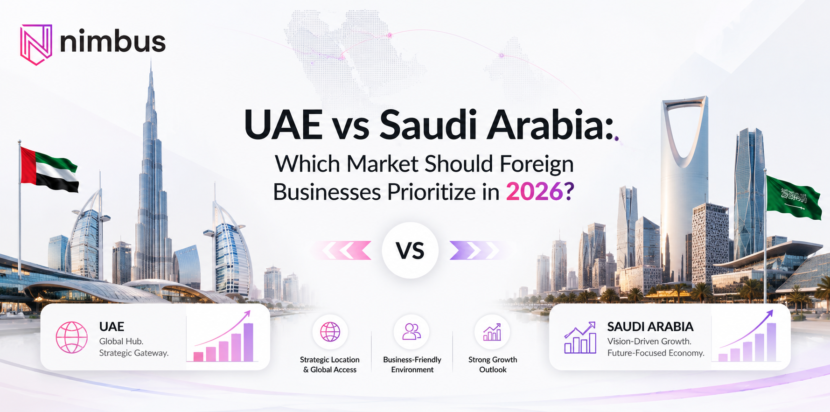
The Gulf has become one of the world’s most attractive destinations for international expansion. Among all regional markets, the UAE and Saudi Arabia continue to dominate investment discussions, each offering compelling opportunities for foreign businesses.
While both countries are actively attracting global investors through regulatory reforms, infrastructure investments, and pro-business policies, they serve different commercial objectives.
If you’re considering business setup in the UAE or evaluating business incorporation in the KSA, the question isn’t simply which country is bigger or faster. The better question is which market best aligns with your business model, growth plans, and operational capabilities.
This article compares both destinations across the factors that matter most to foreign investors in 2026.
Why Your First GCC Market Matters for Business Expansion?
Expanding into the Middle East requires more than obtaining a trade licence. Your first market influences everything that follows, including:
- Initial investment requirements
- Banking accessibility
- Hiring strategy
- Regulatory obligations
- Future regional expansion
Choosing the right jurisdiction from the beginning helps avoid unnecessary restructuring, duplicate licensing costs, and operational delays later. Many international companies eventually end up establishing operations in both countries. However, determining which market to enter first is often the key strategic decision.
UAE vs. Saudi Arabia: 2026 Economic Overview for Investors
Although geographically close, the two economies operate very differently. Let’s have a closer look.
1. The UAE
With world-class infrastructure, a highly diversified economy, and a large expatriate population, The UAE has built its reputation as an international business gateway. Businesses pursuing UAE company formation typically benefit from:
- A mature regulatory framework
- International banking connectivity
- Efficient government services
- Strong logistics infrastructure
- Access to regional and global markets
Whether through a UAE freezone setup or a UAE mainland setup, investors have multiple options depending on their commercial objectives.
2. Saudi Arabia
Saudi Arabia offers something different as it represents one of the Middle East’s largest domestic markets, supported by a population exceeding 35 million and significant government-led investment. Under Vision 2030, Saudi Arabia continues to diversify beyond oil by investing heavily in:
- Manufacturing
- Healthcare
- Tourism
- Renewable energy
- Technology
- Financial services
Company Formation in UAE vs. KSA: Setup Speed and Process
One of the biggest differences lies in the setup process itself. Let’s have a look at the setup process in each region.
1. Business Setup in the UAE
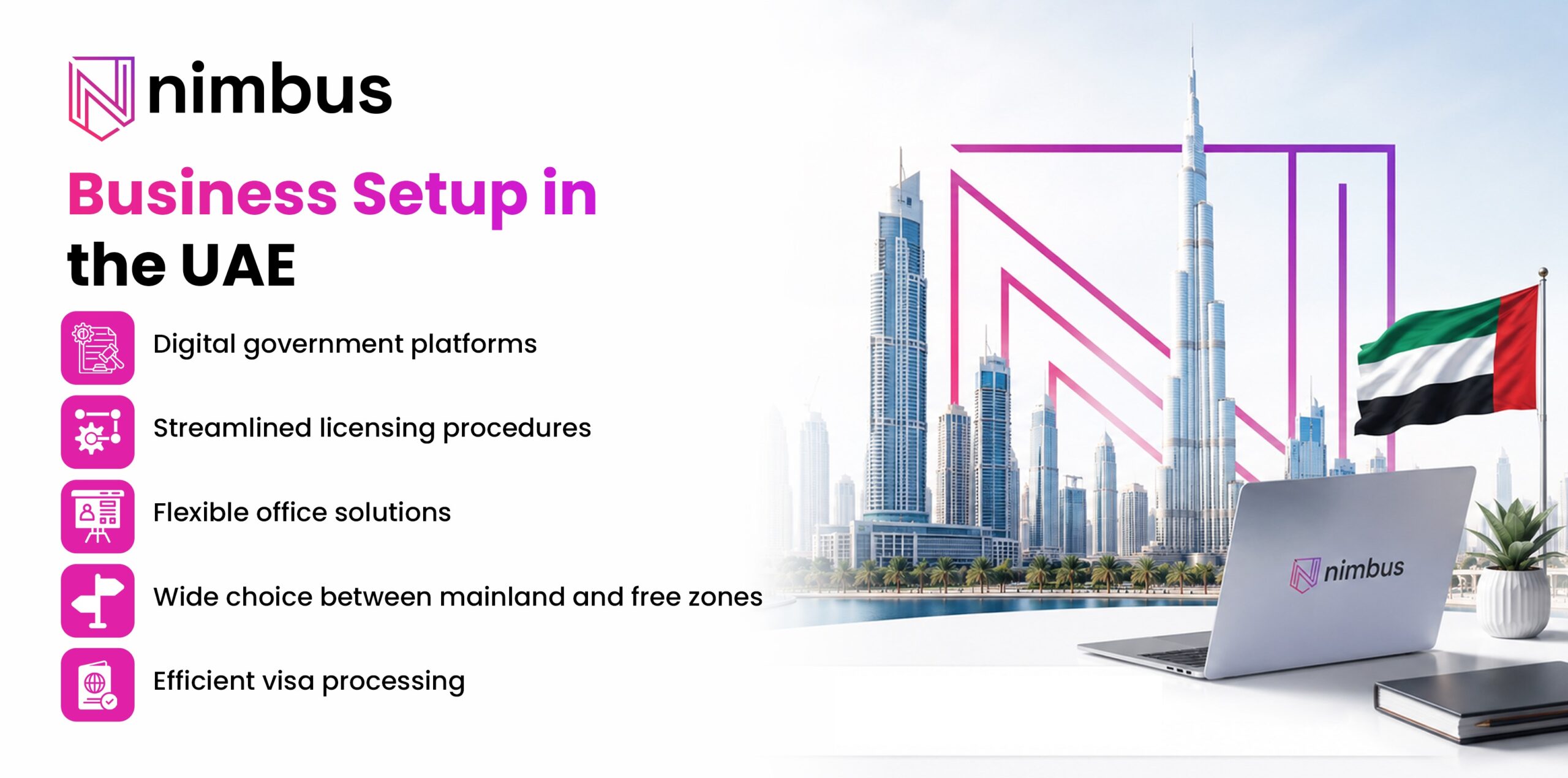
The UAE remains one of the world’s fastest jurisdictions for company formation. Depending on the business activity and licensing authority, many companies can complete incorporation within days once documentation is ready. Advantages include:
- Digital government platforms
- Streamlined licensing procedures
- Flexible office solutions
- Wide choice between mainland and free zones
- Efficient visa processing
Businesses also enjoy flexibility when selecting between a UAE mainland setup and various free zones, allowing structures to be tailored to operational requirements.
2. Business Setup in Saudi Arabia
Saudi Arabia has made significant improvements in recent years, particularly following reforms introduced through the Ministry of Investment (MISA). However, company formation generally involves additional regulatory approvals, especially in regulated industries. Foreign investors should expect:
- More comprehensive documentation
- Sector-specific licensing reviews
- Higher compliance expectations
- Longer approval timelines
Foreign Ownership Rules: Market Access in Dubai vs. Riyadh
Both countries now permit 100% foreign ownership across many sectors. However, the practical experience differs.
1. UAE
Foreign investors eyeing UAE can often retain complete ownership while benefiting from:
- Simplified governance
- Flexible visa allocations
- Efficient licensing amendments
- Easier restructuring as businesses grow
This makes the UAE particularly attractive for entrepreneurs, SMEs, and international service businesses.
2. Saudi Arabia
Saudi Arabia also allows full foreign ownership across numerous industries, but investors are expected to demonstrate stronger operational commitment. Businesses may encounter additional expectations relating to:
- Local employment
- Physical operations
- Regulatory reporting
- Governance standards
Cost of Setting Up a Business: UAE vs. Saudi Arabia Compared
Cost should never be viewed only through initial licensing fees. A realistic comparison considers the entire operating environment.
1. UAE
The UAE allows businesses to scale gradually. Companies can often begin with flexible office facilities, smaller teams, and lower administrative overhead. This approach helps reduce upfront financial pressure while allowing businesses to test regional demand.
2. Saudi Arabia
Saudi Arabia generally requires greater investment from the outset. Costs may include:
- Larger office requirements
- Additional regulatory approvals
- Higher compliance obligations
- Local staffing expectations
Although entry costs are slightly higher, they support access to one of the region’s largest domestic economies.
Corporate Banking and Account Setup in the Middle East
Corporate banking remains one of the most important considerations for international businesses.
1. UAE Banking
The UAE offers a sophisticated banking ecosystem that supports international business activity. Advantages include:
- Multi-currency corporate accounts
- Strong international banking relationships
- Digital banking platforms
- Mature compliance procedures
2. Saudi Banking
Saudi Arabia’s banking sector is highly stable and well regulated. However, account opening generally involves:
- Enhanced compliance reviews
- Greater emphasis on business substance
- Detailed source-of-funds verification
- Longer onboarding timelines
Businesses entering Saudi Arabia should plan banking activities early to avoid operational delays.
Corporate Tax & VAT: UAE vs. Saudi Arabia Tax Regimes
Both jurisdictions maintain attractive tax environments by international standards.
1. UAE
The UAE continues to offer a competitive corporate tax regime alongside an established VAT framework. Businesses benefit from:
- Predictable tax administration
- Clear compliance guidance
- Efficient electronic filing systems
- Strong international tax treaty network
2. Saudi Arabia
Saudi Arabia applies different tax treatments depending on ownership structure. Companies should consider:
- Corporate income tax
- Zakat obligations
- VAT compliance
- Transfer pricing requirements
Professional tax planning is essential before commencing operations.
Talent Acquisition and Saudization: Hiring in the GCC
Access to talent differs considerably.
1. UAE
The UAE provides one of the world’s most international labour markets. Businesses benefit from:
- Global talent pools
- Streamlined employment visas
- Flexible recruitment
- Multilingual workforce
This makes the UAE particularly attractive for consulting firms, technology companies, and regional headquarters.
2. Saudi Arabia
Saudi Arabia has prioritised workforce nationalisation through Saudization initiatives. Companies should prepare for:
- National employment quotas
- Workforce localisation planning
- Sector-specific hiring requirements
Top Industries for Investment in the UAE and Saudi Arabia
Both markets offer exceptional opportunities, but different industries tend to perform better in each jurisdiction.
1. UAE strengths
- Financial services
- Professional consulting
- International trade
- Technology startups
- Digital services
- Holding companies
- Regional headquarters
2. Saudi Arabia strengths
- Manufacturing
- Construction
- Infrastructure
- Healthcare
- Energy
- Industrial projects
- Government procurement
Choosing the appropriate jurisdiction often depends more on customer location than company size.
Common Pitfalls When Expanding to the Middle East
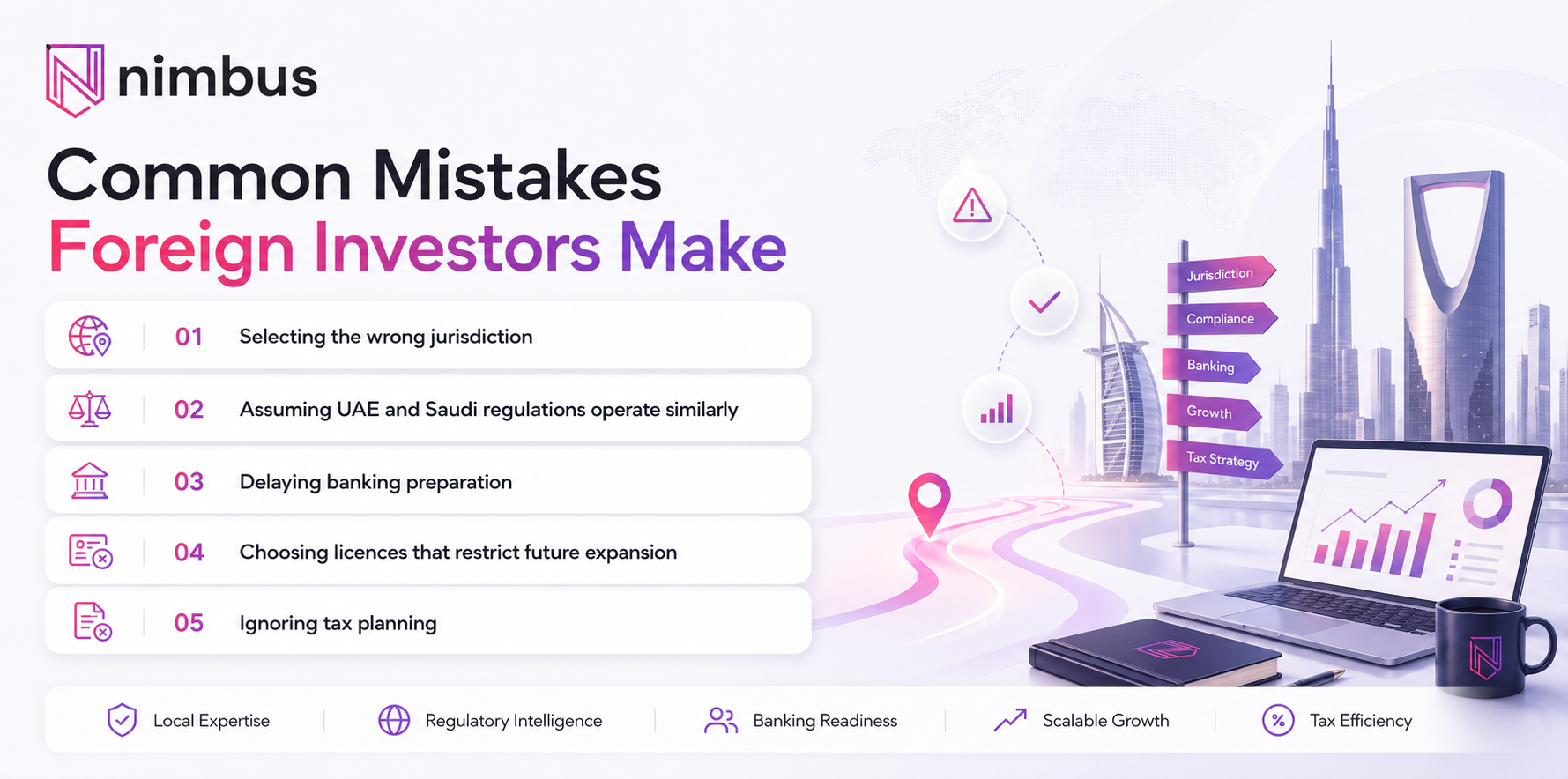
Many expansion challenges arise from planning errors rather than regulatory complexity. Some of the most common mistakes include:
- Selecting the wrong jurisdiction
- Assuming UAE and Saudi regulations operate similarly
- Delaying banking preparation
- Choosing licences that restrict future expansion
- Ignoring tax planning
Working with experienced advisors before company formation can prevent costly restructuring later.
UAE or KSA: Which Jurisdiction is Right for Your Company Setup?
There is no universal answer to whether the UAE or Saudi Arabia should be your first Middle East market. The UAE remains the preferred choice for businesses seeking speed, flexibility, international connectivity, and a lower barrier to entry.
Saudi Arabia, meanwhile, offers unmatched long-term potential for businesses prepared to invest in localisation, larger operations, and direct participation in one of the region’s fastest-growing economies. However, no matter what you choose, establishing the right corporate structure from the outset can make future expansion significantly smoother.
Whether you’re planning a business setup in the UAE or company formation in the KSA, careful planning and regulatory guidance can make the difference between a smooth expansion and an expensive restructuring exercise.
Comments are closed