

The UAE has officially extended the deadline for large businesses to appoint an Accredited Service Provider (ASP) under its new Electronic Invoicing System. While the extension offers companies additional preparation time, it does not change the mandatory implementation date of January 1, 2027.
For businesses operating in the UAE, this development provides a valuable opportunity to strengthen compliance planning, upgrade digital infrastructure, and prepare internal systems for one of the country’s most significant tax and finance modernization initiatives.
Investors considering business setup in the UAE need to understand the e-invoicing framework as it is now essential for long-term compliance and operational efficiency.
Understanding the UAE’s E-Invoicing Initiative
The UAE’s Electronic Invoicing System forms part of a broader digital transformation strategy designed to improve tax compliance, increase transparency, and streamline business transactions across the country.
The framework is based on Ministerial Decision No. 243 of 2025 and Ministerial Decision No. 244 of 2025, which established the legal foundation for mandatory electronic invoicing. The system aims to:
- Standardize invoice formats across businesses
- Improve transaction reporting accuracy
- Strengthen tax compliance
- Enhance transparency in commercial activities
- Support digital transformation initiatives
UAE E-Invoicing Deadline Extended for New ASP Appointment
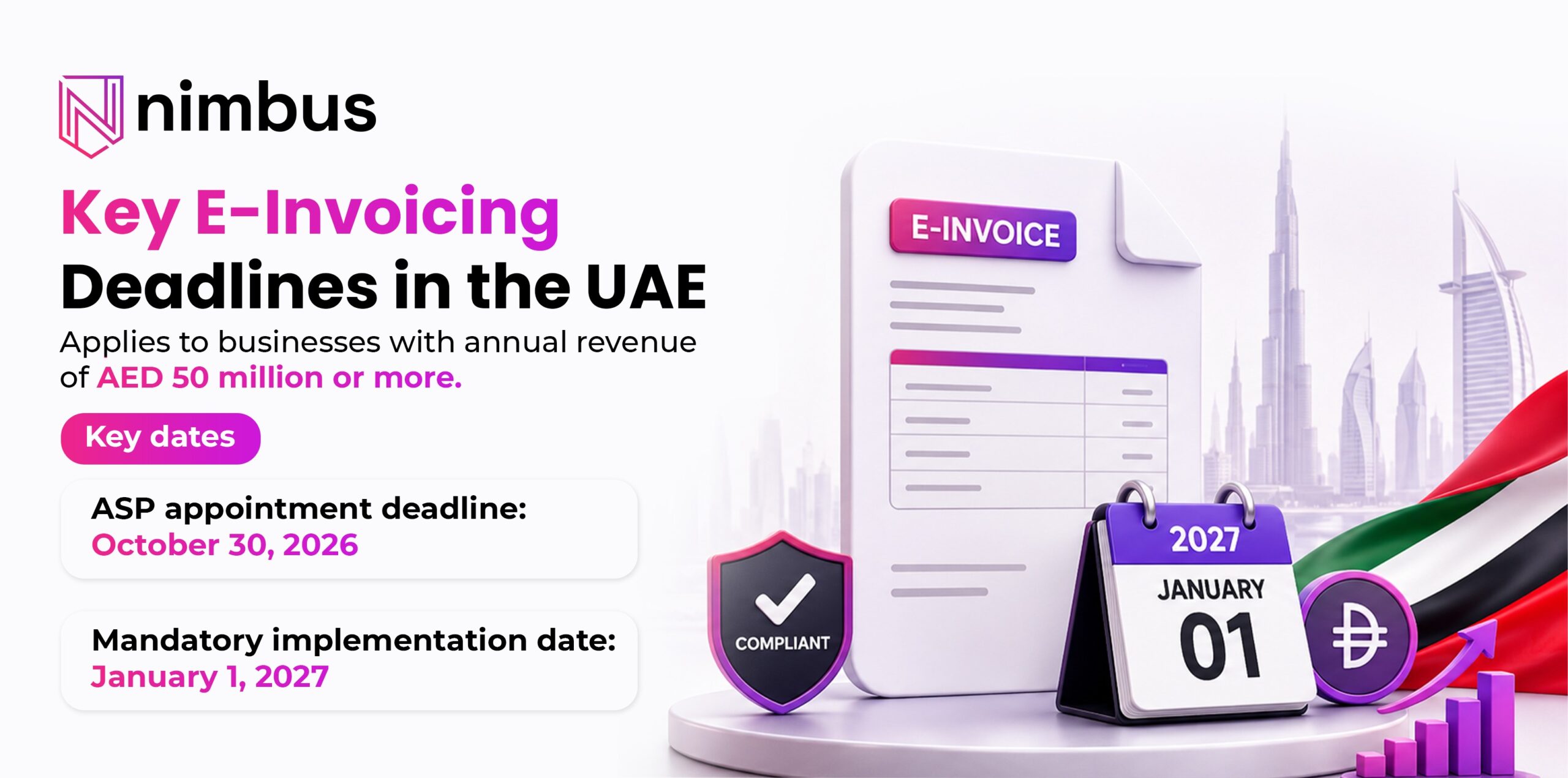
The Ministry of Finance has extended the deadline for large businesses to appoint an Accredited Service Provider. The previous deadline was July 31, 2026. But businesses with annual revenue of AED 50 million (US$13.61 million) or more now have until October 30, 2026, to appoint an ASP.
However, one critical date remains unchanged. The mandatory implementation date is January 1, 2027. This means businesses have gained an additional three months to select and onboard an ASP but will still need to complete all testing, integration, training, and deployment activities before January 2027.
Companies should therefore view this extension as extra preparation time rather than a postponement of compliance obligations.
UAE E-Invoicing Timeline: Key Dates for 2026 and 2027
The UAE’s rollout follows a phased implementation model.
| Implementation Phase | Target Businesses | ASP Appointment Deadline | Mandatory Implementation Date |
|---|---|---|---|
| Phase #1 | Businesses with annual revenue of AED 50 million or more. | October 30, 2026 | January 1, 2027 |
| Phase #2 | Businesses with annual revenue below AED 50 million & Government entities. | March 31, 2027 | October 1, 2027 |
Who Must Comply with UAE E-Invoicing Regulations?
The first mandatory phase specifically targets larger organizations operating within the UAE. Affected entities include:
- UAE mainland companies
- Free zone entities
- Multinational corporations
- Regional headquarters
- Manufacturing businesses
- Service providers exceeding the revenue threshold
Companies involved in business setup in the UAE should incorporate e-invoicing readiness into their long-term operational planning from the outset.
The current implementation primarily targets business-to-business (B2B) transactions and business-to-government (B2G) transactions. At present, business-to-consumer (B2C) transactions remain outside the mandatory scope.
However, businesses should continue monitoring regulatory updates, as future decisions may expand the scope of mandatory e-invoicing.
What is an Accredited Service Provider (ASP) in UAE?
An Accredited Service Provider acts as the technology bridge between businesses and the UAE’s electronic invoicing ecosystem. Their responsibilities include:
- Invoice generation
- Secure transmission
- Digital reporting
- Record management
- Integration with government systems
The Ministry of Finance recently announced enhancements to the ASP accreditation process. Currently, 32 providers have already received accreditation and additional providers are completing the approval process.
How to Choose the Right E-Invoicing ASP
Selecting the right ASP is more than merely a regulatory requirement. It’s a strategic technology decision that can impact:
- Finance operations
- ERP integration
- Tax reporting
- Data security
- Compliance efficiency
Businesses should evaluate providers based on technical compatibility and industry expertise. Choosing an industry-aligned provider can reduce implementation challenges.
E-Invoicing Readiness for New Business Setup in Dubai & UAE
Entrepreneurs pursuing company formation in the UAE should consider e-invoicing readiness from day one. Modern business structures should include:
- Digital accounting systems
- Cloud-based ERP solutions
- Electronic document management
- Automated reporting capabilities
Businesses that adopt digital processes early will be better positioned to meet regulatory requirements and scale efficiently.
Practical Steps Businesses Should Take Now
With the implementation deadline approaching, companies should begin preparations immediately.
- Confirm Applicability: Determine whether your organization meets the AED 50 million revenue threshold, and falls within which phase.
- Review Transaction Flows: Map all invoicing activities, including domestic transactions, cross-border sales, government contracts, and intercompany transactions.
- Assess Existing Systems: Evaluate accounting software, tax reporting tools, and data management systems. Identify any gaps requiring upgrades.
- Begin ASP Evaluation: Do not wait until the final months. Shortlist accredited providers and assess cost, integration capabilities, support services, and security standards.
- Develop an Implementation Roadmap: Create a structured project plan covering provider onboarding, system integration, staff training, and compliance validation.
- Train Internal Teams: Key stakeholders should include finance departments, tax teams, and IT personnel. Early training minimizes operational disruption during implementation.
Operational Benefits of the UAE E-Invoicing Framework
Although regulatory compliance is the primary driver, e-invoicing also offers significant operational advantages. Potential benefits include:
- Faster invoice processing
- Improved cash flow visibility
- Reduced administrative costs
- Better data accuracy
- Reduced fraud risk
E-invoicing: The Future of UAE Business
The extension of the Accredited Service Provider appointment deadline to October 30, 2026, offers welcome flexibility for large businesses. However, with the mandatory implementation date of January 1, 2027, remaining unchanged, organizations cannot afford to delay preparations.
Companies should use the additional time strategically by selecting the right provider, reviewing invoicing workflows, upgrading systems, and preparing teams for the transition.
As electronic invoicing becomes a cornerstone of the UAE’s digital economy, businesses that act early will not only achieve compliance but also strengthen efficiency, transparency, and long-term competitiveness in one of the world’s fastest-growing commercial markets.

Comments are closed