

As businesses expand, markets change and ownership structures become more complex, the corporate structure that worked at the beginning may no longer be the right one.
A company may need to merge with another entity, separate one business division from another, transfer shares to new investors, or reorganize its group structure to improve efficiency.
In the UAE, these transactions are becoming increasingly relevant as companies respond to changing commercial priorities, investment requirements and the country’s evolving corporate tax environment.
For businesses considering business setup in the UAE, understanding restructuring options from the outset can also prevent expensive changes later. This guide explains the key forms of UAE corporate restructuring, including mergers, demergers and share transfers, and highlights the practical considerations businesses should address before proceeding.
What is Corporate Restructuring in the UAE & Dubai?
Corporate restructuring involves changing the legal, ownership or operational structure of a business without necessarily ending its commercial activities. The objective can vary significantly. A business may restructure to:
- Consolidate several companies into one entity
- Separate different business divisions
- Bring in new investors
- Transfer ownership within a group
- Prepare a business for a sale
- Improve governance and operational efficiency
- Facilitate succession planning
The appropriate restructuring method depends on the company’s legal form, jurisdiction, shareholders, assets, liabilities, regulatory approvals and tax position. For companies undertaking company formation in the UAE, considering these future possibilities early can make later restructuring considerably easier.
1. Company Mergers in the UAE: Combining Business Operations
A merger allows two or more companies to combine their operations and legal interests. Under the UAE Commercial Companies Law, a merger can result in the merged company or companies ceasing to exist as separate legal entities, with the surviving or newly established company becoming the legal successor to their rights and obligations.
A merger may make sense when businesses have:
- Common shareholders
- Complementary operations
- Overlapping administrative functions
- Similar customer bases
- A shared strategic direction
For example, an international group operating two UAE subsidiaries may decide to consolidate them into a single entity to reduce duplication in management, accounting, licensing and administration.
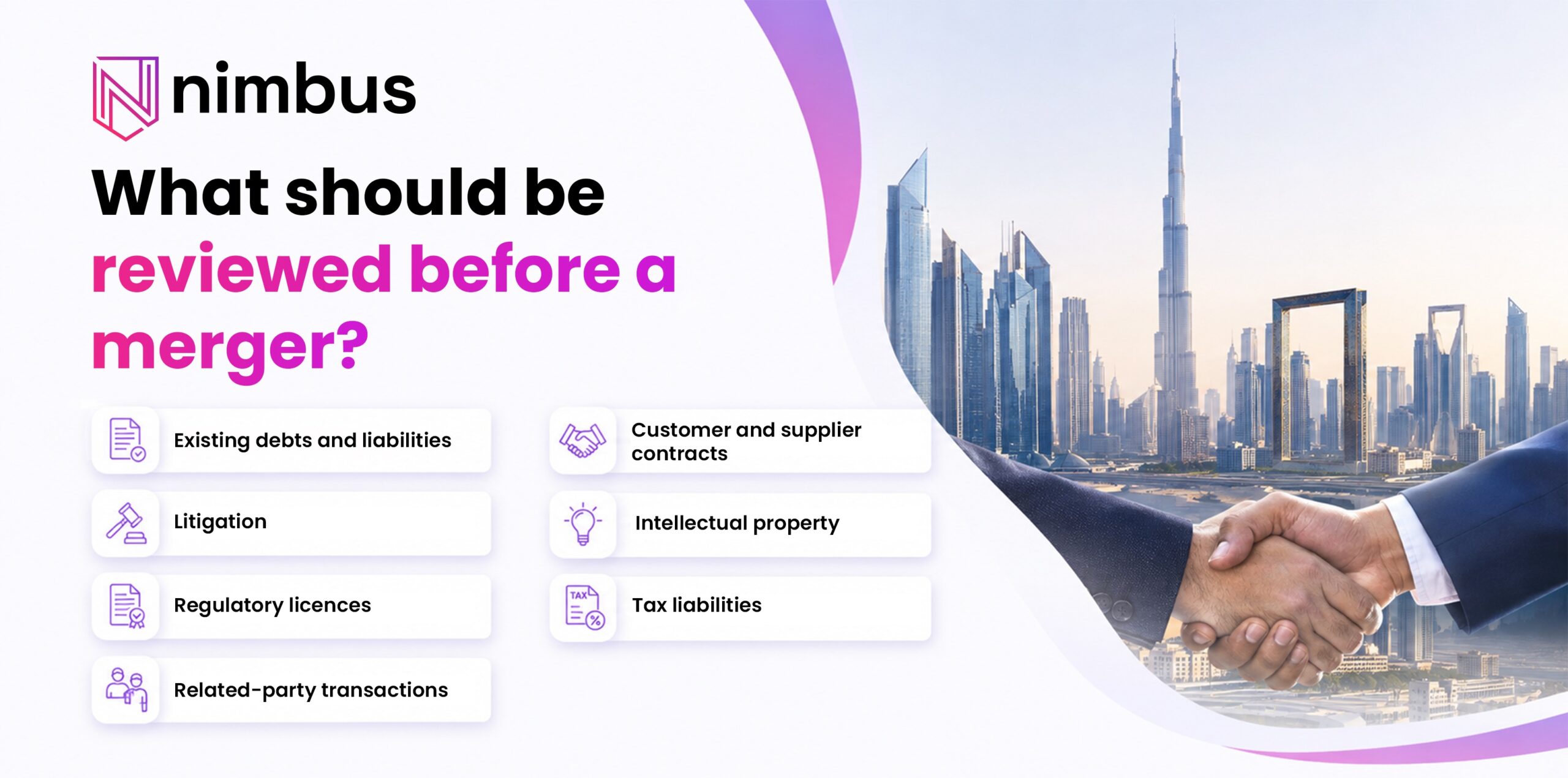
What should be reviewed before a merger?
A merger requires more than simply combining two company names. Businesses should conduct legal and financial due diligence covering:
- Existing debts and liabilities
- Customer and supplier contracts
- Litigation
- Intellectual property
- Regulatory licences
- Tax liabilities
- Related-party transactions
The transaction should also establish how assets, liabilities, employees and contractual relationships will be treated after completion.
2. Corporate Demergers & Business Spin-Offs in the UAE
A demerger, sometimes referred to as a divestiture or corporate split, takes the opposite approach to a merger. Instead of combining businesses, a company separates particular activities, assets or business divisions into independent entities.
The UAE Commercial Companies Law provides a framework for divestiture, including the splitting of assets, activities, and equity into independently operated companies. A demerger can be useful when a company has grown into several unrelated business lines. For example, a group may operate construction, technology, and consultancy.
Keeping all of these activities within one company may eventually create unnecessary commercial and governance complexity. A restructuring could separate the activities into different entities while maintaining common ownership through a holding structure.
Why consider a demerger?
Businesses may use demergers to:
- Separate high-risk and low-risk activities
- Bring investors into a specific business
- Create independent management structures
- Facilitate succession planning
- Ring-fence intellectual property or other assets
The exact legal procedure depends on the company’s legal form and the relevant UAE authority.
3. Share Transfers: Changing Ownership Without Restructuring Operations
Not every restructuring requires a merger or demerger. Sometimes the business itself remains unchanged while ownership changes through a share transfer. A share transfer can occur when:
- An existing shareholder sells shares
- A new investor acquires an interest
- Shares are transferred between group companies
- A shareholder exits the business
- A corporate group reorganizes its ownership structure
The process can involve shareholder approvals, amendments to constitutional documents, regulatory filings and updates to the relevant commercial register. The requirements can also differ between mainland companies and entities established in free zones or financial free zones.
4. Restructuring Rules: UAE Mainland vs Free Zone Companies
The UAE offers several corporate jurisdictions, and restructuring requirements can vary depending on where the entity is registered. A company established through UAE mainland setup will generally deal with the relevant emirate’s licensing authority and federal requirements applicable to its activity.
Free zone companies, meanwhile, are subject to the rules and procedures of their respective free zone authorities. This distinction becomes important when restructuring involves:
- Share transfers
- Mergers
- Changes in business activities
- Asset transfers
- Licence amendments
- Cross-border transactions
For sophisticated groups, DIFC and ADGM may also be relevant where an English-law-based legal environment, investment structures, foundations or specialized corporate vehicles are appropriate.
5. UAE Corporate Tax: Navigating Business Restructuring Relief
One of the most important developments for UAE businesses is the interaction between restructuring and Corporate Tax. The UAE Corporate Tax regime provides Business Restructuring Relief for qualifying transactions.
Subject to the applicable conditions, certain mergers, demergers, business transfers and other restructuring transactions can be carried out without immediately triggering a taxable gain or loss. However, this relief is not automatic.
Companies must assess whether the transaction satisfies the statutory requirements and maintain appropriate documentation. There can also be clawback provisions.
For example, the FTA’s current guidance explains that certain subsequent transfers or disposals within specified periods can cause previously claimed restructuring relief to be clawed back. This makes tax planning particularly important before signing definitive transaction documents.
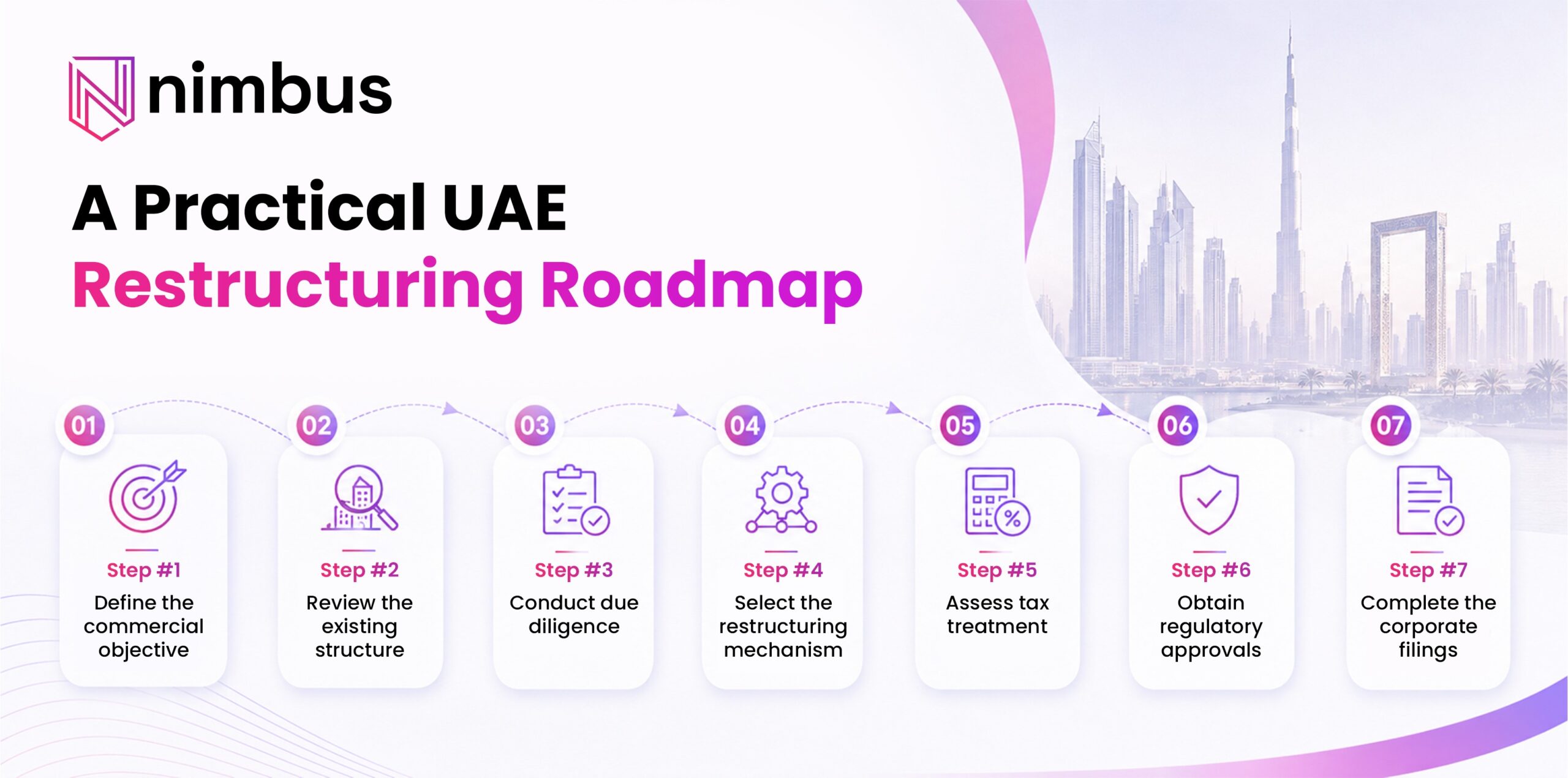
6. Step-by-Step Corporate Restructuring Process in the UAE
A successful restructuring should be planned as a coordinated legal, financial project.
- Step #1: Define the commercial objective
Start by asking why the restructuring is necessary. Is the goal growth, investment, asset protection, or anything else? The answer determines which structure is most appropriate. - Step #2: Review the existing structure
Map the group’s companies, shareholders, assets, licences, contracts, intellectual property, and banking arrangements. This gives advisors a complete picture before any transaction is designed. - Step #3: Conduct due diligence
Legal, financial and tax due diligence can identify liabilities that may otherwise transfer into the new structure. This is especially important for mergers and business transfers. - Step #4: Select the restructuring mechanism
Depending on the objective, the appropriate route may be: a merger, demerger, share transfer, holding company reorganization, or group restructuring. - Step #5: Assess tax treatment
The transaction should be reviewed under the UAE Corporate Tax regime before implementation. If Business Restructuring Relief or Qualifying Group Relief may apply, the relevant conditions and documentation should be assessed in advance. - Step #6: Obtain regulatory approvals
Depending on the structure and activity, approvals may be required from licensing authorities, sector regulators, shareholders, lenders or other stakeholders. - Step #7: Complete the corporate filings
The final stage may involve updating commercial licences, Articles of Association, beneficial ownership information, tax registrations, and banking records.
If a transaction results in cessation of a taxable business, Corporate Tax deregistration may also need to be considered.
When Should You Consider Business Reorganization in the UAE?
There is no universal trigger, but restructuring is worth considering when:
- You have multiple companies performing overlapping functions
- Your business has expanded into unrelated activities
- New investors are entering the group
- A shareholder wants to exit
- You are preparing for an acquisition or sale
- Valuable assets need to be separated from operating risk
- You are expanding across multiple UAE jurisdictions
UAE corporate restructuring is no longer simply a tool used by large multinational groups. Growing SMEs, family businesses, entrepreneurs and international investors are increasingly using mergers, demergers, share transfers and holding structures to create more efficient corporate groups.
The right approach depends on the company’s objectives, legal structure, jurisdiction, shareholders, assets, liabilities and tax position. However, businesses should obtain corporate advice tailored to their specific circumstances. The right planning can help reduce regulatory friction and ensure that the new structure supports the company’s next stage of growth.

Comments are closed