
Three regulatory environments are particularly important, which include:
- The Virtual Assets Regulatory Authority (VARA) in Dubai
- The Financial Services Regulatory Authority (FSRA) in Abu Dhabi Global Market (ADGM)
- The Dubai Financial Services Authority (DFSA) in the Dubai International Financial Centre (DIFC)
Understanding their differences is an essential first step for entrepreneurs, fintech companies and institutional investors considering business setup in the UAE
1. VARA: Dubai’s dedicated framework for virtual assets
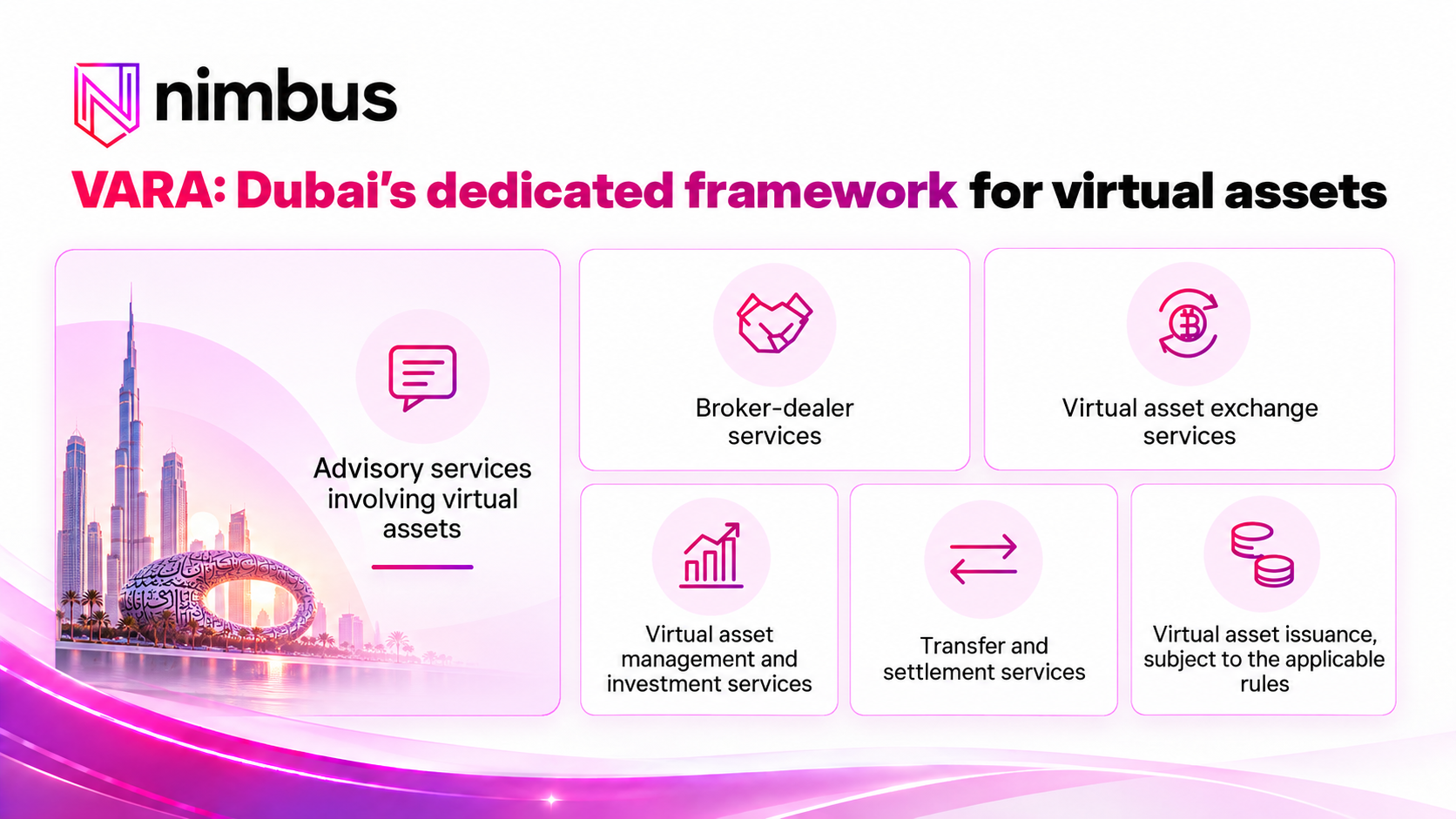
Established under Dubai Law No. 4 of 2022, VARA regulates virtual asset activities across Dubai, including its mainland and free zones, except for the DIFC, which has its own financial regulator. Its framework is designed specifically for virtual assets and the businesses providing related services. It covers activities including:
- Advisory services involving virtual assets
- Broker-dealer services
- Virtual asset exchange services
- Virtual asset management and investment services
- Transfer and settlement services
- Virtual asset issuance, subject to the applicable rules
The regulatory approach is activity-based. A company’s obligations depend on what it actually does, rather than simply describing itself as a blockchain or cryptocurrency business.
VARA’s updated activity rulebooks, published in May 2025 and effective from 19 June 2025, strengthened requirements around market integrity, risk oversight, margin trading, token distribution, and operational controls. Its virtual asset issuance rules also address categories of issuance, disclosures, and additional requirements.
For businesses, the practical implication is that a commercial licence alone does not authorise regulated virtual asset services. A business proposing to operate an exchange, safeguard customer assets or provide other regulated services must meet the applicable requirements before commencing those activities.
Official Reference:
VARA’s regulations and rulebooks are available at https://rulebooks.vara.ae/.
2. ADGM: A financial centre for institutional digital assets
Abu Dhabi Global Market is an international financial centre with its own legal and regulatory framework. Its FSRA supervises regulated financial services conducted within its jurisdiction.
ADGM’s digital asset framework distinguishes between different types of instruments and activities, including virtual assets, fiat-referenced tokens, digital securities, derivatives, and investment funds involving digital assets.
Financial services firms undertaking regulated digital asset activities generally need the relevant Financial Services Permission from the FSRA. Depending on the business model, this can involve requirements relating to governance, capital, custody, technology, financial crime controls, and client protection.
ADGM has also continued refining its framework. Amendments implemented in June 2025 streamlined the process for accepting virtual assets and revised aspects of capital requirements and fees. In April 2026, the FSRA finalised a framework for staking activities involving clients’ virtual assets, including rules on eligible firms, permitted rewards and client disclosures.
These developments demonstrate an important feature of institutional regulation: the framework must evolve as business models change, without treating every new product as exempt from existing safeguards.
ADGM may be worth considering for businesses focused on regulated financial services, institutional trading, custody, asset management, tokenised securities or related infrastructure. The decision still requires a detailed assessment of the intended activities and the permissions needed.
Official Reference:
Get details on ADGM’s regulatory landscape at https://www.adgm.com/business-areas/digital-assets.
3. DIFC: A distinct regime for crypto token financial services
The Dubai International Financial Centre operates separately from the wider Dubai regulatory framework administered by VARA. Financial services involving crypto tokens within or from DIFC fall within the DFSA’s regulatory perimeter, where applicable.
The DFSA introduced its crypto token regime in 2022 and implemented significant updates on 12 January 2026. One important change is that the regulator no longer maintains a prescribed list of recognised crypto tokens.
Instead, authorised firms are responsible for determining, on a reasoned and documented basis, whether the tokens they deal with meet the DFSA’s suitability criteria. This shifts more responsibility to regulated firms.
Businesses must be able to explain why a token is appropriate for the relevant activity and demonstrate that their decisions are supported by documented assessment and adequate controls.
The revised framework also strengthens investor safeguards and introduces proportionate reporting requirements. Firms planning to provide financial services involving crypto tokens must obtain DFSA authorisation where required, in addition to completing the relevant DIFC registration and incorporation steps.
DIFC may appeal to financial institutions, fintech businesses, and firms seeking proximity to established banking, investment and professional services networks.
Official Reference:
For more information, check out https://www.dfsa.ae/crypto
Choosing between VARA, ADGM and DIFC
The three regimes share an emphasis on oversight and risk management, but they are not interchangeable.
- VARA is the dedicated virtual asset regulator for Dubai outside DIFC. It is relevant to businesses undertaking activities, such as virtual asset exchange, brokerage, and management within its jurisdiction.
- ADGM’s FSRA provides a financial services framework covering virtual assets, digital securities, funds, and specific token-related activities.
- DIFC’s DFSA regulates financial services involving crypto tokens under its own framework, including the revised rules effective from January 2026.
The right choice starts with the business model. Founders should identify whether the company will develop blockchain software, provide technology to regulated firms, hold client assets, manage investments, issue tokens or facilitate payments.
These activities can have materially different licensing implications. A software developer supplying infrastructure to a licensed exchange may have a different regulatory profile from a company operating the exchange itself. Early regulatory mapping can help businesses avoid choosing a jurisdiction based solely on incorporation costs or headline licensing packages.
 UAE Digital Assets and Virtual Asset Businesses:
Regulatory Landscape in 2026
Company formation is not the same as financial authorisation
UAE company formation can provide the legal structure through which a business employs staff, signs contracts, leases premises and conducts permitted commercial activities. It does not, by itself, confer permission to undertake regulated financial or virtual asset services.
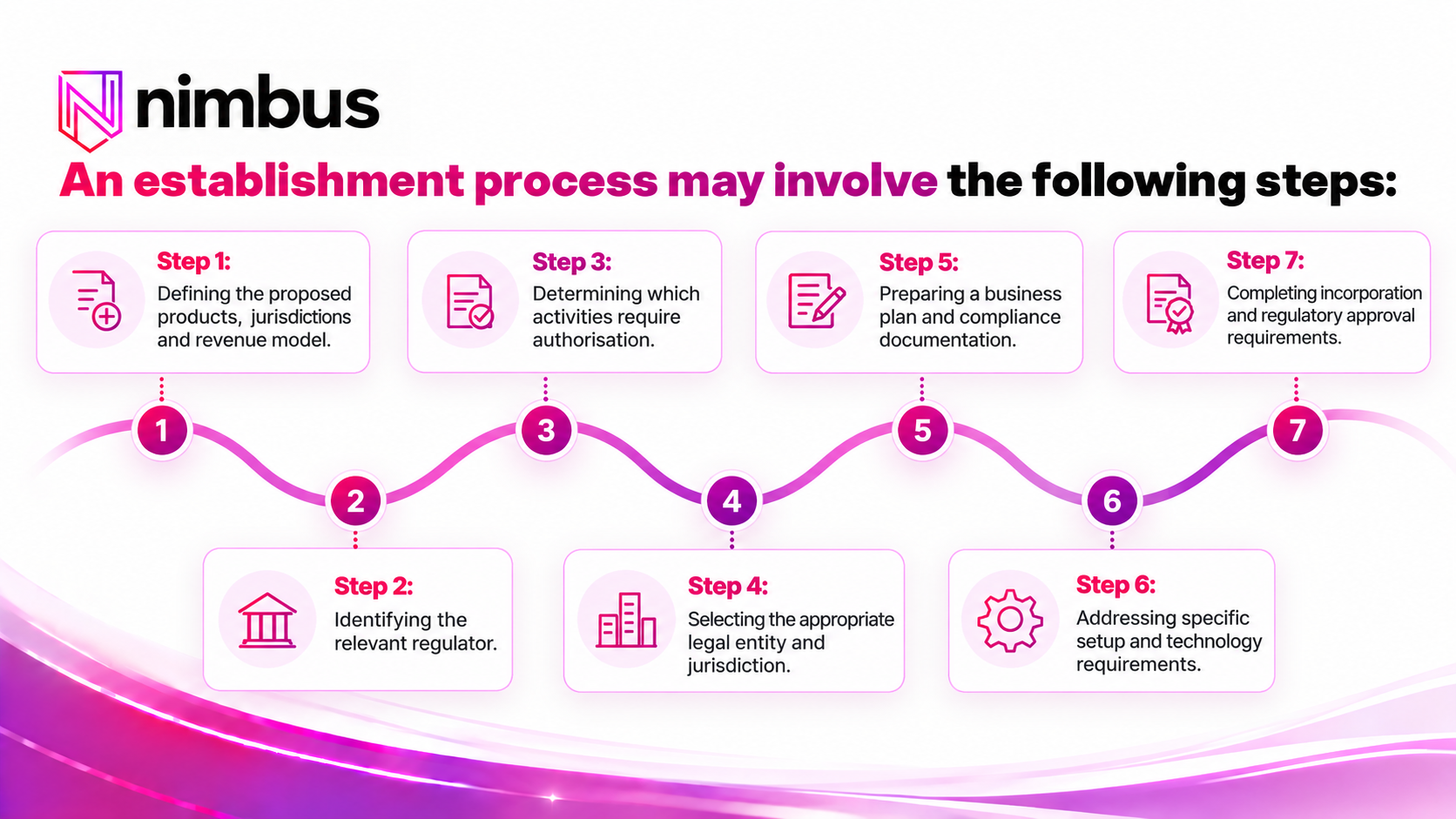
An establishment process may involve the following steps:
- Defining the proposed products, jurisdictions and revenue model.
- Identifying the relevant regulator.
- Determining which activities require authorisation.
- Selecting the appropriate legal entity and jurisdiction.
- Preparing a business plan and compliance documentation.
- Addressing specific setup and technology requirements.
- Completing incorporation and regulatory approval requirements.
The precise sequence varies. Some businesses must engage with the regulator before incorporation is finalised, while others may complete certain establishment steps as part of the authorisation process.
Founders should also plan for ongoing obligations, including anti-money laundering controls, sanctions compliance, customer due diligence, cybersecurity, incident management, and reporting. Tax and data protection must be considered separately as tax treatment depends on the relevant UAE rules.
What institutional readiness means in practice?
The UAE’s regulatory progress is important because institutional investors assess the entire operating environment. They need confidence in how assets are safeguarded, how transactions are monitored, and how operational failures are handled.
They also examine the quality of counterparties, the availability of banking services, and the legal treatment of customer assets. Regulation, however, cannot eliminate market volatility or guarantee commercial success. Nor does a licence from one UAE regulator automatically authorise operations in another jurisdiction.
Cross-border services require their own legal and regulatory analysis. For businesses, the edge lies in building compliance into the operating model from the beginning.
Closing Thoughts
The UAE’s digital asset landscape in 2026 is defined by specialised regulatory frameworks. VARA, ADGM’s FSRA, and DIFC’s DFSA each provide a distinct pathway, with requirements shaped by the activities and instruments involved.
For founders considering business setup in the UAE, the priority should be to match the business model to the correct jurisdiction and regulatory permissions. Careful planning can reduce avoidable delays, clarify compliance costs, and support a more sustainable launch.
Comments are closed