

For firms considering Abu Dhabi Global Market (ADGM), this decision requires more than comparing licence fees or selecting a familiar category. The nature of the services offered, the way client assets are handled, and the proposed operating model all influence the regulatory requirements.
Understanding these factors early can help businesses avoid unnecessary delays, unexpected compliance costs, and changes to their corporate structure later.
This article explains how ADGM licensing works, what businesses should consider when assessing their options, and how the decision fits into a wider strategy for business setup in the UAE.
What is ADGM? Understanding the FSRA Regulatory Framework
ADGM is an international financial centre located in Abu Dhabi. It has its own civil and commercial legal framework based on the direct application of English common law, alongside an independent financial regulator, the Financial Services Regulatory Authority (FSRA).
The jurisdiction attracts a range of businesses, including investment firms, family offices, and holding structures. One important distinction is that ADGM does not have a single licensing route. Financial services firms and non-financial businesses follow different registration and authorisation processes.
The FSRA regulates financial services activities, while the ADGM Registration Authority oversees company registration and commercial licensing. Financial services firms generally need to obtain the relevant FSRA approval before completing the applicable registration and licensing requirements.
Check out the link for detailed information:
Source: ADGM’s FSRA application guidance.
Key Benefits of ADGM Company Formation for Financial Firms
Choosing a jurisdiction is an important part of UAE company formation. ADGM may be suitable for businesses that need a recognised financial centre or a structure designed around investment and financial services. Some of its key attractions include:
- An established legal framework: ADGM operates under a legal system designed to support international commercial and financial activities.
- A dedicated financial regulator: The FSRA supervises regulated financial services and sets requirements relevant to the activities.
- International business connections: The jurisdiction provides an environment for firms working with investors, financial institutions, and professional advisers.
- Specialist structuring options: Businesses may consider structures such as holding companies, foundations and special purpose vehicles (SPVs), depending on their objectives.
However, ADGM is not automatically the right choice for every business.
The decision of jurisdiction selection should account for the company’s actual activities, customer locations, staffing needs, and future expansion plans.
How to Choose the Right ADGM Financial Services Licence
A common mistake is to select a licence based on the company’s branding or broad description of its services. For financial services firms, the more important question is what the business will actually do.
Consider two companies that both describe themselves as wealth management firms. One provides investment recommendations to clients, while the other makes discretionary decisions and manages investment portfolios on their behalf.
Although their marketing descriptions may sound similar, their activities can fall under different regulatory permissions. Before selecting a licensing route, businesses should clarify:
- Which services will be provided to clients?
- Will the company give investment advice or manage investments?
- Will it hold, control or safeguard client money or assets?
- Who will the clients be, and where will they be based?
- How will the business earn revenue?
These questions help establish the activities that must be assessed against the FSRA’s regulatory framework. The FSRA evaluates applications based on the proposed business model, regulated activities, and other relevant factors.
FSRA License Categories Explained (Categories 1 to 5)
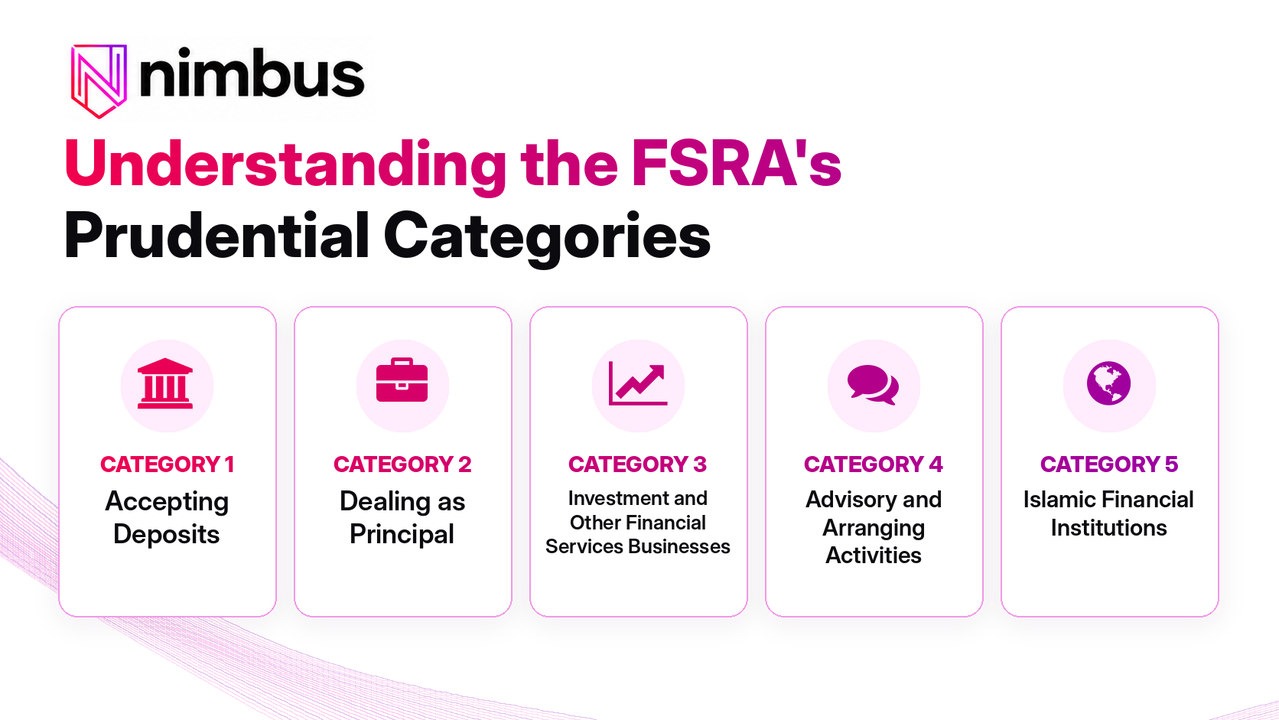
The FSRA uses prudential categories to determine aspects of the regulatory requirements applicable to authorised financial services firms. These classifications are not simply a menu of interchangeable commercial licences.
The appropriate classification depends on the regulated activities and the applicable regulatory rules. The following overview provides a general introduction to commonly referenced categories. However, it is not a substitute for checking the current FSRA rulebooks and requirements.
Category 1: Accepting Deposits
This category is associated with deposit-taking activities and is generally relevant to institutions with banking operations rather than ordinary advisory or investment consultancy businesses. Businesses operating in this area face substantial regulatory requirements covering capital, risk management, and financial resilience.
Category 2: Dealing as Principal
Category 2 is associated with dealing in investments as principal, subject to the precise activities and applicable rules. Depending on the business model, this can include activities such as proprietary trading and market making. Businesses considering this route need to establish exactly how they will transact and what risks they will assume.
Category 3: Investment and Other Financial Services Businesses
Category 3 contains several subcategories, including 3A, 3B, and 3C. Their application depends on the activities carried out by the firm.
Category 3A is generally associated with dealing in investments as agent. Category 3B is associated with providing custody, subject to the applicable regulatory definitions and requirements.
Category 3C is associated with managing assets. This may be relevant to investment managers and certain fund management businesses, depending on their specific activities and structure.
Category 4: Advisory and Arranging Activities
Category 4 is often relevant to firms undertaking activities such as advising on investments or credit and arranging deals in investments. The permissions required depend on the actual services being provided and other activities may require additional or different authorisations. The FSRA’s applicable capital and prudential requirements must also be checked.
Category 5: Islamic Financial Institutions
Category 5 is associated with Islamic financial institutions and the relevant regulatory framework for their activities. Businesses exploring this route need to understand the specific requirements applicable to their proposed products, operations, and Sharia-compliant financial services.
Important: The categories above are general prudential classifications. The latest FSRA rules should be reviewed before making capital, cost, or licensing decisions.
ADGM vs. DIFC: Which UAE Financial Free Zone Fits Your Business?
For many financial services firms, the decision extends beyond ADGM to the Dubai International Financial Centre (DIFC). Both are established financial free zones in the UAE, but they have separate regulatory frameworks.
ADGM’s financial services regulator is the FSRA, while financial services conducted in or from DIFC are regulated by the Dubai Financial Services Authority (DFSA). The right choice depends on the business rather than the reputation of either location. Businesses should compare:
- The activities they intend to carry out.
- The applicable regulatory permissions and conditions.
- Their target clients and commercial relationships.
- Office, staffing, and operational requirements.
- Setup costs and ongoing compliance responsibilities.
ADGM SPV Setup: When to Choose a Special Purpose Vehicle
Not every investment-related business needs an FSRA financial services permission. Some investors need a legal entity to hold shares, property interests, or other eligible assets rather than an operating company that provides financial services to clients. In these circumstances, an ADGM special purpose vehicle may be worth considering.
ADGM describes SPVs as passive holding companies intended to isolate financial and legal risk by ring-fencing particular assets and liabilities. They cannot be used to conduct operational business or hire staff. However, it is not a substitute for a regulated financial services firm where the activities require FSRA authorisation.
Businesses should also check the applicable eligibility, company service provider, and ongoing compliance requirements before establishing an SPV. Choosing between an operating company and a passive holding structure is an important part of getting the overall setup right.
Step-by-Step Guide: How to Get an FSRA Licence in ADGM
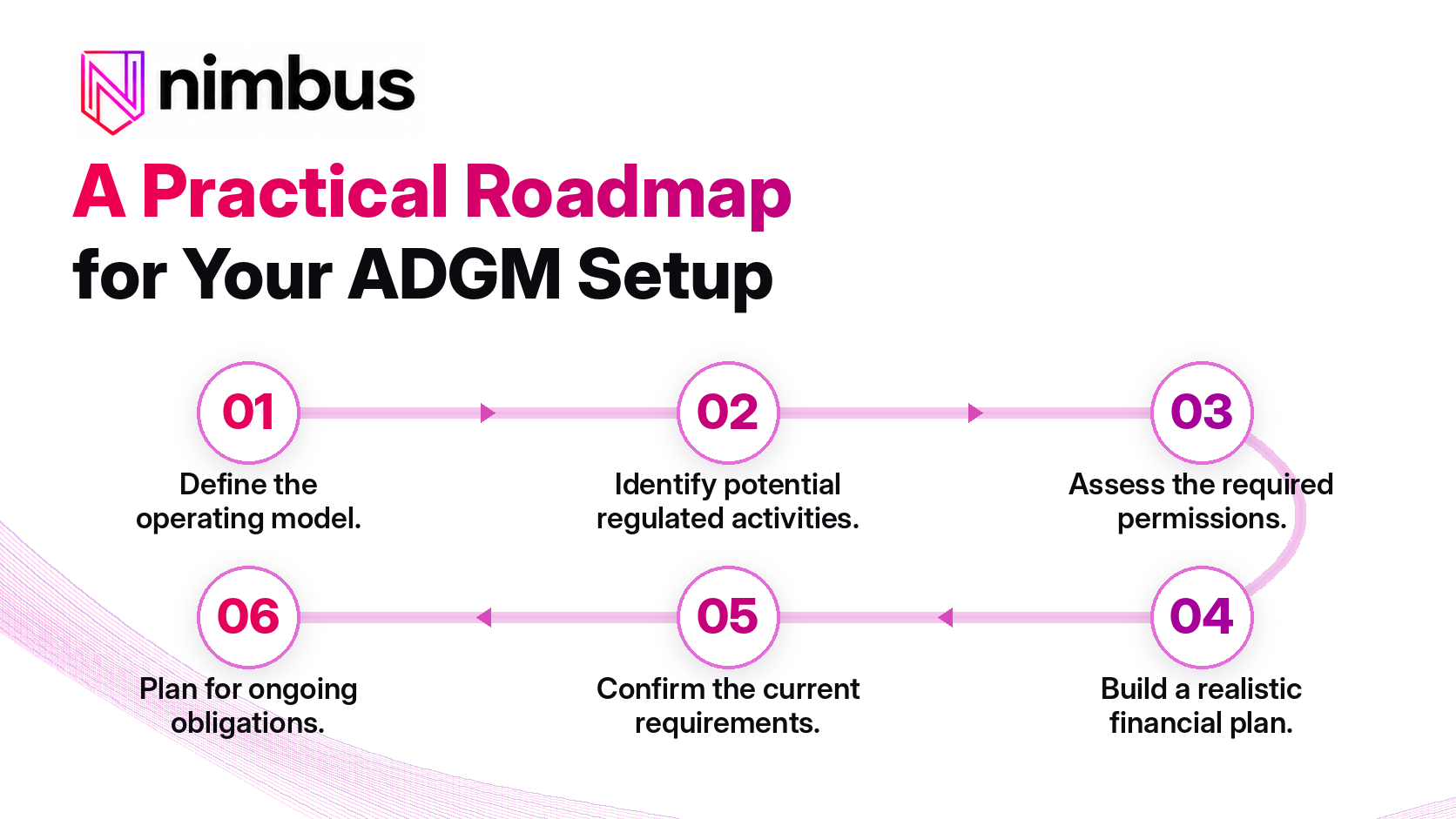
A structured assessment can make the licensing process clearer and reduce avoidable rework. Businesses can begin with the following steps.
- Define the operating model.
Document the services, revenue streams, customer relationships and day-to-day activities. - Identify potential regulated activities.
Determine which aspects of the proposed business may fall within the FSRA’s regulatory scope. - Assess the required permissions.
Review the relevant regulatory definitions, prudential category and applicable conditions. - Build a realistic financial plan.
Account for capital, application costs, premises, staffing and continuing compliance. - Confirm the current requirements.
Review official rules and seek professional advice before submitting an application. - Plan for ongoing obligations.
Consider governance, regulatory compliance, and how future changes to the business model could affect permissions.
The FSRA’s published application process includes an initial discussion, review of the proposed business model and regulatory business plan, application assessment, in-principle approval where applicable, and fulfilment of conditions before the Financial Services Permission is granted.
How to Modify or Upgrade Your ADGM Licence Permissions
A business may be able to apply to vary its permissions or make changes to its structure, but regulatory approval or other formal steps may be required. The process depends on the nature of the change. It is generally more efficient to assess the intended activities carefully before launching.
Set Up Your ADGM Financial Firm with Nimbus Consultancy
Selecting the right ADGM licensing route requires a clear understanding of the business model, the applicable regulatory permissions, and the operational commitments involved. At Nimbus Consultancy, we help businesses evaluate their proposed activities, consider suitable UAE jurisdictions, and plan their business setup accordingly.
Comments are closed