

However, establishing a factory involves more than registering a company. Investors must consider the legal structure, licensing, approvals, workforce requirements, and other ongoing compliance obligations.
This guide explains the main stages of business setup in Saudi Arabia for foreign manufacturers, helping investors understand the scenario in a better way.
Why Invest in Saudi Arabia’s Manufacturing Sector?
Industrial development is a central part of Saudi Arabia’s economic diversification strategy. The Kingdom is working to expand domestic manufacturing capacity, develop local supply chains, and increase the competitiveness of Saudi-made products. Several factors make the market worth considering for international manufacturers:
- Growing demand for industrial products, construction materials, and consumer goods.
- Industrial cities offering developed sites, utilities and infrastructure.
- Government programmes supporting industrial investment and localisation.
The National Industrial Strategy aims to develop a more diversified and competitive industrial base. For foreign investors, this creates opportunities to manufacture locally rather than relying exclusively on exports into the Saudi market.
100% Foreign Ownership in Saudi Arabia: MISA Eligibility for Manufacturers
Foreign investors may establish wholly foreign-owned manufacturing businesses where the proposed activity is permitted and the applicable regulatory conditions are satisfied.
A Saudi shareholder is not automatically required for every manufacturing activity. The first step is to confirm the exact industrial activity, ownership eligibility, and any activity-specific restrictions with the Ministry of Investment of Saudi Arabia (MISA).
Requirements may vary according to the product, ownership structure, and any sector-specific restrictions. That’s why, confirming eligibility early is an important part of KSA company formation.
LLC vs. Foreign Branch: Best Legal Structure for a Factory in KSA
The legal structure you select affects management, ownership, and the way your business operates in Saudi Arabia. Two common options for foreign companies are listed below.
1. Limited Liability Company (LLC)
An LLC is often suitable for manufacturers establishing a long-term presence in the KSA. It creates a separate legal entity and generally limits shareholders’ liability to their investment, subject to applicable law. An LLC can be appropriate if you plan to:
- Operate a factory under a dedicated Saudi entity.
- Employ workers and enter into local supply contracts.
- Purchase or lease industrial facilities.
- Expand manufacturing operations over time.
2. Branch of a Foreign Company
A branch extends the overseas parent company’s operations into Saudi Arabia rather than creating a separate subsidiary. This option may suit established manufacturers that want to operate under their existing corporate identity.
However, the parent company generally remains responsible for the branch’s liabilities. Before deciding, compare the implications for contractual obligations, financing, and future expansion.
Documents Required for MISA Industrial License & Company Formation
Organising your documentation early can help reduce delays during the investment registration and incorporation stages. Foreign corporate shareholders will generally need to prepare the following documents.
- Commercial registration or incorporation documents.
- Financial statements for the latest fiscal year, as required for the application.
- Articles of Association or equivalent constitutional documents.
- A board resolution authorising the Saudi investment.
- Passport or identification documents for relevant shareholders and the appointed general manager.
- Additional declarations or supporting documents.
Documents issued overseas may require notarisation, authentication, legalisation, or certified translation, depending on the issuing country and the receiving authority’s requirements. The exact checklist should be confirmed against the current MISA application requirements.
Top Industrial Cities (MODON) & Special Economic Zones (SEZs) in KSA
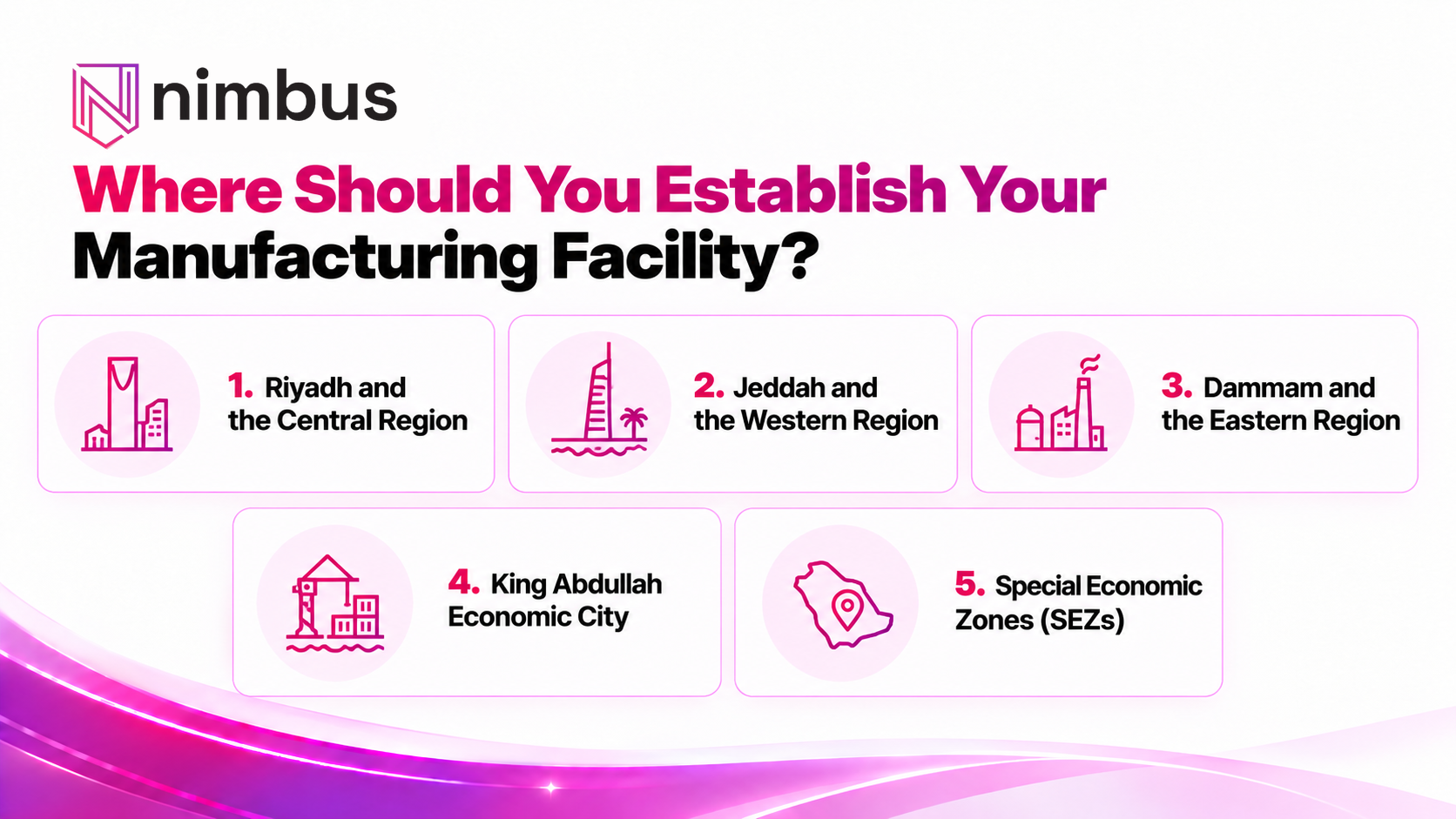
Choosing a factory location is a strategic decision that affects transportation costs, access to suppliers, and regulatory requirements. Saudi Arabia has an established network of industrial cities administered by the Saudi Authority for Industrial Cities and Technology Zones, alongside specialised economic zones. Consider the following locations when assessing your options.
1. Riyadh and the Central Region
Industrial areas around Riyadh offer access to a large domestic market, commercial customers, distributors, and government-related procurement opportunities.
2. Jeddah and the Western Region
Jeddah’s port access and commercial connections make the western region worth considering for businesses that depend on imports, exports, or nationwide distribution.
3. Dammam and the Eastern Region
The Eastern Province has strong links to energy, petrochemicals, metals and engineering supply chains. Manufacturers serving these industries may benefit from proximity to industrial customers and established infrastructure.
4. King Abdullah Economic City
King Abdullah Economic City (KAEC) offers industrial and logistics infrastructure associated with its Red Sea location.
5. Special Economic Zones (SEZs)
Depending on the business model, investors may also evaluate Saudi Arabia’s designated Special Economic Zones (SEZs). A Special Economic Zone may provide specific incentives or operating advantages for eligible businesses, but the benefits depend on the zone and its applicable rules.
Investors should compare these arrangements with conventional industrial locations before making a decision.
Step-by-Step Guide: How to Set Up a Manufacturing Plant in Saudi Arabia
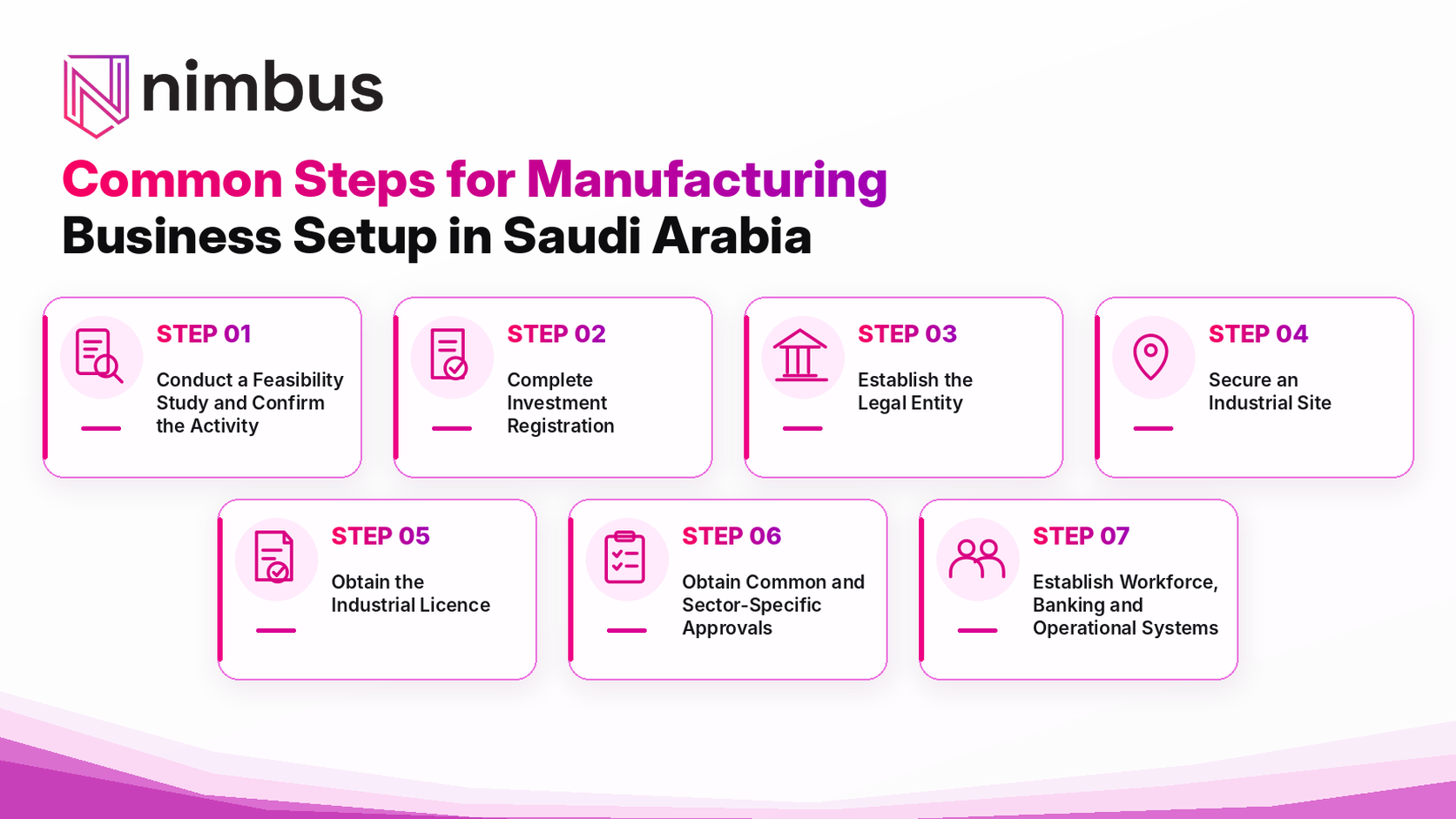
Although the exact sequence varies by activity and location, the following stages provide a practical framework for company formation in Saudi Arabia.
Step 1: Conduct a Feasibility Study and Confirm the Activity
Before applying for registrations, define what the factory will produce, who its customers will be, and how the operation will function. Also, identify the appropriate business activity early. Your feasibility study should cover:
- Market demand and expected sales volumes.
- Capital expenditure and working capital.
- Factory space, electricity, and other utility requirements.
- Workforce requirements and obligations.
- Applicable industrial approvals.
Step 2: Complete Investment Registration
Foreign investors should complete the applicable registration process with MISA before commencing investment activities. Prepare the required corporate documents and financial statements. Once registration is completed, proceed with the relevant incorporation and commercial registration procedures.
Step 3: Establish the Legal Entity
The next stage is to establish the chosen LLC or register the relevant branch, as applicable. Depending on the structure, this may involve:
- Reserving a company name.
- Registering the entity with the Ministry of Commerce.
- Obtaining the Commercial Registration (CR).
- Completing applicable registration or membership requirements.
The exact procedures and digital services available should be confirmed at the time of application.
Step 4: Secure an Industrial Site
Once the proposed facility and site have been identified, determine which authority administers the location. Depending on the project, this may involve MODON, the relevant economic cities or SEZ authority, or a municipality. Check that the site can accommodate the project’s infrastructure requirements.
Step 5: Obtain the Industrial Licence
Manufacturing projects require an industrial licensing process through the Ministry of Industry and Mineral Resources (MIM), using the applicable government platform. However, an initial industrial licence does not automatically authorise production.
Saudi Arabia’s official industrial licensing service states that the establishment-stage licence is valid for one year and does not permit the holder to begin production.
Step 6: Obtain Common and Sector-Specific Approvals
A factory may have the necessary corporate registrations and industrial permissions but still need additional approvals for its products. For regulated products, the Saudi Standards, Metrology and Quality Organization (SASO) and the SABER platform may be relevant.
Requirements depend on the product’s classification, processes, and applicable technical regulations. For instance, a business entering food and beverages production will need to comply with applicable SFDA requirements and other food-sector approvals.
Step 7: Establish Workforce, Banking and Operational Systems
Before commencing operations, arrange the practical systems required to run the factory. These may include:
- Opening a corporate bank account.
- Completing tax and applicable social insurance registrations.
- Obtaining the necessary work authorisations.
- Registering with the relevant labour and payroll platforms.
- Arranging employee insurance and workplace safety procedures.
Banking, employee onboarding, and regulatory registrations may depend on preceding approvals or company documentation.
Saudi Government Incentives for Manufacturers: SIDF, MODON & Made in Saudi
Saudi Arabia offers several programmes and industrial infrastructure options that may help qualifying manufacturing projects.
1. Saudi Industrial Development Fund (SIDF)
SIDF provides financing for eligible industrial projects, including factory establishment and expansion. The fund publishes financing terms that can extend to 20 years, depending on the project and the financing required.
2. MODON Industrial Facilities
MODON administers industrial cities and offers industrial land and other facilities to eligible investors. The lease terms, infrastructure, and application requirements vary by location and facility.
3. Made in Saudi
The Made in Saudi programme promotes products manufactured in the Kingdom and supports the development of local production. Manufacturers interested in using the programme’s branding should verify the current eligibility criteria.
Post-Setup Factory Compliance in KSA: ZATCA, Saudization & Environmental Rules
Successful business setup in Saudi Arabia requires continued regulatory management after incorporation and the start of production. Here are a few key factors to consider.
1. Tax and Financial Reporting
Register with the Zakat, Tax and Customs Authority (ZATCA) as applicable to your business and maintain accurate financial records. Professional advice is recommended when establishing tax, accounting, and reporting framework.
2. Renewals and Records
Maintain a schedule of renewal dates for registrations, licences, employee documentation, and other permits. Update company details when management, business activities, or factory operations change.
3. Employment Compliance
Manufacturers must comply with applicable labour regulations and Saudization requirements. The obligations may depend on the business activity, workforce size, occupation, and current regulatory classification.
4. Environmental, Safety, and Quality Management
Factories must maintain the relevant environmental permissions, workplace safety controls, equipment standards, and product-quality systems.
Key Takeaways: Starting Your Industrial Business in Saudi Arabia
Saudi Arabia’s industrial expansion creates opportunities for foreign manufacturers, but entering the market requires more than registering a legal entity.
The most effective approach is to align your market research, location, industrial licensing, regulatory requirements, and financing strategy from the beginning.
A well-planned company formation process can help you establish a sustainable business. With the right preparation, manufacturers can establish a stronger foundation for operating in Saudi Arabia and participating in its evolving industrial economy.
Comments are closed