

The Regional Headquarters (RHQ) Programme is at the centre of this strategy. Introduced in 2021 by the Ministry of Investment of Saudi Arabia (MISA) and the Royal Commission for Riyadh City, the programme was designed to encourage multinational companies to move regional functions to Saudi Arabia.
The response has been substantial. By Q1 2026, more than 780 international companies had obtained RHQ status, well above the original Vision 2030 target of 480 companies by 2030.
But numbers alone do not answer the bigger question: is establishing an RHQ in Saudi Arabia still worth it in 2026?
For companies evaluating business setup in the KSA, the answer can be yes, but the decision requires more than looking at the headline tax incentives. Procurement access, operational substance, staffing, office costs, and compliance requirements, everything need to be considered.
In this post, we look at the broader aspect of the situation.
Why the MISA RHQ License is Crucial for Business Setup in KSA
The RHQ Programme combines two powerful policy tools. The first is a set of incentives designed to make Saudi Arabia more attractive as a regional corporate base. The second is a procurement requirement that can directly affect a multinational’s ability to compete for certain Saudi government contracts.
Since 1 January 2024, Saudi government entities have generally been restricted from contracting with multinational companies whose regional headquarters are outside the Kingdom for contracts exceeding SAR 1 million, subject to specified exemptions.
For companies heavily dependent on Saudi government projects, an RHQ can increasingly become part of their market-entry strategy. The policy also aligns with the broader objectives of Vision 2030, which seeks to increase foreign investment, diversify the economy, and position Riyadh as a major regional business centre.
Core Activities and Scope of a Saudi Regional Headquarters
An RHQ is designed to perform strategic and administrative functions for a multinational’s operations across the MENA region. It is not intended to replace the group’s operating companies. Instead, the RHQ can oversee functions such as:
- Regional business planning
- Budgeting and financial performance monitoring
- MENA marketing strategy
- Human resources and training
- Accounting and auditing
- Logistics and supply-chain management
Commercial activities and revenue-generating operations generally need to be conducted through separately licensed entities. This distinction is particularly important when planning company formation in the KSA. Businesses should determine early whether they need an RHQ, an operating entity, or both.
Understanding Saudi RHQ Tax Incentives & Benefits in 2026
One of the strongest arguments for the RHQ Programme remains its tax incentive package. Eligible RHQ activities can benefit from:
- 0% corporate income tax for 30 years
- 0% withholding tax on specified eligible payments for 30 years
- A 10-year exemption from applicable Saudisation percentage requirements for the RHQ entity
- 250 work visas allocated from the outset
- Spouse work permit eligibility
However, the tax benefit should not be interpreted as a blanket exemption from all Saudi taxes. VAT, Zakat where applicable, and Real Estate Transaction Tax continue to apply under the relevant rules.
The 0% corporate income tax treatment also applies to eligible RHQ activities rather than automatically covering every activity or income stream connected with a multinational group.
Economic Substance Rules and RHQ Licensing Requirements
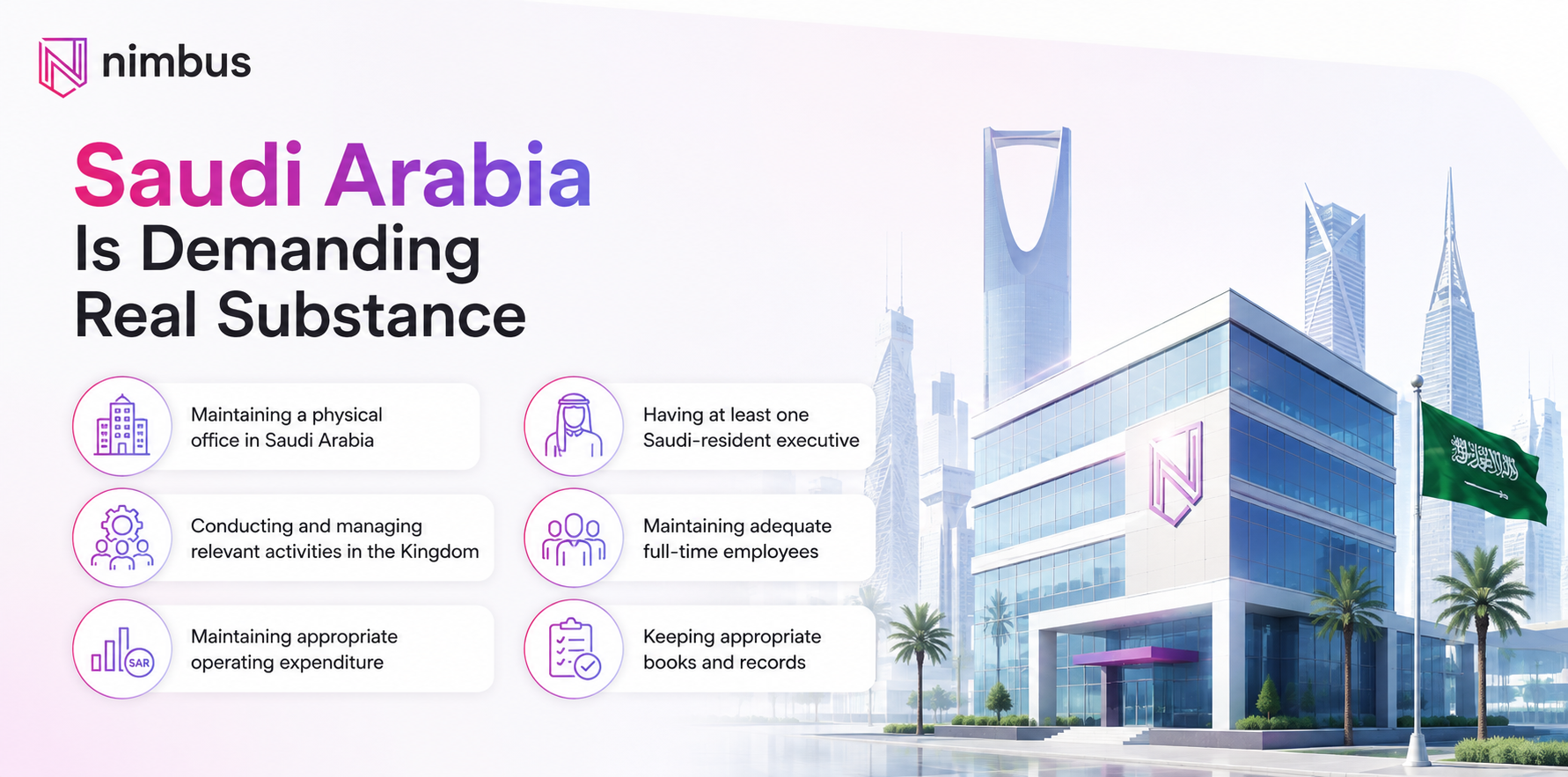
The RHQ incentive package comes with responsibilities. Companies cannot simply obtain a licence, put a name on an office door, and expect the benefits to continue indefinitely. The programme includes economic substance requirements covering areas such as:
- Maintaining a physical office in Saudi Arabia
- Conducting and managing relevant activities in the Kingdom
- Maintaining appropriate operating expenditure
- Having at least one Saudi-resident executive
- Maintaining adequate full-time employees
- Keeping appropriate books and records
An RHQ must also meet operational milestones. The programme requires operations to commence within six months of licensing, while the required staffing structure includes at least 15 full-time employees and three senior or C-suite executives within the applicable timeframe.
These requirements are important for businesses considering business setup in Saudi Arabia because the RHQ should be treated as a genuine regional management centre, not simply as a compliance vehicle.
Finding Office Space in Riyadh for Your Regional HQ
The rapid expansion of RHQs has also changed Riyadh’s commercial property market. By Q1 2026, Riyadh’s Grade A office market was operating with very high occupancy, while rents continued to increase amid strong demand and limited supply.
The King Abdullah Financial District (KAFD) has become one of the most prominent locations for international companies, while other business districts such as Laysen Valley have also attracted major corporate tenants.
Top Multinational Companies with RHQ Licenses in Saudi Arabia
The growing list of international companies associated with the RHQ Programme includes businesses from a wide range of industries. Examples include:
- PwC
- Deloitte
- PepsiCo
- Hewlett Packard Enterprise
- Goldman Sachs
- Amazon
- Microsoft
The diversity of these companies is significant. Professional services firms, technology companies, financial institutions, and industrial businesses are all establishing or expanding their presence in Saudi Arabia. This suggests that the RHQ opportunity is not limited to one particular industry.
Integrating the RHQ into Your Vision 2030 Market Entry Strategy
An RHQ does not necessarily need to stand alone. For many multinationals, the most effective structure may involve an RHQ alongside one or more operating entities. A proper distinction can make the overall structure easier to manage while supporting regulatory and tax compliance.
Businesses should also consider whether a Special Economic Zone (SEZ) could support particular activities. Saudi Arabia’s SEZ framework offers incentives and tailored regulatory environments for eligible sectors and investors.
The best structure therefore depends on the company’s industry, ownership model, intended activities, workforce requirements, and regional expansion plans.
Key Checklist Before Applying for a Saudi RHQ License
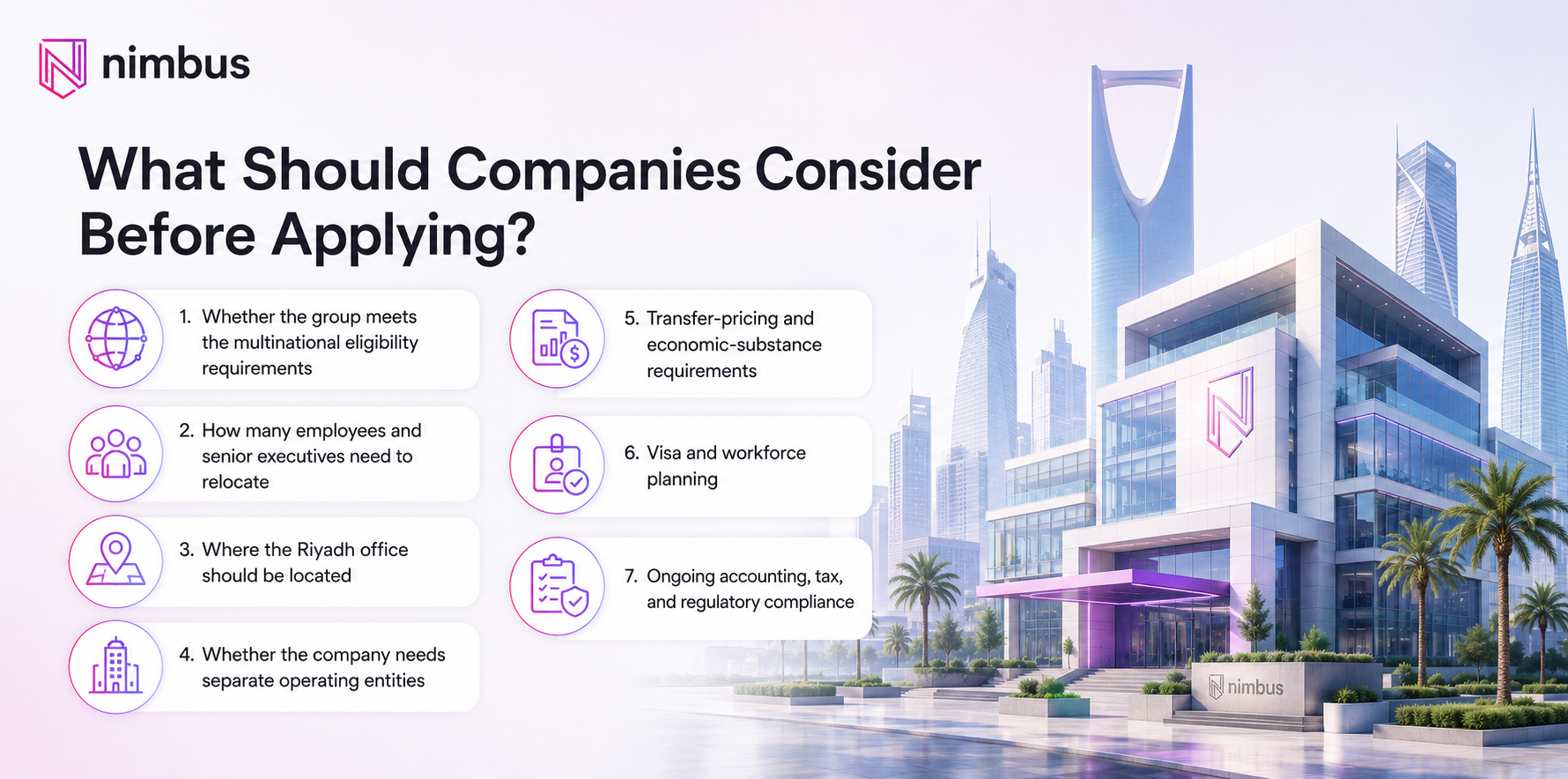
Before starting company formation in the KSA or pursuing an RHQ licence, multinational companies should assess:
- Whether the group meets the multinational eligibility requirements
- How many employees and senior executives need to relocate
- Where the Riyadh office should be located
- Whether the company needs separate operating entities
- Transfer-pricing and economic-substance requirements
- Visa and workforce planning
- Ongoing accounting, tax, and regulatory compliance
Getting these decisions right before incorporation can prevent expensive restructuring later.
Is the Saudi RHQ Program Worth the Investment in 2026?
For the right multinational, yes. The strongest business case exists for companies that:
- Regularly bid for Saudi government or state-linked contracts
- Need a regional management base
- Want to benefit from the long-term tax incentives
- Plan to expand across the wider MENA region
- Want closer access to Saudi giga-projects and major investment programmes
For companies with little Saudi exposure, however, establishing an RHQ purely to obtain tax benefits may not make commercial sense.
Next Steps for Your Company Formation in Saudi Arabia
Saudi Arabia’s RHQ Programme has clearly changed the way multinational companies approach regional expansion. For investors considering business setup in the KSA, the programme can offer a combination of tax incentives, workforce benefits, and closer access to one of the region’s fastest-transforming economies.
But the benefits come with substance and compliance expectations. A successful RHQ strategy should therefore begin with a clear assessment of the company’s commercial objectives rather than the incentives alone.
Comments are closed