

As the UAE continues to attract investors, and international businesses, good governance is becoming an important part of building a credible and sustainable company. For businesses considering business setup in the UAE, governance should not be scheduled for later, but should be considered when the business is being structured.
UAE Corporate Governance Laws & Regulations for Businesses
The UAE’s governance environment involves several laws and regulatory authorities.
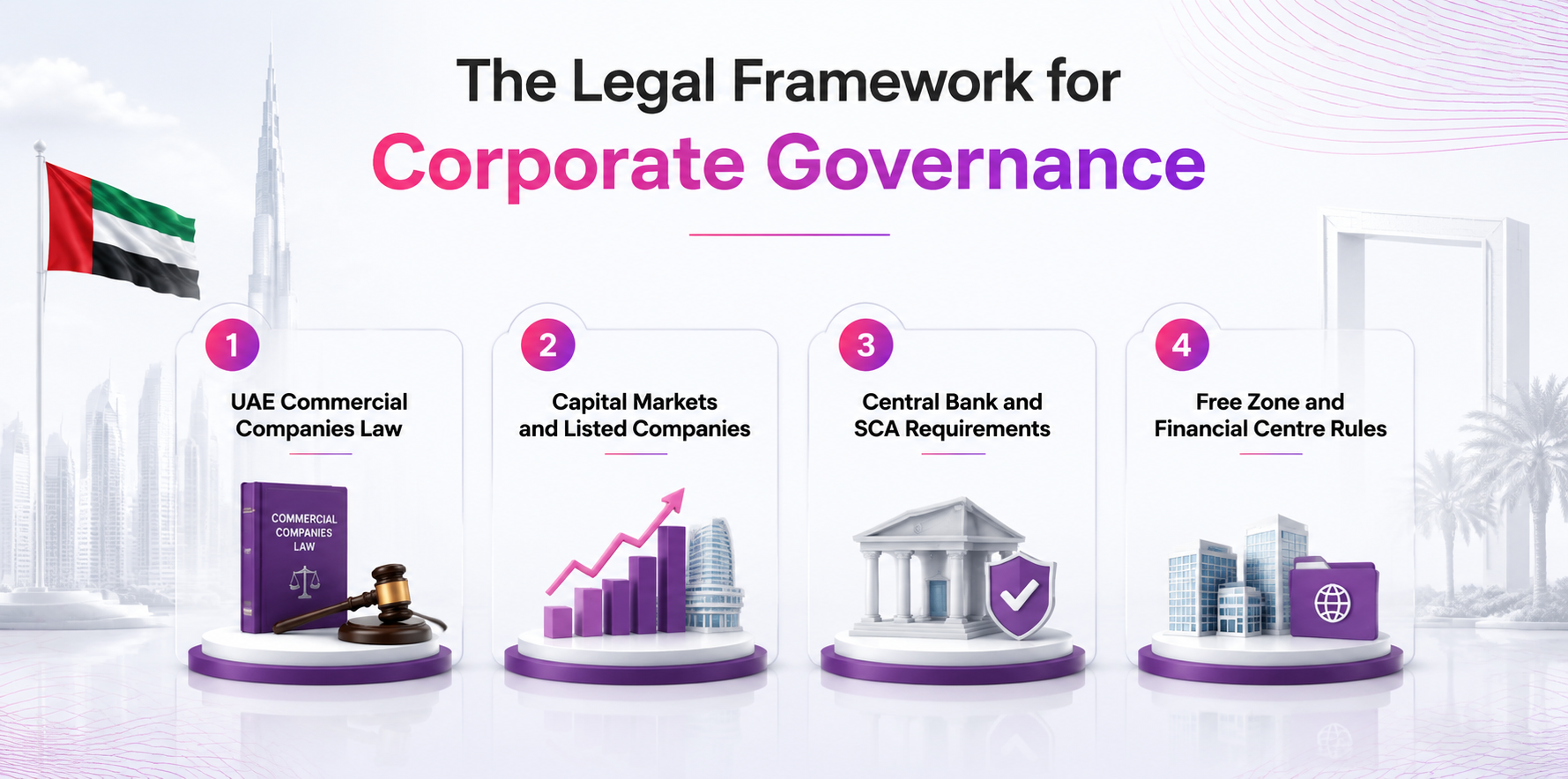
1. UAE Commercial Companies Law
Federal Decree-Law No. 32 of 2021 establishes important rules relating to company management, shareholder rights, and corporate decision-making. For LLCs, the law sets out provisions relating to managers, their responsibilities, shareholder meetings, and other aspects of company administration.
2. Capital Markets and Listed Companies
Companies listed on the Dubai Financial Market (DFM) or Abu Dhabi Securities Exchange (ADX) are subject to additional governance and disclosure requirements.
3. Central Bank and SCA Requirements
Financial institutions regulated by the Central Bank of the UAE are subject to specific governance and risk-management requirements. The Securities and Commodities Authority also oversees relevant companies and capital-market activities, with requirements covering areas such as transparency and shareholder protection.
4. Free Zone and Financial Centre Rules
Not every UAE company operates under exactly the same regulatory framework. Businesses established through a UAE freezone setup should consider the rules of the relevant free-zone authority.
Companies operating in the Abu Dhabi Global Market (ADGM) or Dubai International Financial Centre (DIFC) are subject to their respective legal and regulatory frameworks. This makes jurisdiction an important consideration when planning company formation in the UAE.
7 Essential Corporate Governance Best Practices for UAE SMEs
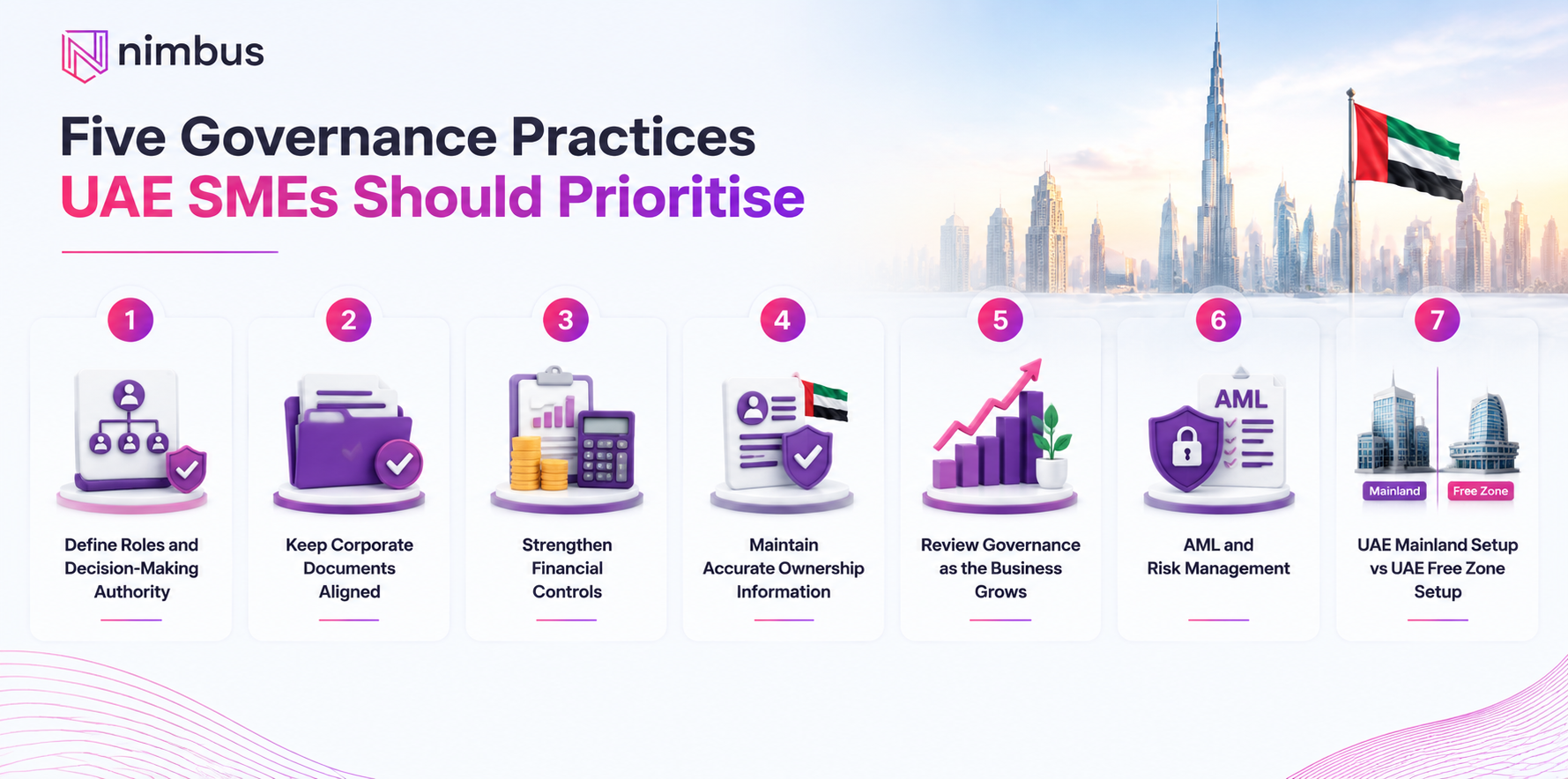
1. Define Roles and Decision-Making Authority
Founders and managers should understand exactly what they are authorised to approve. A simple authority matrix can identify who can:
- Sign contracts
- Approve payments
- Hire senior employees
- Open or operate bank accounts
- Make investment decisions
2. Keep Corporate Documents Aligned
The company’s Memorandum of Association (MOA), shareholder arrangements, and actual business practices should not contradict each other. This becomes particularly important when:
- A new shareholder joins
- Ownership changes
- The company raises capital
- A shareholder exits
- Management changes
- The company restructures
3. Strengthen Financial Controls
Good governance does not require a large internal audit department. SMEs can start with practical controls such as:
- Separating payment approval from reconciliation
- Setting expenditure limits
- Reviewing bank transactions regularly
- Maintaining proper accounting records
- Conducting periodic financial reviews
These measures can reduce errors, fraud risks, and unauthorised spending.
4. Maintain Accurate Ownership Information
Ownership transparency is an important part of UAE corporate compliance. Companies subject to the UAE beneficial ownership framework need to maintain accurate information about their ultimate beneficial owners and update relevant records when required.
Ownership reviews should therefore form part of the company’s governance process, particularly after:
- Share transfers
- New investments
- Restructuring
- Changes in control
- Changes to beneficial owner’s details
5. Review Governance as the Business Grows
Governance shouldn’t remain unchanged simply because the company was incorporated years ago. Growth often creates new risks, and governance should evolve accordingly. A review is useful when the business:
- Raises external funding
- Adds shareholders
- Enters new markets
- Acquires another company
- Restructures its group
- Expands its management team
- Changes its business activities
6. AML and Risk Management
Corporate governance also connects with broader compliance responsibilities, including anti-money laundering requirements. The UAE introduced Federal Decree-Law No. 10 of 2025 on Anti-Money Laundering, Combating the Financing of Terrorism and Proliferation Financing, which came into force on October 14, 2025.
Depending on the business and its regulatory classification, appropriate compliance measures can include:
- Customer due diligence
- Beneficial owner identification
- Record keeping
- Risk assessment
- Employee training
- Suspicious transaction reporting where applicable
Businesses should ensure their AML procedures reflect the current legal framework rather than relying on outdated compliance policies.
7. UAE Mainland Setup vs UAE Free Zone Setup
Governance requirements can also influence the choice between UAE mainland setup and UAE freezone setup. The decision should not be based solely on incorporation costs or ownership. Businesses should consider:
- Nature of the activity
- Licensing requirements
- Regulatory oversight
- Ownership structure
- Office requirements
- Future expansion plans
A structure that works well for a technology startup may not be appropriate for a regulated financial business or a company serving specific mainland customers. The right setup should support both the company’s current operations and its long-term plans.
Why Good Governance Matters for Business Growth and Investment in the UAE
Good corporate governance does not have to mean excessive paperwork or complicated approval structures. For UAE SMEs, it should create practical clarity around:
- People: Who is responsible?
- Processes: How are decisions made?
- Controls: What prevents mistakes or misuse?
- Ownership: Who owns and controls the company?
- Compliance: What legal and regulatory obligations apply?
- Growth: Does the structure still work as the business expands?
For entrepreneurs planning business setup in the UAE, these questions are worth addressing alongside licensing, taxation, banking, and immigration considerations.
Final Takeaways: Future-Proofing Your UAE Business with Strong Governance
Corporate governance is not simply a compliance exercise. For SMEs, it can provide the structure needed to manage growth, protect shareholder interests, reduce risk, and build credibility.
A company that establishes clear responsibilities and controls early is generally better positioned to handle new investors, changing ownership, expansion, and the challenges that come with growth.

Comments are closed