


Dubai has taken another significant step toward strengthening its policies for investors, entrepreneurs, and expatriates. In a major update to its property-linked residency framework, it has removed the previous AED 750,000 minimum property value requirement for sole owners applying for the two-year Property Investor Visa.
The change marks an important shift in Dubai’s real estate and immigration landscape. By lowering the entry barrier to residency, Dubai is opening new opportunities for first-time property buyers, smaller investors, remote professionals, and individuals seeking long-term ties to the UAE.
For foreign nationals considering real estate investment alongside business setup in the UAE, the revised rules create greater flexibility and provide an additional pathway to residency without requiring a high-value property purchase. Let’s look into the details of the updated visa framework.
Understanding Dubai’s Property Investor Visa
Dubai’s Property Investor Visa is a residency permit granted to eligible foreign nationals who own qualifying real estate within the emirate. The visa allows investors to:
- Reside legally in the UAE
- Sponsor eligible family members
- Open bank accounts
- Access various resident services
Unlike employment-based visas, the Property Investor Visa is linked to property ownership rather than an employer or business sponsor. This flexibility has made it particularly attractive for:
- International property investors
- Entrepreneurs
- Remote workers
- High-net-worth individuals
The visa is generally issued for two years and can be renewed as long as eligibility requirements continue to be met.
Dubai Investor Visa New Rules: No Minimum Property Value
The most significant change is the removal of the AED 750,000 minimum property value threshold for sole property owners. Previously, foreign investors needed to own property valued at AED 750,000 or more to qualify for the two-year residency visa.
Under the revised rules, individuals who own a property in their sole name may now apply for the two-year Property Investor Visa regardless of the property’s market value.
This means that owners of studio apartments and smaller residential properties may now qualify for residency if all other conditions are satisfied. The requirements for jointly owned properties remain different. Each co-owner must hold a share in the property worth at least AED 400,000.
Dubai Golden Visa Property Requirements
The UAE’s long-term property investor Golden Visa continues to require a minimum property investment of AED 2 million. The recent changes only affect the two-year Property Investor Visa and do not alter Golden Visa eligibility criteria.

Why This Change Matters for Foreign Investors?
The removal of the minimum value requirement significantly broadens access to Dubai residency. Previously, many property owners were excluded despite having fully paid and registered properties simply because their units fell below the AED 750,000 threshold. The revised framework benefits several categories of investors, which are enlisted below.
1. First-Time Property Buyers
Many first-time investors begin with smaller units due to budget considerations. Studios and one-bedroom apartments often serve as an entry point into Dubai’s property market. The new rules allow these buyers to enjoy residency benefits without needing to increase their investment solely to meet visa requirements.
2. Remote Workers
Dubai has become a leading destination for remote professionals seeking a tax-efficient and internationally connected base. Owning a smaller residential property can now provide a residency pathway alongside lifestyle benefits.
3. Entrepreneurs and Business Owners
Entrepreneurs considering UAE company formation often look for residency options that provide flexibility. Property-linked residency can complement this by providing an additional long-term residence route independent of business ownership structures.
Eligibility Criteria for the 2-Year Investor Visa Dubai
Although the minimum property value requirement has been removed for sole owners, applicants must still meet other eligibility criteria. Generally, applicants should ensure that:
- The property is located within Dubai
- Ownership is officially registered with the Dubai Land Department
- A valid title deed or electronic ownership certificate is available
- The property is completed and not solely off-plan
- Any mortgage-related requirements are satisfied
The visa remains tied to genuine property ownership and proper registration within Dubai’s real estate system.
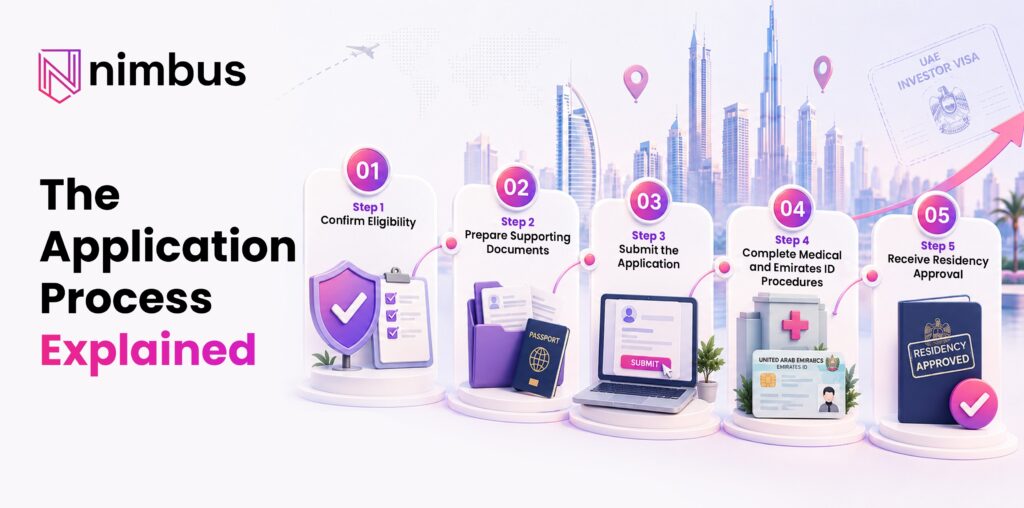
How to Apply for a Real Estate Visa in Dubai
The application process is generally managed through official Dubai Land Department channels. The process typically includes the following steps.
Step 1: Confirm Eligibility
Investors should verify that:
- Property ownership is properly registered
- Documentation is complete
- Ownership structure meets applicable requirements
Step 2: Prepare Supporting Documents
All required property, identity, and supporting documents should be gathered in advance.
Step 3: Submit the Application
Applications are submitted through the relevant government channels with payment of applicable fees.
Step 4: Complete Medical and Emirates ID Procedures
Applicants must undergo medical fitness testing, biometric registration, and Emirates ID processing where required.
Step 5: Receive Residency Approval
Once approved, the investor receives a renewable two-year residence permit. Processing times are generally estimated at seven to ten business days, although actual timelines may vary.
Sponsoring Family on a Dubai Property Visa
One of the most attractive features of the Property Investor Visa is the ability to sponsor eligible family members. Depending on applicable rules and documentation requirements, investors may sponsor spouses, children, and parents. This makes the visa particularly appealing for families planning a longer-term move to Dubai.
Impact on Dubai’s Property Market
The revised rules are expected to have a positive impact across several segments of the real estate market. Smaller units that previously fell below visa eligibility thresholds may become more attractive to foreign buyers. This could support demand for:
- Studios
- One-bedroom apartments
- Mid-market residential units
- Emerging community developments
The reduced residency barrier may also encourage more international buyers to enter the market. For many investors, residency benefits play an important role in purchasing decisions.
How the New Rules Benefit Investors?
For entrepreneurs considering business setup in the UAE, the revised visa framework offers additional flexibility. Property-linked residency can serve as a complementary solution that reduces dependence on employment or corporate sponsorship. This can be particularly useful for startup founders and international entrepreneurs.
As company formation in the UAE continues to attract global business owners, the ability to combine property investment with residency creates an even stronger value proposition.
Expert Guidance for Your Dubai Property Visa with Nimbus Consultancy
Navigating property investment and residency regulations requires careful planning. Nimbus Consultancy supports investors by helping them:
- Assess suitable residency options
- Review property ownership structures
- Understand mortgage-related requirements
- Evaluate broader business and investment strategies
Our certified professionals can provide guidance on aligning residency, property ownership, and corporate structuring objectives.
Closing Thoughts
Dubai’s decision to remove the AED 750,000 minimum property value requirement for sole owners represents a significant shift in the emirate’s residency landscape.
The reform lowers barriers for foreign investors, encourages participation in the real estate market, and strengthens Dubai’s appeal as one of the world’s most attractive destinations for international investors, entrepreneurs, and globally mobile professionals.

Comments are closed