
The UAE Green Licensing Framework is designed to simplify the setup process for companies whose activities support environmental and climate objectives. The initiative is closely linked to Expo City Dubai’s Green Innovation District, where the first Green Licence was issued in 2025.
The district serves as a hub for climate technology startups, research institutions, and sustainability-focused enterprises. For investors planning company formation in the UAE, this license provides access to innovation clusters, research partnerships, and opportunities to collaborate with government and corporate partners.
This post digs into the details of the Green License Framework that ensures that businesses entering the UAE’s sustainability ecosystem can scale quickly while remaining aligned with national climate targets.
Regulations Supporting Green Businesses
Recent regulatory developments have reinforced the UAE’s commitment to climate accountability. The Federal Decree-Law No. 11 of 2024 introduced mandatory greenhouse gas emissions reporting and maintaining verifiable environmental performance data for businesses in the UAE, including free zone entities.
Foreign businesses going for business setup in the UAE must therefore establish robust systems for measuring environmental impact, energy usage, and emissions reduction.
Why the UAE Is Emerging as a Global CleanTech Hub
The UAE’s approach to sustainability combines policy with practical business support. Besides focusing primarily on environmental regulation, the UAE has created an ecosystem that encourages innovation while maintaining strong environmental standards.
For entrepreneurs considering business setup in the UAE, this environment offers a powerful combination of advantages including access to major infrastructure projects, funding opportunities and investment networks, and innovation-focused free zones.
Together, these factors are transforming the country into a leading destination for climate technology development.
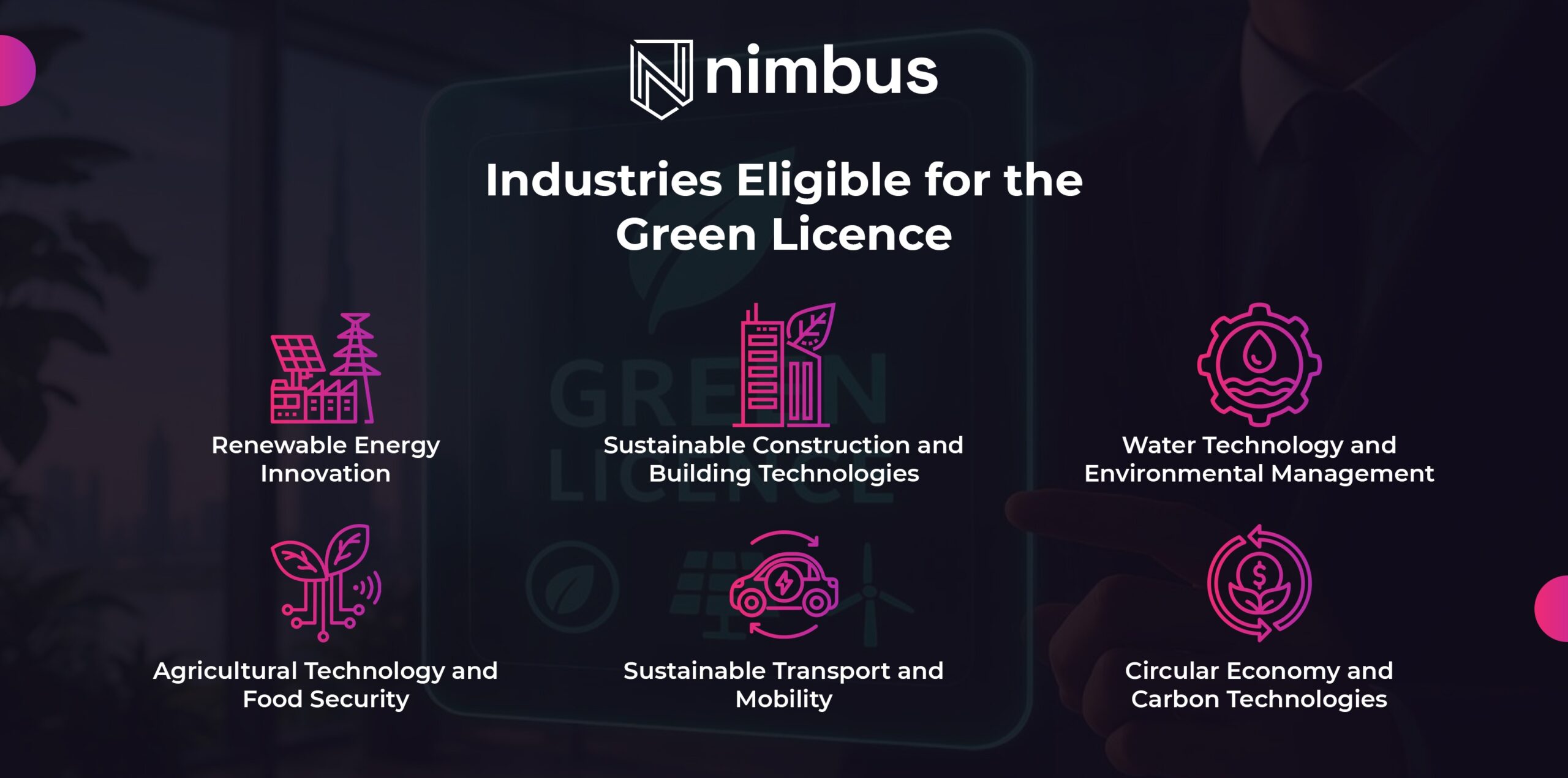
Industries Eligible for the Green Licence
Companies applying for the Green Licence must demonstrate that their activities contribute directly to environmental improvement, emissions reduction, or resource efficiency. Several sectors have emerged as particularly strong candidates.
Renewable Energy Innovation
Renewable energy remains one of the most active sectors within the UAE’s sustainability landscape. Solar energy costs have declined significantly over the past decade, helping the UAE achieve some of the lowest solar tariffs globally. This progress has increased demand for startups developing solutions such as:
- Solar optimisation software
- Battery storage technologies
- Hybrid renewable systems
- Smart grid management platforms
Businesses entering these markets often benefit from strong government support and access to large infrastructure projects.
Sustainable Construction and Building Technologies
The UAE has introduced strict efficiency standards for buildings, creating demand for innovative construction technologies. Startups that develop solutions such as low-carbon construction materials and energy-efficient insulation systems will be welcomed across the real estate sector.
These technologies are particularly relevant for companies pursuing UAE mainland setup, as they often work directly with government infrastructure projects and large commercial developers.
Water Technology and Environmental Management
Water security is a critical priority for the UAE, given the region’s desert climate. CleanTech startups focusing on water innovation can contribute to solutions such as:
- Desalination efficiency technologies
- Smart irrigation systems
- Water recycling platforms
- Leak detection technologies
These innovations improve water efficiency while supporting urban development, agriculture, and industrial activity.
Agricultural Technology and Food Security
The UAE is also investing heavily in agricultural technology to strengthen food security. Advanced greenhouse systems, vertical farming technologies, and precision irrigation tools are helping local agriculture adapt to challenging environmental conditions.
Sustainable Transport and Mobility
Transportation is another sector undergoing major transformation. National initiatives are encouraging the expansion of electric vehicle infrastructure, including multiple charging stations across the country. Startups developing mobility solutions such as EV charging networks and green logistics platforms are increasingly relevant.
Circular Economy and Carbon Technologies
Emerging technologies in carbon capture, waste recycling, and circular manufacturing are also gaining traction. For example, some companies are converting agricultural waste into biodegradable materials, while others are developing solutions that capture or reuse carbon emissions.
Choosing Between Mainland and Free Zone Setup
When launching a CleanTech venture, entrepreneurs must choose between UAE mainland setup and UAE freezone setup. Both structures offer advantages depending on the business strategy.
Mainland Licensing
A mainland structure allows businesses to operate anywhere in the UAE and work directly with public sector entities. However, mainland businesses may also require additional approvals from authorities such as:
- The Ministry of Climate Change and Environment
- Municipal environmental departments
- Sector-specific regulators
This setup is ideal for companies planning to participate in large-scale infrastructure or government procurement projects.
Free Zone Ecosystems
For many early-stage startups, UAE freezone setup offers a streamlined entry into the market. Some free zones are particularly well suited for CleanTech companies, including:
- Expo City Dubai – Green Innovation District
- Masdar City in Abu Dhabi
- Sharjah Research Technology and Innovation Park
- Dubai Science Park
Funding Opportunities
The UAE has developed a strong financial ecosystem supporting sustainable innovation. Entrepreneurs launching company formation in the UAE can access various funding sources, including government grants and incentives and climate-focused investment programs.
Key organisations supporting CleanTech ventures include:
- Abu Dhabi Investment Office
- Khalifa Fund for Enterprise Development
- Dubai SME
These programmes provide financial support, mentorship, and infrastructure access for qualifying startups.
CleanTech Accelerators and Innovation Hubs
There are several incubators help startups refine their technologies and scale operations. Examples include:
- The Catalyst in Masdar City, which offers seed funding and mentorship
- Hub71 in Abu Dhabi, which attracts global climate technology startups
- Expo City innovation programs, which facilitate partnerships between startups and large corporations
These initiatives provide founders with valuable access to technical expertise, pilot projects, and investment networks.
Compliance and Environmental Responsibilities
While the UAE provides strong support for sustainability ventures, CleanTech companies must also meet strict compliance obligations including:
- Monitoring greenhouse gas emissions
- Maintaining environmental reporting systems
- Obtaining environmental permits where necessary
Companies working in sectors such as energy, waste management, and industrial manufacturing may also need to submit regular environmental impact reports.
Launching CleanTech Venture in the UAE
As global demand for sustainability solutions continues to grow, the UAE’s Green Licensing Framework provides a compelling opportunity for global investors.
For founders pursuing UAE company formation, the combination of regulatory clarity, infrastructure investment, and financial support makes the UAE one of the most attractive destinations in the world for launching a CleanTech startup.

Comments are closed