

Freelancing in the UAE has become a viable option for independent professionals who want to work with local and international clients while living in the country.
Digital licensing systems, self-employment permits and flexible residency options have reduced some of the barriers traditionally associated with starting a business in the UAE.
The trend is particularly visible in Abu Dhabi. Data from the Abu Dhabi Registration and Licensing Authority (ADRA) showed a 261 percent increase in freelance licences during the first quarter of 2026. The same period also saw a 21 percent increase in new economic licences and a 12 percent rise in active licences.
The data hints towards a strong current interest in independent professional activity. For professionals considering business setup in the UAE, freelancing can provide a relatively simple route into the market without immediately establishing a full company.
Why Apply for a Freelance Visa in the UAE? Key Benefits
The UAE has spent years developing an environment designed to attract investors, businesses and skilled professionals. Freelancing fits naturally into that strategy because it allows individuals to offer specialised services without the infrastructure required by a conventional company.
The economic contribution of freelancers is also significant. UAE government-linked information has previously estimated that freelancers contribute more than AED 10 billion annually to the economy, with more than 100,000 licensed freelancers operating in the country. Several factors are behind this growth, including:
- Digital application and licensing procedures
- Greater availability of self-employment permits
- Options for self-sponsored residency
- Growing demand for design, consulting and creative services
- Access to both UAE-based and international clients
The result is a market where an individual can potentially establish a legal professional activity without creating a large corporate structure from day one.
What is a UAE Freelance License? Dubai vs. Abu Dhabi Options
A freelance licence or permit allows an individual to provide approved professional services independently. It is different from establishing a conventional company.
For example, a freelance professional may offer services such as consulting, content writing, software development, marketing, or other approved activities, depending on the licensing authority.
ADRA’s Abu Dhabi Freelancer Licence is one example. It allows eligible professionals to operate as sole proprietors, does not require a physical office and offers more than 100 activities. The basic licence cost is AED 1,200 and includes six investor-selected activities, with additional activities available for an extra fee.
Dubai has its own freelance structures. The Dubai Development Authority describes its Freelancer Licence as a Sole Professional Licence, allowing an independent professional to conduct business under their personal name.
It is important to note that there is no single UAE-wide freelance licence with one fixed price. The authority, activity, residency requirements and additional services all affect the final cost.
UAE Freelance Visa vs. License: Guide to the Green Visa
A licence and a residence visa are separate things. The licence or permit gives you the legal basis to carry out the approved professional activity. A residence visa, on the other hand, determines your right to live in the UAE.
The exact process depends on the licensing authority and your circumstances. Some freelance arrangements can be linked with residency options, while individuals already living in the UAE may have different requirements.
The UAE’s Green Residence is one important option for qualifying self-employed professionals. According to the Federal Authority for Identity, Citizenship, Customs and Port Security, freelancers and self-employed individuals applying under this route generally need a freelance or self-employment permit issued by MoHRE, a bachelor’s degree, specialised diploma or equivalent qualification, and proof of financial stability.
The applicant must demonstrate freelance income of at least AED 360,000 in each of the previous two years or provide evidence of financial solvency. The income and qualification requirements are important, particularly for someone moving to the UAE for the first time.
Documents Required for a UAE Freelance Permit in 2026
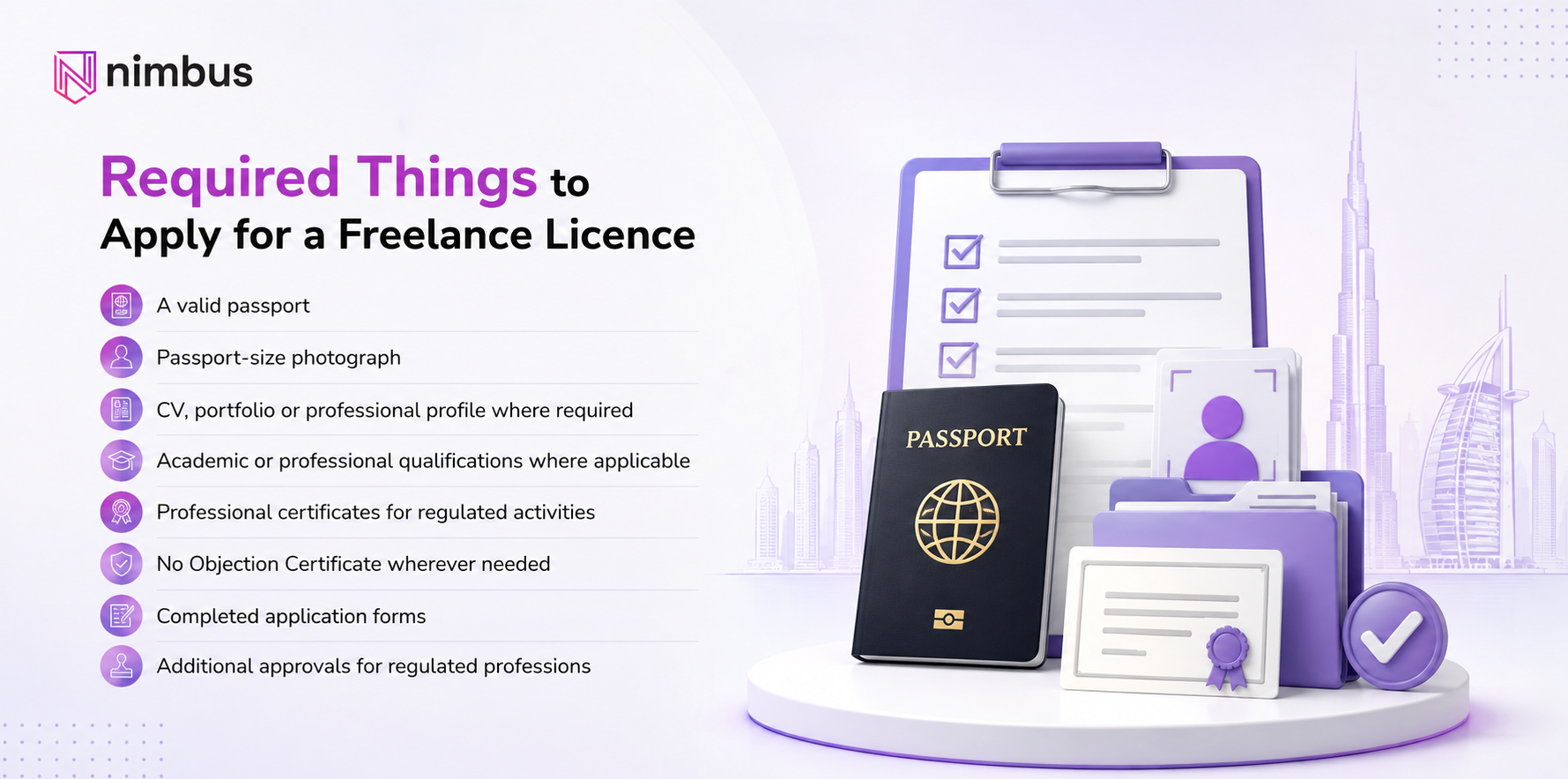
Eligibility depends on the selected authority and activity, so applicants should check the exact requirements before submitting an application. In general, applicants should provide:
- A valid passport
- Passport-size photograph
- CV, portfolio or professional profile where required
- Academic or professional qualifications where applicable
- Professional certificates for regulated activities
- No Objection Certificate wherever needed
- Completed application forms
- Additional approvals for regulated professions
ADRA, for example, lists attested academic qualifications, professional certificates and an NOC among the possible requirements for its Freelancer Licence.
People who are already employed or living in the UAE should pay particular attention to their existing employment or sponsorship arrangements. An NOC may be required depending on the authority, licence category and circumstances.
How to Get a Freelance License in the UAE: Step-by-Step Guide
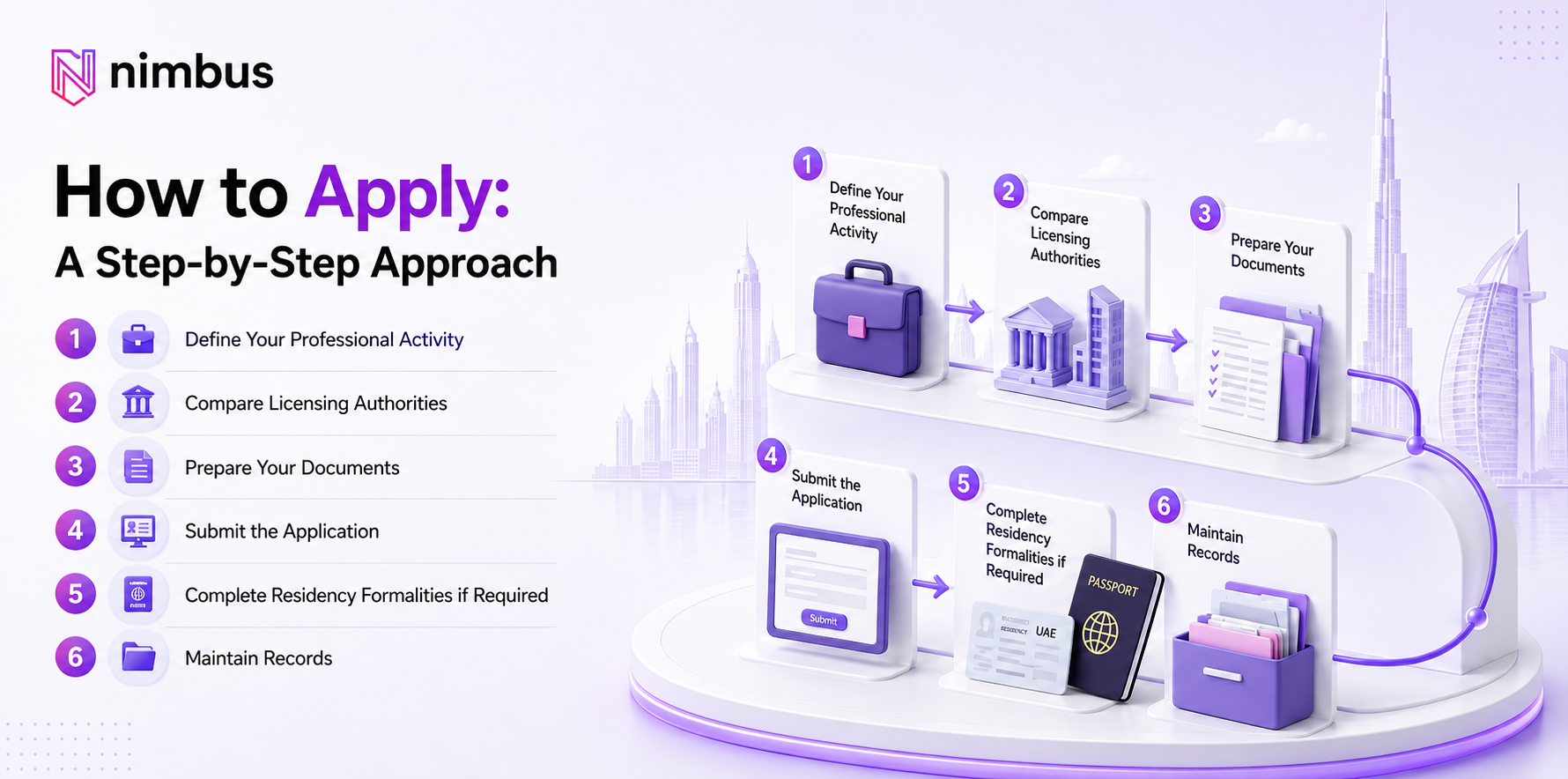
The process is relatively straightforward, and here are the key steps for application.
- Define Your Professional Activity: Start by identifying exactly what you will sell. Don’t simply choose a broad category because it sounds convenient. Your actual services should match the activity listed on your licence.
- Compare Licensing Authorities: Next, compare mainland and free-zone options. Check the relevant emirate’s licensing authority and the rules applicable to your activity. For UAE freezone setup, understand the rules and regulations of the respective free zone. ADRA, for example, allows freelancers to operate from home without a dedicated office and provides access to more than 100 activities.
- Prepare Your Documents: Gather your passport, photograph, CV, and necessary documents. If your activity is regulated, additional approvals may be necessary.
- Submit the Application: Many applications can be completed online. Dubai Development Authority, for example, allows applicants to apply online.
- Complete Residency Formalities if Required: If you need UAE residency, the licence application may be followed by the relevant immigration, medical examination and Emirates ID procedures.
- Maintain Records: Keep contracts, invoices, receipts, bank records and tax documentation organised from the beginning.
How Much Does a Freelance License Cost in the UAE (2026 Breakdown)?
There isn’t one universal cost for starting a freelance business in the UAE. The total depends on whether you need residency, which authority you choose, the activity you select and whether services such as medical testing, Emirates ID processing, or establishment cards are included in your package. A realistic budget should consider:
- Freelance licence
- Application and government charges
- Residence visa, if required
- Medical examination
- Emirates ID
- Health insurance
- Activity-specific approvals
- Annual renewal fees
UAE Corporate Tax and VAT Rules for Freelancers
Tax compliance is another area where freelancers need to separate different thresholds. A natural person conducting a business or business activity in the UAE becomes subject to Corporate Tax registration when total business turnover exceeds AED 1 million in a calendar year.
The Federal Tax Authority confirms that salaries, personal investment income and real estate investment income are excluded from this business turnover calculation.
The AED 1 million figure is therefore a registration threshold for a natural person conducting business. It should not be confused with the AED 375,000 Corporate Tax rate threshold.
Ready to Start Your Freelance Journey in the UAE?
The UAE’s freelance ecosystem in 2026 offers independent professionals more flexibility than the traditional business setup model. Abu Dhabi’s sharp increase in freelance licences, together with digital application systems and self-employment residency pathways, reflects growing demand for flexible professional structures.
At the same time, prospective freelancers should avoid treating every advertised package as interchangeable. Licence activities, visa eligibility, tax thresholds, renewal fees and free-zone rules can vary considerably.
For someone exploring business setup in the UAE, the practical approach is to define and confirm the appropriate activity, calculate the complete first-year and renewal costs, and then select the licence and residency route that fits the business. However, careful planning at the beginning can prevent expensive changes later.

Comments are closed