

A new chapter in UAE’s corporate tax evolution
The UAE’s corporate tax system is still relatively new, with a standard rate of 9 percent applied to taxable income above AED 375,000. Within this framework, the introduction of an R&D tax credit marks a natural progression toward a more mature tax regime.
Unlike broad-based tax exemptions, this incentive is targeted. It is designed to reward companies that invest in genuine innovation activities, particularly those involving technological development and scientific advancement.
For businesses evaluating company formation in the UAE, this signals that the country is actively encouraging high-value, knowledge-driven operations.
AN OVERVIEW OF THE UAE’S R&D STRUCTURE
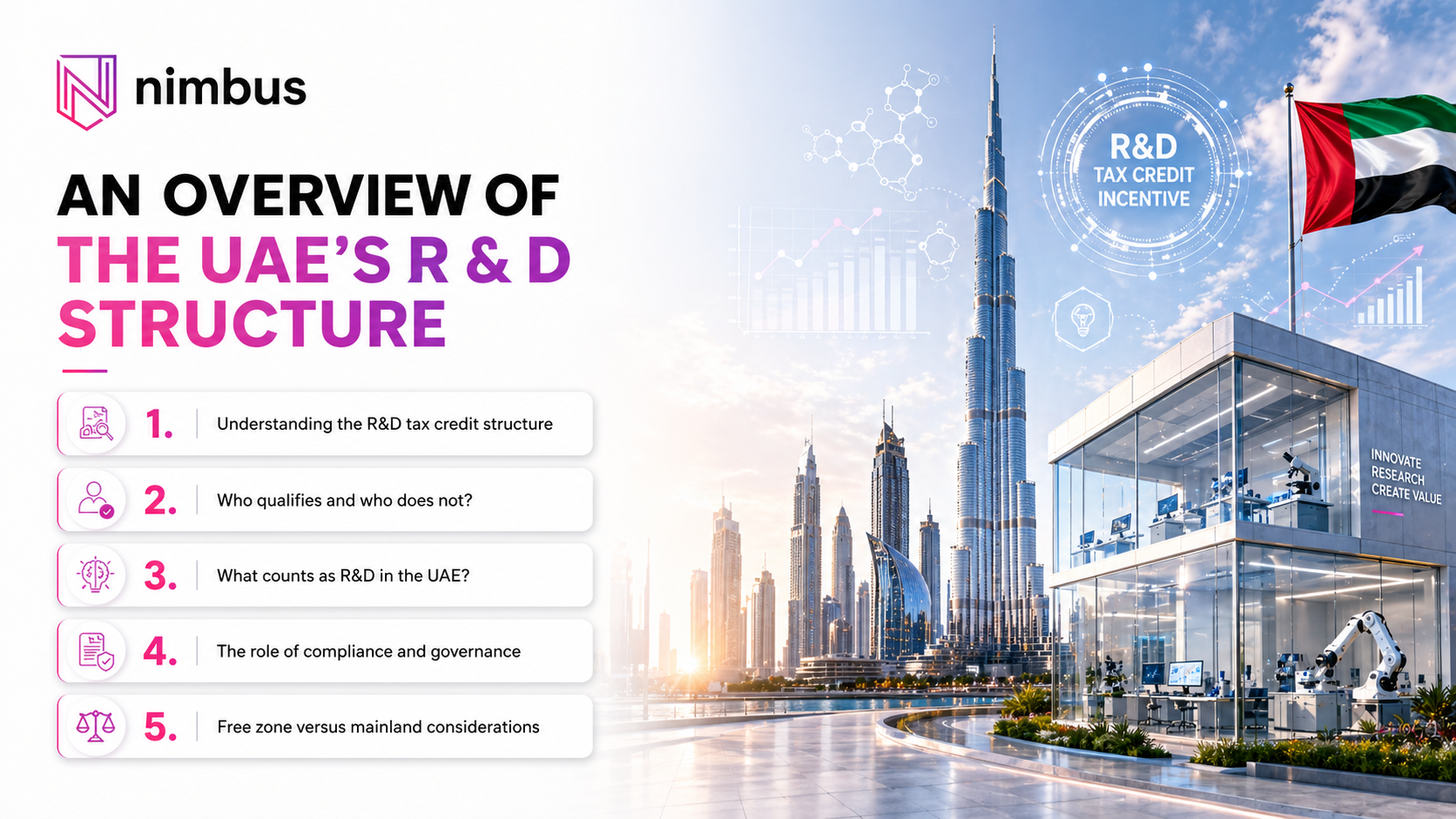
Understanding the R&D tax credit structure
The UAE’s R&D tax incentive is structured as a non-refundable corporate tax credit of up to 50 percent on qualifying expenditure, capped at AED 5 million per tax period. The credit operates on a tiered system:
- 15 percent on the first AED 1 million of qualifying R&D spend, requiring at least 2 R&D staff
- 35 percent on expenditure between AED 1 million and AED 2 million, requiring at least 6 R&D staff
- 50 percent on expenditure between AED 2 million and AED 5 million, requiring at least 14 R&D staff
This structure is significant because it links financial incentives directly to operational substance. Companies cannot simply reclassify costs; they must demonstrate real investment in people, processes, and innovation capacity.
Who qualifies and who does not?
The incentive applies to what the law defines as “Qualifying Entities,” which include:
- UAE-based companies subject to corporate tax
- Certain free zone entities
- Foreign companies operating through a permanent establishment in the UAE
However, not all businesses will benefit equally. The program excludes entities that have elected small business relief, and it requires a minimum R&D project spend of AED 500,000. Additional conditions include:
- Expenditure must be deductible under corporate tax rules
- Costs funded by government grants are not eligible
- The same expense cannot be claimed under multiple incentives
- Claims must be supported by detailed documentation
This means that early-stage startups or companies with limited R&D budgets may find the incentive less accessible, at least in its initial phase.
For entrepreneurs evaluating UAE business setup, this highlights the importance of aligning business models with the incentive’s requirements from the outset.
What counts as R&D in the UAE?
The UAE has aligned its definition of qualifying R&D activities with the OECD Frascati Manual, an internationally recognized standard. To qualify, activities must involve systematic experimentation or investigation and the creation of new knowledge or capabilities.
Excluded activities include:
- Routine software implementation
- Marketing research
- Administrative or operational improvements
- Work in social sciences, arts, or humanities
This definition is intentionally strict and ensures that the incentive supports genuine innovation rather than routine business activities. For companies considering business setup in the UAE, this distinction is critical. Not all “innovation” qualifies in a tax sense.
The role of compliance and governance
One of the defining features of the UAE’s R&D tax credit is its emphasis on compliance and documentation. Businesses must:
- Obtain pre-approval for each R&D project from the Emirates Research and Development Council
- Maintain detailed technical and financial records for at least seven years
- Submit claims alongside corporate tax filings
- Provide periodic progress reports if required
There are also claw-back provisions. If a company is later found not to meet the criteria, previously claimed credits may be treated as unpaid tax and must be repaid. For companies undergoing UAE company formation, this reinforces the need to integrate tax planning, legal structuring, and operational processes from day one.
Free zone versus mainland considerations
The introduction of the R&D tax credit adds a new dimension to the longstanding decision between UAE freezone setup and UAE mainland setup. Free zones have traditionally been attractive due to simplified regulatory frameworks and sector-specific ecosystems.
However, companies benefiting from a 0 percent effective tax rate may not fully utilize a non-refundable tax credit, since there is little or no tax liability to offset. Mainland entities, on the other hand, may find the incentive more valuable because:
- They are subject to the standard corporate tax rate
- They can directly offset tax liabilities with the credit
- They may have greater flexibility in serving the domestic market
Sector-specific impact
The R&D tax credit is likely to have the greatest impact on industries where innovation is both measurable and scalable. Key sectors include:
- Technology and software development
- Advanced manufacturing and industrial automation
- Life sciences and healthcare innovation
- Renewable energy and sustainability solutions
These sectors are already central to the UAE’s economic diversification strategy, and the new incentive strengthens their position. For investors exploring company formation in the UAE, sector alignment will play a major role in determining the value of this incentive.
Strategic implications for investors
The introduction of the R&D tax credit changes the conversation around business setup in the UAE. Previously, the focus was often on tax efficiency and ease of incorporation. Now, there is a growing emphasis on innovation capacity and talent development. This shift has several strategic implications:
- Companies may choose to relocate or expand R&D functions into the UAE
- Multinational groups may reassess their regional structures
- Investors may prioritize sectors aligned with national innovation goals
What to Expect in the Next Phase?
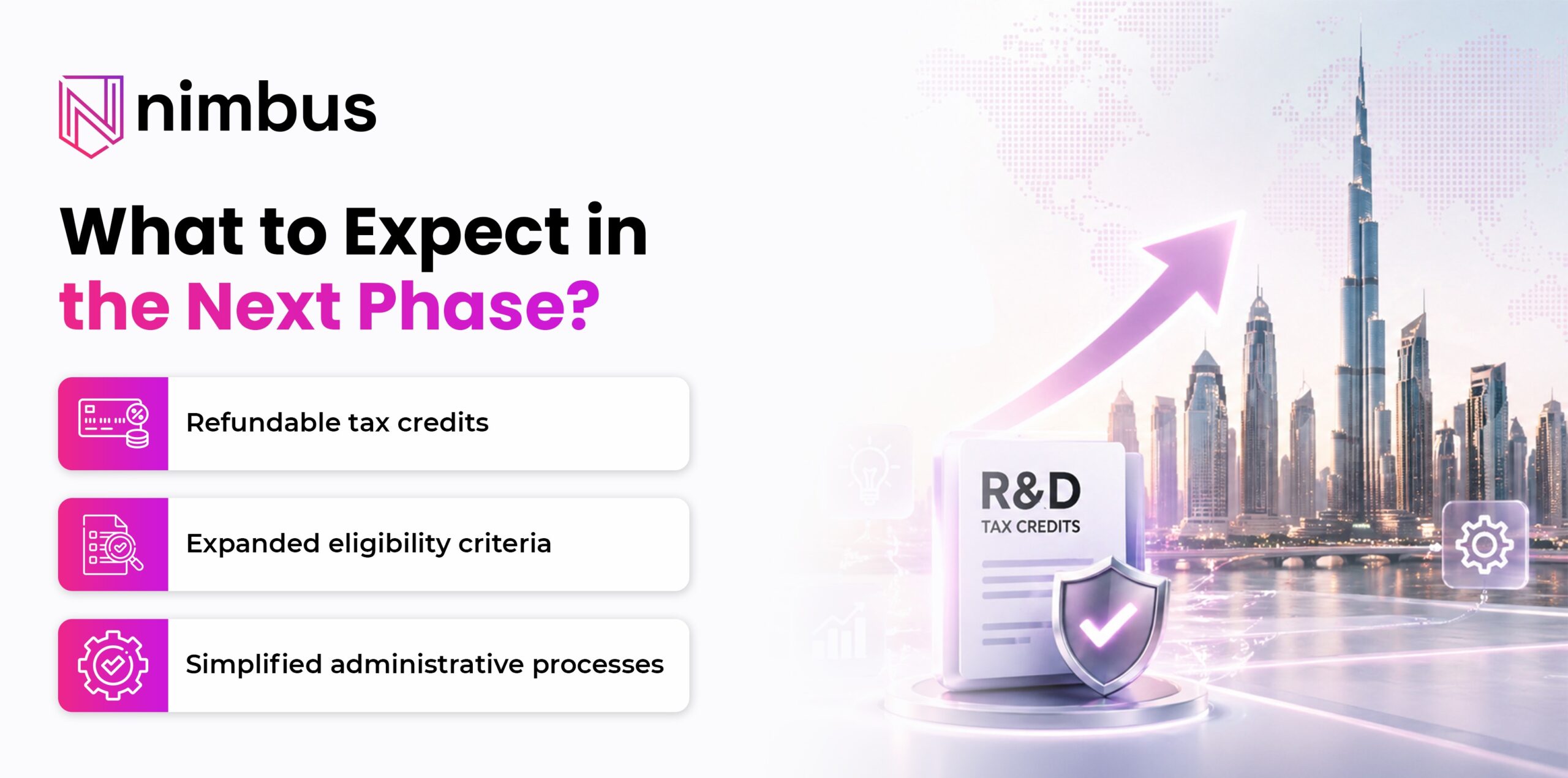
The current program represents the first of the UAE’s R&D tax incentive strategy. The government has indicated that future phases may introduce:
- Refundable tax credits
- Expanded eligibility criteria
- Simplified administrative processes
These changes could make the incentive more accessible, particularly for startups and early-stage companies.
Closing Thoughts
The launch of the UAE’s R&D tax credit marks a significant milestone in the country’s economic and regulatory development. It reflects a broader shift toward innovation and global alignment in tax policy.
For businesses considering UAE company formation, the incentive offers a compelling opportunity but also demands careful planning. It is not a blanket benefit; it rewards those who invest in real R&D capabilities and maintain strong compliance standards.
In a region increasingly defined by competition for talent, technology, and capital, the UAE’s shows that the future belongs to businesses that build, not just that operate.

Comments are closed