

The UAE’s regulatory landscape is becoming significantly more demanding in 2026 as businesses face the combined impact of corporate tax implementation, stricter anti-money laundering rules, Emiratisation enforcement, and new governance and reporting obligations.
For companies operating in the UAE, compliance has evolved into an ongoing operational responsibility that affects legal structures, taxation, hiring, governance, banking relationships, and day-to-day business continuity.
Whether businesses are considering business setup in the UAE for the first time or managing an established operation, understanding the country’s evolving compliance framework has become essential for sustainable growth.
The increasing complexity also means that businesses across the UAE must now assess compliance obligations from the very beginning rather than treating them as secondary considerations. This article covers the essentials. So, let’s take a dive.
Why Compliance Has Become a Major Business Priority in the UAE?
The UAE has spent the last several years modernizing its economic and regulatory framework to align with international standards. This transformation includes:
- Introduction of federal corporate tax
- Enhanced anti-money laundering (AML) enforcement
- Expanded Emiratisation targets
- Stronger corporate governance rules
- Climate-related reporting obligations
As a result, regulators, banks, and stakeholders now expect companies to maintain well-structured compliance systems because failing to adapt may lead to:
- Financial penalties
- Licence suspension
- Banking restrictions
- Delays in visa processing
- Tax disputes
- Increased regulatory scrutiny
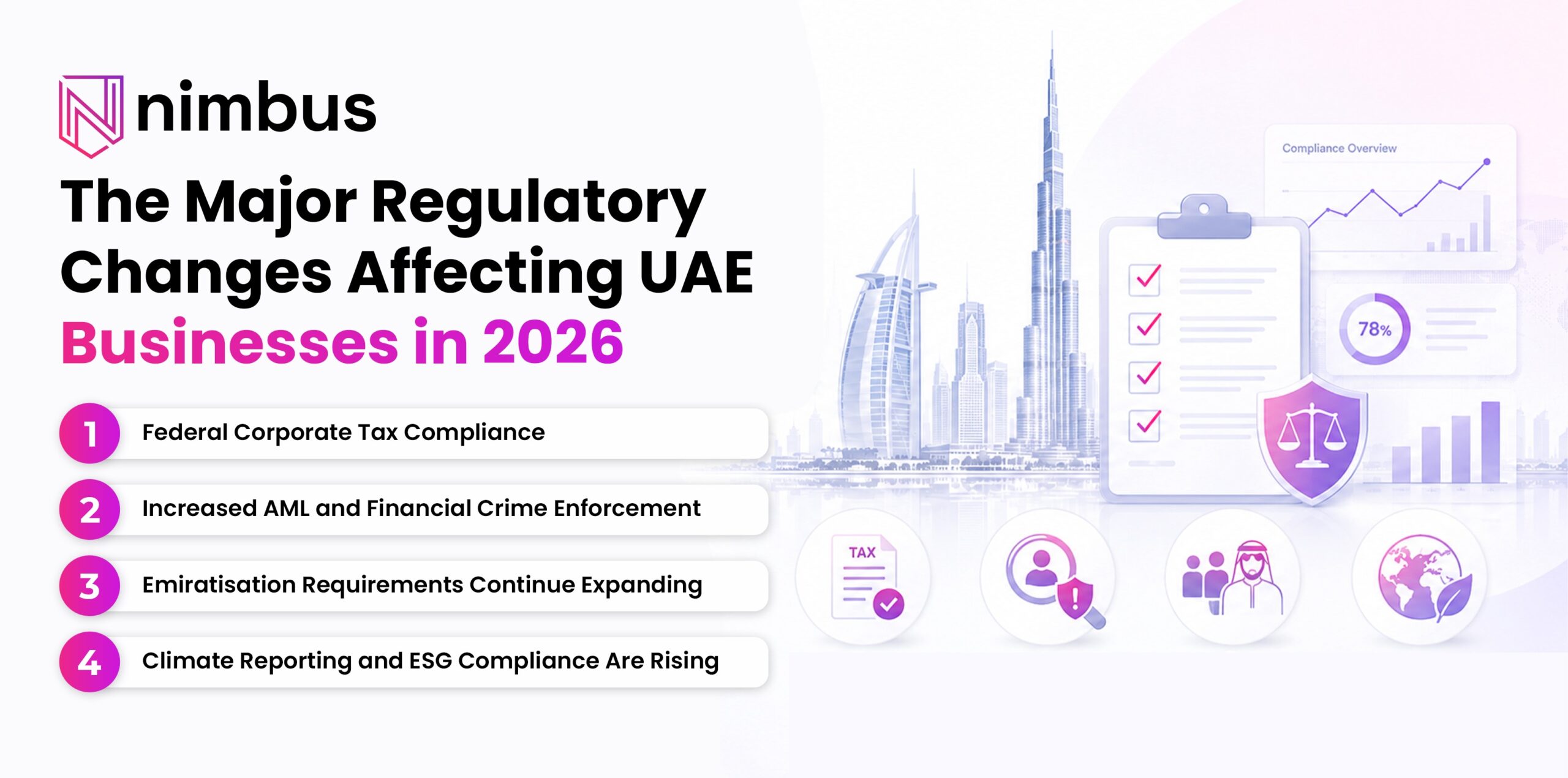
The Major Regulatory Changes Affecting UAE Businesses in 2026
Several overlapping regulatory developments are reshaping how businesses operate across the UAE.
1. Federal Corporate Tax Compliance
The UAE’s federal corporate tax framework has fundamentally changed the business environment. While the standard corporate tax rate remains internationally competitive at 9 percent for taxable income exceeding AED 375,000, the practical compliance obligations are becoming more significant. Businesses must now manage:
- Corporate tax registration
- Annual tax filings
- Financial documentation
- Transfer pricing requirements
- Related-party transaction disclosures
- Record retention obligations
2. Increased AML and Financial Crime Enforcement
The UAE has strengthened anti-money laundering regulations across multiple sectors.
Regulators are paying closer attention to:
- Ultimate beneficial ownership structures
- Customer due diligence procedures
- Source of funds verification
- Risk assessments
- Suspicious transaction reporting
Designated Non-Financial Businesses and Professions (DNFBPs) face particularly high scrutiny. This includes:
- Corporate service providers
- Real estate businesses
- Consultants
- Financial intermediaries
- Accounting firms
Banks are also conducting more rigorous compliance reviews before onboarding or maintaining corporate accounts.
3. Emiratisation Requirements Continue Expanding
Employment compliance is becoming another major focus area in 2026. The UAE government continues expanding Emiratisation targets for private sector companies. Businesses operating in mainland UAE must increasingly integrate workforce nationalization into:
- Recruitment planning
- HR strategy
- Operational budgeting
Failure to meet Emiratisation requirements can lead to financial penalties and restrictions on work permit processing. Companies pursuing UAE mainland setup must evaluate workforce planning from the beginning.
4. Climate Reporting and ESG Compliance Are Rising
The UAE’s new climate-related legislation is introducing additional compliance expectations across sectors. Businesses are increasingly expected to:
- Monitor emissions data
- Maintain environmental records
- Align with ESG frameworks
- Participate in climate-related reporting
This marks a broader shift toward transparency and accountability in corporate operations. For multinational companies and investors, ESG compliance is also becoming important for:
- Access to capital
- Investor confidence
- International partnerships
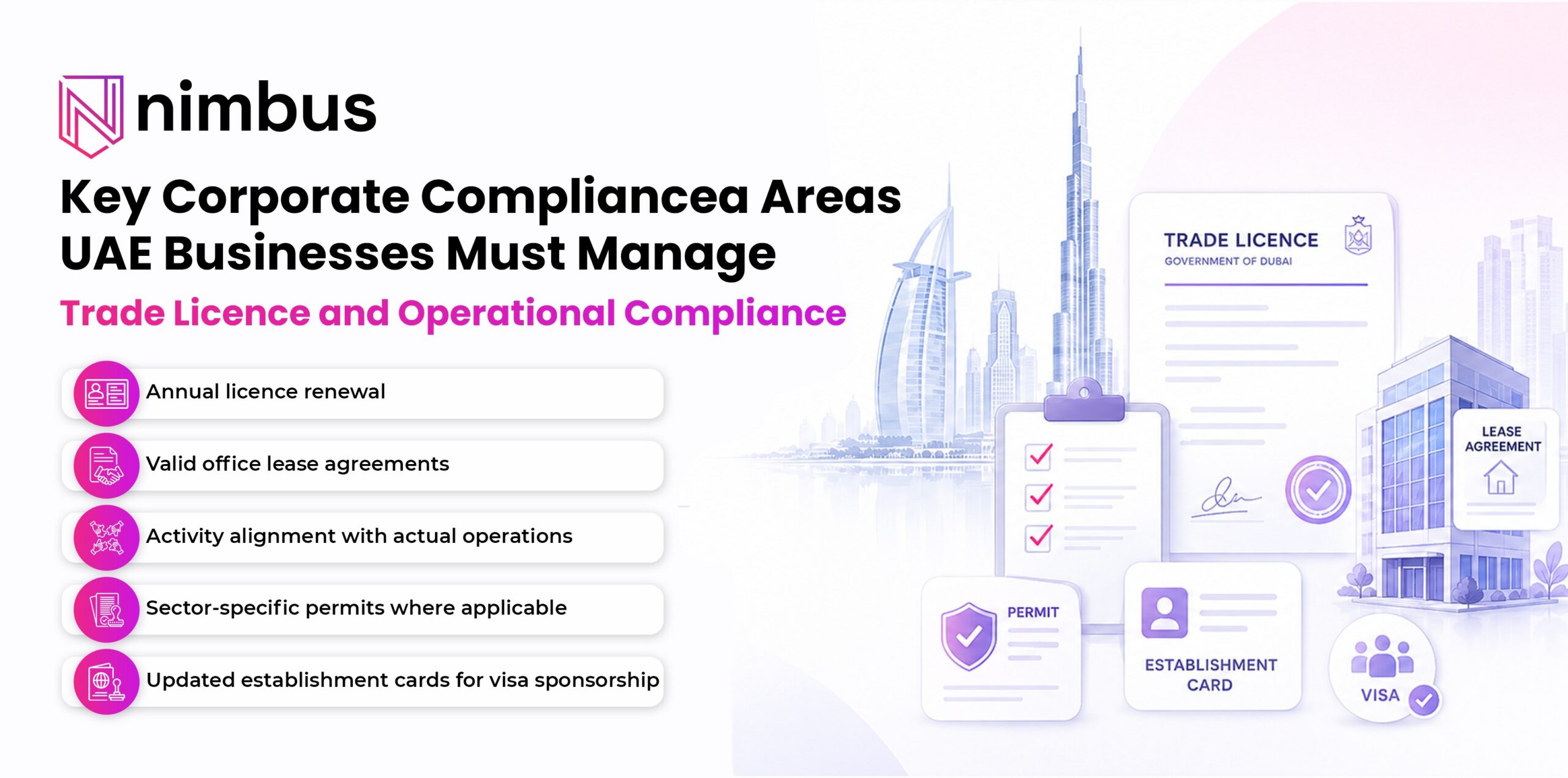
Key Corporate Compliance Areas UAE Businesses Must Manage
Businesses operating in the UAE now face compliance obligations across multiple operational areas.
1. Trade Licence and Operational Compliance
Every UAE business must maintain an active and properly renewed trade licence. Key requirements include:
- Annual licence renewal
- Valid office lease agreements
- Activity alignment with actual operations
- Sector-specific permits where applicable
- Updated establishment cards for visa sponsorship
One of the most common compliance risks arises when companies operate activities that do not fully match their licensed scope. This can create regulatory exposure during inspections or banking reviews.
2. Employment and Workforce Compliance
Employment compliance requirements continue to expand. Businesses must ensure:
- Proper employment contracts
- Compliance with labour law standards
- Accurate gratuity calculations
- Employee record maintenance
- Workplace policy implementation
- Timely payroll processing
- Visa compliance
HR compliance has become increasingly important for both UAE freezone setup and UAE mainland setup structures.
3. Tax and Financial Compliance
Tax compliance obligations now extend far beyond VAT. Companies must manage:
- Corporate tax filings
- VAT returns
- Invoice documentation
- Audit requirements where applicable
- Transfer pricing documentation
Free zone businesses face additional scrutiny when seeking to maintain preferential tax treatment. They must demonstrate:
- Qualifying income activities
- Adequate economic substance
- Operational presence
- Proper reporting practices
4. Corporate Governance Requirements Are Expanding
Governance and transparency standards are becoming increasingly important in the UAE. Businesses must maintain:
- Ultimate Beneficial Owner (UBO) registers
- Shareholder records
- Director records
- Corporate resolutions
- Board meeting documentation
- Ownership updates
Failure to maintain accurate governance records can lead to regulatory penalties, banking delays, licence renewal complications, and increased due diligence scrutiny.
The Biggest Compliance Risks Businesses Face in 2026
Several high-risk areas are becoming particularly important.
1. Misalignment Between Licensed and Actual Activities
Businesses often expand services without updating licences. This creates significant exposure during banking reviews, tax audits, and licence renewals.
2. Weak Tax Documentation
Corporate tax audits are expected to increase. Companies without proper financial records, transfer pricing support, tax calculations, and invoices may face disputes and penalties.
3. Poor AML Controls
Many smaller businesses still underestimate AML compliance obligations. Weak internal controls can create regulatory penalties, banking restrictions, and increased due diligence scrutiny.
4. Improper Management
Improper contract management and inaccurate gratuity calculations remain common operational risks. Labour disputes can quickly escalate into court proceedings, and reputational concerns.
How Businesses Should Prepare for the UAE Compliance Environment?
Companies should adopt a proactive compliance strategy rather than reacting to regulatory problems after they arise.
1. Conduct Regular Compliance Audits
Businesses should periodically review licence structures, tax compliance, HR documentation, and AML procedures. This helps identify gaps before regulators do.
2. Maintain Strong Documentation
As UAE enforcement becomes increasingly evidence-based, businesses must maintain transactional records, documentation, internal policies, and audit trails.
3. Reassess Corporate Structures
Many businesses established before corporate tax implementation are now reassessing their structures. This includes reviewing holding company arrangements, transfer pricing exposure, and cross-border activities.
Professional guidance is becoming increasingly important for businesses involved in UAE company formation and restructuring.
The Future of Compliance in the UAE
Corporate compliance in the UAE has become a central operational priority. For companies considering business setup in the UAE, understanding the regulatory environment is now essential from the earliest planning stages.
For businesses operating across the UAE, compliance readiness will increasingly determine operational stability, banking access, and tax efficiency. Businesses that invest in structured compliance systems today will be far better positioned to operate confidently and grow sustainably in the UAE’s increasingly sophisticated regulatory environment.

Comments are closed