


The UAE is preparing for one of the most significant legal reforms in its modern commercial history. Federal Decree-Law No. 25 of 2025 introduces a new Civil Transactions Law that will replace the long-standing 1985 Civil Code starting from 1 June 2026.
While the structure of the previous framework remains largely intact, the new legislation modernizes several areas of civil and commercial law. It clarifies judicial interpretation, strengthens pre-contractual obligations, expands liability rules, and introduces updated provisions relating to property, contracts, and corporate structures.
For companies considering business setup in the UAE, these reforms represent an important development in the country’s evolving legal landscape. Businesses already operating in the UAE should understand how the new civil code may influence contractual practices, risk management strategies, and corporate governance structures.
This article explores the most relevant elements of the new law and what they mean for businesses operating across UAE’s jurisdictions, both mainland and freezone setups.
A Modern Legal Framework for a Global Business Hub
Over the past four decades, the UAE’s civil law framework has supported the country’s growth. However, economic expansion, technological change, and increasingly complex cross-border transactions have created the need for a more modern legal structure.
Federal Decree-Law No. 25 of 2025 aims to address these developments by refining legal language, clarifying judicial procedures, and incorporating legal concepts that reflect contemporary commercial practice. Let’s have a look at the reforms.
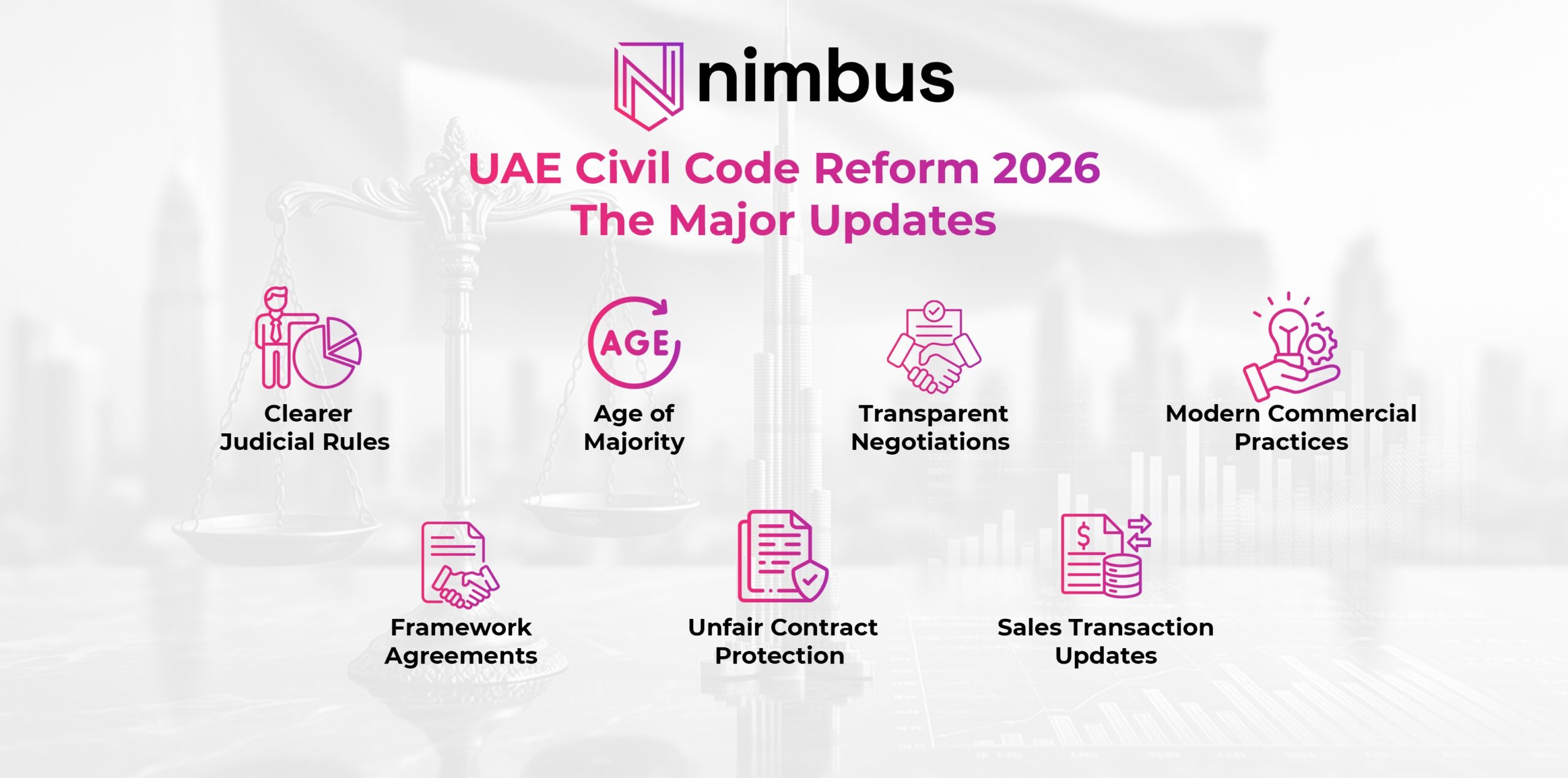
UAE Civil Code Reform 2026 – The Major Updates
1. Clearer Rules for Judicial Interpretation
One of the most important updates in the new Civil Code relates to how courts interpret civil disputes. The law establishes a clearer hierarchy for judicial interpretation.
Courts must first rely on explicit legislative text. If the law does not provide guidance on a particular issue, judges may apply principles derived from Islamic Sharia. However, the law clarifies that courts are not limited to a single theological school and may choose interpretations that best serve justice and public interest.
This structured approach helps reduce ambiguity in legal interpretation. For companies involved in UAE company formation, greater legal clarity helps improve confidence in contractual enforcement and dispute resolution.
2. Changes to the Age of Majority
Another notable reform concerns the age of legal majority. Under the previous Civil Code, full contractual capacity was granted at 21 lunar years. The new law reduces the age of majority to 18 Gregorian years.
This means individuals aged 18 and above will have full legal capacity to enter into contracts starting from June 2026. For businesses operating in sectors such as finance, digital services, and retail, this reform has several implications:
- contracts signed with individuals aged 18 or older will have stronger legal enforceability
- onboarding procedures may need to be updated to reflect the new legal age
- consumer platforms may see an expansion of legally eligible customers
Companies involved in company formation in the UAE should review their compliance procedures to ensure customer verification systems reflect this change. The law also introduces protections for minors and vulnerable individuals.
3. Transparent Contract Negotiations
One of the most impactful reforms for businesses concerns pre-contractual obligations. The new Civil Code formally introduces the principle of good faith during negotiations. Parties must conduct negotiations honestly and responsibly.
Abusive termination of negotiations may lead to liability if it causes harm to the other party. In addition, the law introduces mandatory disclosure obligations. Parties must reveal fundamental and decisive information during negotiations. Key features include:
- disclosure duties cannot be waived through contract clauses
- deliberate withholding of essential information may justify contract annulment
- negotiation records may become relevant evidence in disputes
This reform highlights the importance of structured documentation during negotiations. Companies should implement internal procedures to document communications and ensure transparent disclosure practices.
4. Modern Commercial Practices
The updated Civil Code also recognizes modern forms of contract formation. Electronic communications, digital acceptance, and conduct-based agreements are explicitly recognized under the new law. This aligns the legal framework with digital business models that rely on online transactions.
The law also clarifies the difference between binding offers and invitations to treat, such as advertisements or promotional listings. These clarifications are particularly relevant for businesses operating digital platforms, eCommerce marketplaces, and technology-based services.
5. Recognition of Framework Agreements
The new Civil Code formally acknowledges framework agreements as valid contractual structures. Framework agreements establish core contractual terms governing repeated transactions over time. They are commonly used in:
- supply chain arrangements
- long-term service agreements
- distribution partnerships
- strategic commercial alliances
By recognizing framework agreements in statute, the law provides greater legal certainty for businesses that rely on recurring transactions rather than single isolated contracts.
6. Addressing Unfair Contracts
Another major development in the new Civil Code involves doctrines related to unfair contractual arrangements. The law expands traditional concepts such as mistake, duress, and misrepresentation.
It also introduces clearer rules addressing economic exploitation. Courts may intervene when contracts demonstrate significant imbalance caused by:
- dependency or vulnerability
- inexperience in negotiations
- abuse of bargaining power
In such cases, courts may annul unfair agreements and modify obligations to restore fairness. The law also clarifies limitation periods for challenging defective contracts, providing greater procedural certainty.
7. Changes to Sales Transactions
The law also introduces updated provisions governing the sale of goods.
One key reform involves latent defect liability. The limitation period for claims related to hidden product defects has been extended. Key changes include:
- defect claims can now be raised within one year of delivery
- buyers may reject defective goods or seek price reductions
- replacement of defective goods may be requested where applicable
Previously, claims were limited to six months in many situations. For manufacturers and suppliers working in the UAE, this extension increases post-sale liability exposure and highlights the importance of quality control systems.

Preparing for the Civil Code Transition
The new law will take effect on 1 June 2026. In general, it will not apply retroactively to contracts concluded before that date unless explicitly stated. However, companies should begin preparing well in advance. Businesses may wish to review:
- Template commercial contracts
- Negotiation and disclosure procedures
- Implement Quality Control systems
- Product liability frameworks
Companies operating across both UAE mainland setup and UAE freezone setup jurisdictions should ensure internal policies remain consistent with the new civil law framework.
Dawn of a New Legal Era in the UAE
The introduction of Federal Decree-Law No. 25 of 2025 represents the most significant modernization of UAE civil law since the 1980s. By clarifying legal interpretation and modernizing liability rules, the new Civil Code reflects the evolution of the UAE’s business environment.
For investors and businesses considering business setup in the UAE, the reform signals a mature and increasingly sophisticated legal ecosystem.
However, early preparation will help navigate the transition smoothly and benefit from the stronger legal certainty.

Comments are closed