

Post COVID, remote work has become a standard operating structure. In the UAE, regulators have recognised this shift and formally incorporated remote work into labour law. However, while hiring remote staff is legally permitted, compliance depends heavily on how and where the worker is engaged.
Companies that misunderstand visa requirements, payroll obligations, or foreign tax exposure may face regulatory penalties or unexpected legal risks.
For businesses exploring business setup in the UAE, understanding how remote hiring works is essential. This article explains the legal framework and operational considerations for building compliant remote teams in the UAE.
The Rise of Remote Work
Remote employment became formally recognised in the UAE under Federal Decree-Law No. 33 of 2021, which introduced remote work as a legally accepted employment model alongside full-time and part-time roles. The law acknowledges that employees may perform their duties outside a traditional office environment.
However, this flexibility does not remove the employer’s compliance obligations. Companies in the UAE must still follow labour regulations, visa rules, payroll systems, and employment protections.
Remote Hiring Models for UAE Companies
Remote hiring structures depend primarily on where the employee lives. The legal treatment differs significantly between workers based in the UAE and those located abroad. Understanding these differences is critical for compliance.
1. Hiring Remote Employees Who Live in the UAE
When a remote employee resides inside the UAE, they are legally considered a standard UAE employee. The fact that they work from home, residing in any another emirate does not change their legal employment status. However, the employment contract must clearly state that the position is remote or hybrid.
Employers must therefore comply with all standard labour obligations, including:
- Issuing a compliant employment contract
- Registering the employee with the Ministry of Human Resources and Emiratisation (MOHRE)
- Sponsoring the employee’s residence visa if they are an expatriate
- Paying salary through the Wages Protection System (WPS)
All statutory employee rights remain intact, including:
- Annual leave
- Sick leave
- End-of-service gratuity
- Termination notice requirements
2. Hiring Remote Workers Outside the UAE
Hiring remote workers living outside the UAE requires different structures. UAE labour systems are built around residency and visa sponsorship, meaning overseas workers generally cannot be registered as employees unless they relocate. Instead, companies can hire international remote workers through one of three models.
a) Independent Contractor Agreements
Several businesses hire overseas workers as independent contractors. This offers flexibility but can create misclassification risk if the contractor is treated like a traditional employee. To reduce risk, contractor agreements should focus on working hours and avoid exclusive employment arrangements.
b) Employer of Record (EOR)
An Employer of Record acts as the legal employer in the worker’s home country while the UAE company manages daily work activities. This model significantly reduces legal risk but increases operational cost. The EOR handles:
- Payroll processing
- Tax reporting
- Social security contributions
c) Overseas Subsidiaries
Some companies establish an international subsidiary or partner entity that formally employs remote staff. While this offers full control, it requires additional compliance management. Businesses sometimes choose this route when remote hiring becomes a core operational strategy.
Differences Between Mainland, Free Zone, and Financial Free Zone Rules
Remote hiring rules can vary depending on the jurisdiction where the company is licensed. Understanding these differences helps companies select the most suitable structure during business setup in the UAE.
1. Mainland
Mainland companies regulated by MOHRE can only officially employ individuals who hold valid UAE work permits. Workers based abroad cannot be registered as employees in MOHRE systems and therefore must be engaged through contractual arrangements.
2. Free Zone
Companies operating under UAE freezone setup follow similar rules when hiring UAE-based employees. Employees residing in the UAE must still obtain:
- Residence visas
- Work permits
- Registered employment contracts
3. ADGM and DIFC Structures
Financial free zones operate under independent legal frameworks. Abu Dhabi Global Market (ADGM) explicitly recognises overseas employees within its employment regulations.
Companies can hire workers living outside the UAE without issuing UAE work visas. This makes ADGM particularly attractive for companies building international teams.
The Dubai International Financial Centre (DIFC) also supports remote work but does not yet offer the same level of formal recognition for overseas employees.
Contract Clauses for Remote Workers
Remote employment contracts require careful drafting to prevent disputes. These clauses help avoid disputes regarding attendance expectations or allowances.
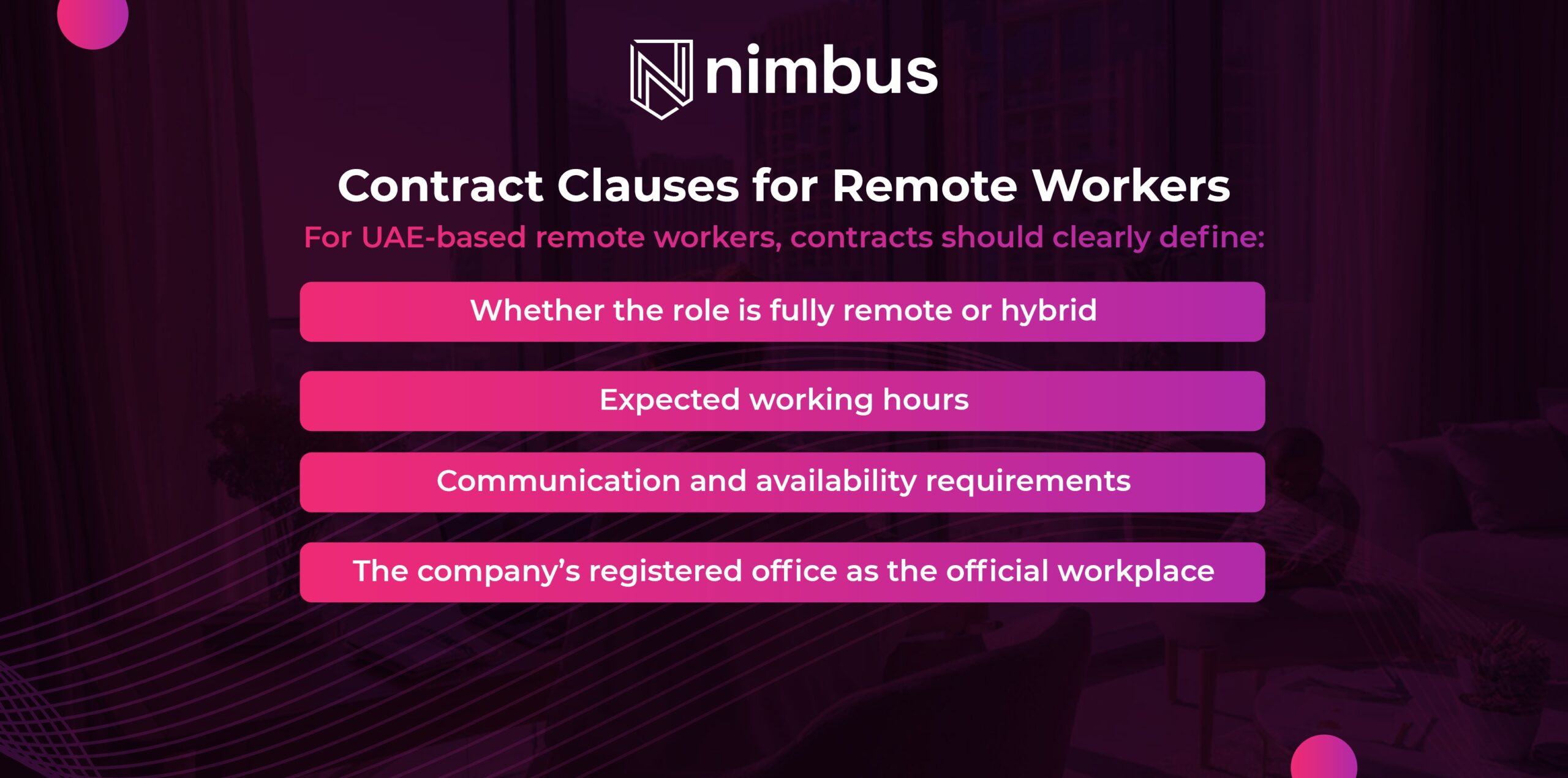
For UAE-based remote workers, contracts should clearly define:
- Whether the role is fully remote or hybrid
- Expected working hours
- Communication and availability requirements
- The company’s registered office as the official workplace
Other Essentials for Remote Workers
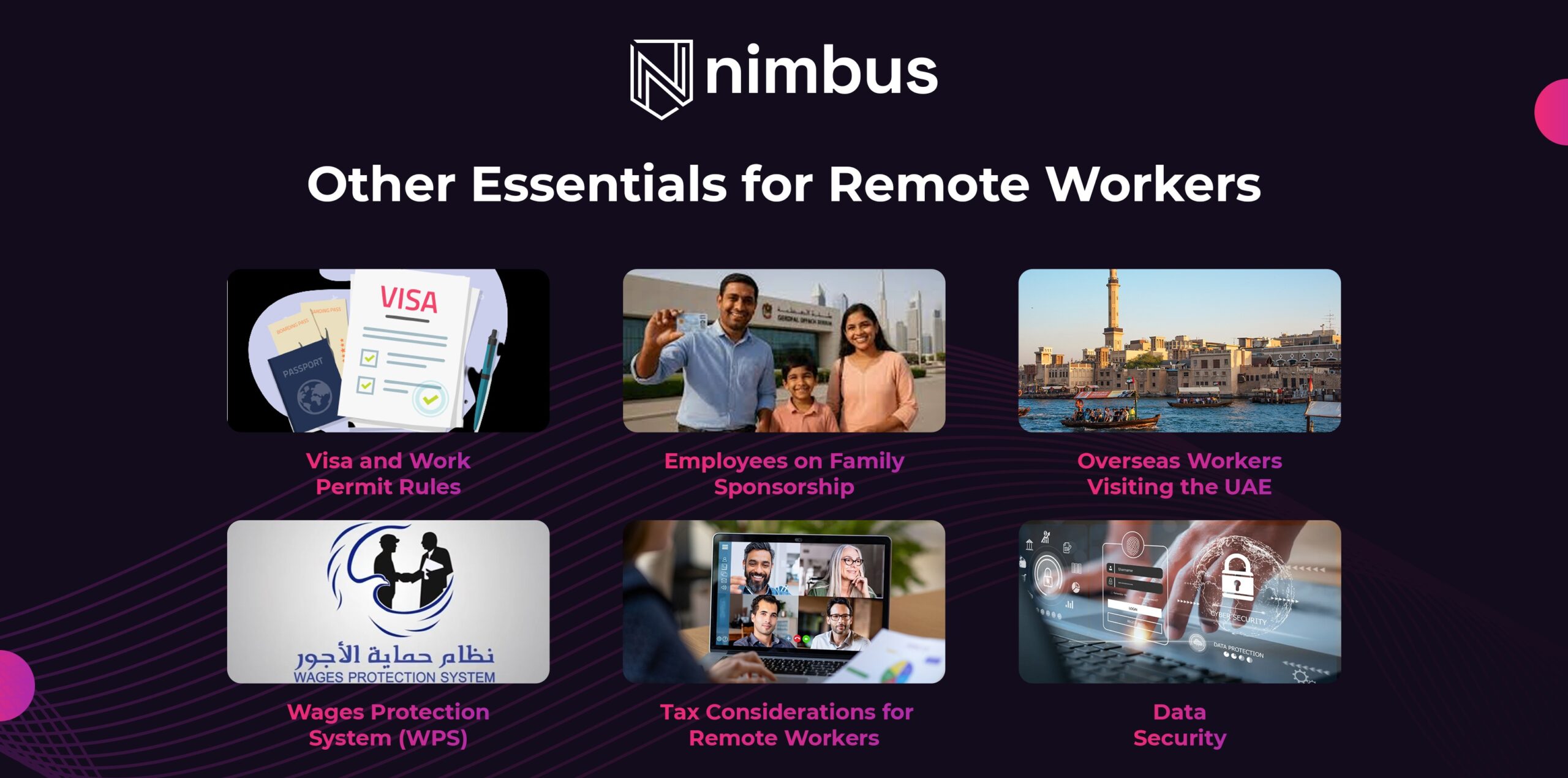
1. Visa and Work Permit Rules
Remote work does not eliminate immigration requirements. Any expatriate working remotely while living in the UAE must still hold a valid residence visa and work permit.
2. Employees on Family Sponsorship
Individuals sponsored by family members can work remotely for companies, but the employer must still obtain a work permit authorising employment under family sponsorship. Failing to secure this permit is one of the most common compliance violations discovered during labour inspections.
3. Overseas Workers Visiting the UAE
International remote employees visiting the UAE for meetings or training should enter the country using business or visit visas. Working physically in the UAE without a work permit can create immigration risk. Short visits for onboarding or corporate meetings are generally acceptable when documented properly.
4. Wages Protection System (WPS)
The WPS applies to all employees, including those working remotely. Employers must pay salaries through approved WPS channels and ensure payroll records match employment contract terms. Failure to comply can result in:
- Fines of AED 5,000 per employee
- Suspension of work permits
- Labour inspections
5. Tax Considerations for Remote Workers
Although the UAE does not impose personal income tax, hiring workers abroad can create tax obligations in other countries. One key concern is permanent establishment risk. A permanent establishment may arise if overseas employees:
- Negotiate contracts
- Generate revenue
- Operate from a fixed business location
Companies can reduce this risk by ensuring contracts are signed in the UAE and limiting authority for overseas staff.
6. Data Security
Remote access introduces new cybersecurity risks. Companies should implement:
- Multi-factor authentication
- Secure cloud systems
- Immediate access revocation during employee offboarding
These controls are necessary across sectors handling sensitive data such as fintech and healthcare.
Remote Hiring as a Strategic Advantage

Remote work has become the new norm. For UAE companie, it provides access to global talent while maintaining a presence in one of the world’s most dynamic business hubs.
However, success depends on aligning employment models with legal requirements, visa rules, payroll compliance, and tax considerations. With proper planning and the right legal structure, UAE companies can create distributed teams that combine global expertise with the strategic advantages of operating in the UAE.
Comments are closed