
For international investors, Saudi Arabia has developed into a major regional market for technology, manufacturing, tourism, renewable energy, financial services, entertainment and other advanced industries.
The country’s approach to foreign investment is also becoming more sophisticated. Rather than relying only on incentives such as tax advantages or financial support, Saudi Arabia is working to improve market access, simplify investment procedures and create an environment where international companies can establish and expand operations.
Why Foreign Investment in Saudi Arabia is Booming Beyond Vision 2030
Vision 2030 has played a central role in attracting investment by setting clear targets for economic diversification and private-sector growth. However, the next phase is increasingly focused on turning those ambitions into sustainable investment opportunities.
Saudi Arabia’s position gives it an important advantage. It is the largest economy in the Gulf Cooperation Council and has a population of more than 30 million people, creating a substantial domestic market.
Its location also connects Asia, Europe and Africa, making the Kingdom strategically important for companies looking to develop regional supply chains. The government has therefore been working on several fronts simultaneously:
- Opening additional economic sectors to foreign investors
- Improving investment regulations
- Reducing administrative barriers
- Developing special economic zones
- Supporting strategic industries
- Encouraging public-private partnerships
- Attracting multinational companies and regional headquarters
This combination is helping create an investment environment that extends beyond the headline targets associated with Vision 2030.
100% Foreign Ownership: Setting Up a Business in Saudi Arabia
One of the most significant developments for international businesses has been the gradual liberalisation of foreign investment rules. Saudi Arabia allows foreign investors to establish businesses in many sectors without the need for a Saudi shareholder, subject to the applicable licensing, regulatory and sector-specific requirements.
The Saudi Ministry of Investment, commonly referred to as MISA, plays a central role in facilitating foreign investment and providing investment-related services.
This is particularly important for companies that want greater control over their Saudi operations. Full foreign ownership can make it easier for international businesses to determine their management structure, protect intellectual property and integrate their Saudi operation into their global business.
However, investors should not assume that every activity is automatically open to 100 percent foreign ownership. Certain activities can be restricted or subject to additional approvals, licensing requirements or specific conditions. For this reason, foreign investors should confirm the permitted activity and regulatory requirements before incorporating a Saudi entity.
Navigating the New Saudi Investment Law & MISA Guidelines
Saudi Arabia has also been modernising its investment framework to provide greater clarity and protection for investors. The country’s updated Investment Law is part of this broader effort.
The framework aims to establish a more unified approach to investment, regardless of whether the investor is Saudi or foreign, while strengthening principles related to investor rights and equal treatment. The continued development of Saudi commercial legislation is therefore an important part of the Kingdom’s broader investment proposition.
Business Setup Benefits in Saudi Arabia’s Special Economic Zones (SEZ)
Another major component of Saudi Arabia’s investment strategy is the development of Special Economic Zones. Rather than offering the same incentive package to every company, Saudi Arabia is increasingly using targeted zones to attract businesses in specific industries and activities.
These zones can provide a combination of:
- Competitive tax treatment
- Customs-related advantages
- Streamlined regulatory processes
- Flexible employment arrangements
- Infrastructure designed for specific industries
- Strategic access to ports, airports and logistics networks
- Support for international investors
The exact benefits depend on the zone and the nature of the business.
For example, companies involved in logistics, cloud computing, or maritime industries may find that a specialised economic zone provides advantages that a conventional commercial registration does not. Investors should therefore compare the available jurisdictions before choosing where to establish their Saudi operation.
Corporate Tax, VAT, and Financial Incentives for Foreign Investors
Tax considerations remain an important part of any foreign investment decision. Saudi Arabia generally applies a 20 percent corporate income tax rate to the taxable profits of non-Saudi investors, although specific rules and exemptions can apply depending on the structure and activity.
In addition, Saudi has introduced targeted tax incentives for qualifying investments in certain Special Economic Zones. These can include preferential tax rates or other fiscal benefits, subject to eligibility requirements and applicable regulations.
Companies should also consider customs and VAT implications when assessing the total cost of establishing a business. Saudi Arabia applies VAT at 15 percent on most taxable goods and services. However, VAT treatment can differ depending on the transaction, industry and location.
Businesses should assess corporate tax, VAT, customs duties, payroll costs, licensing expenses and compliance requirements as part of their investment model.
Regional Headquarters (RHQ) and Non-Financial Perks in KSA
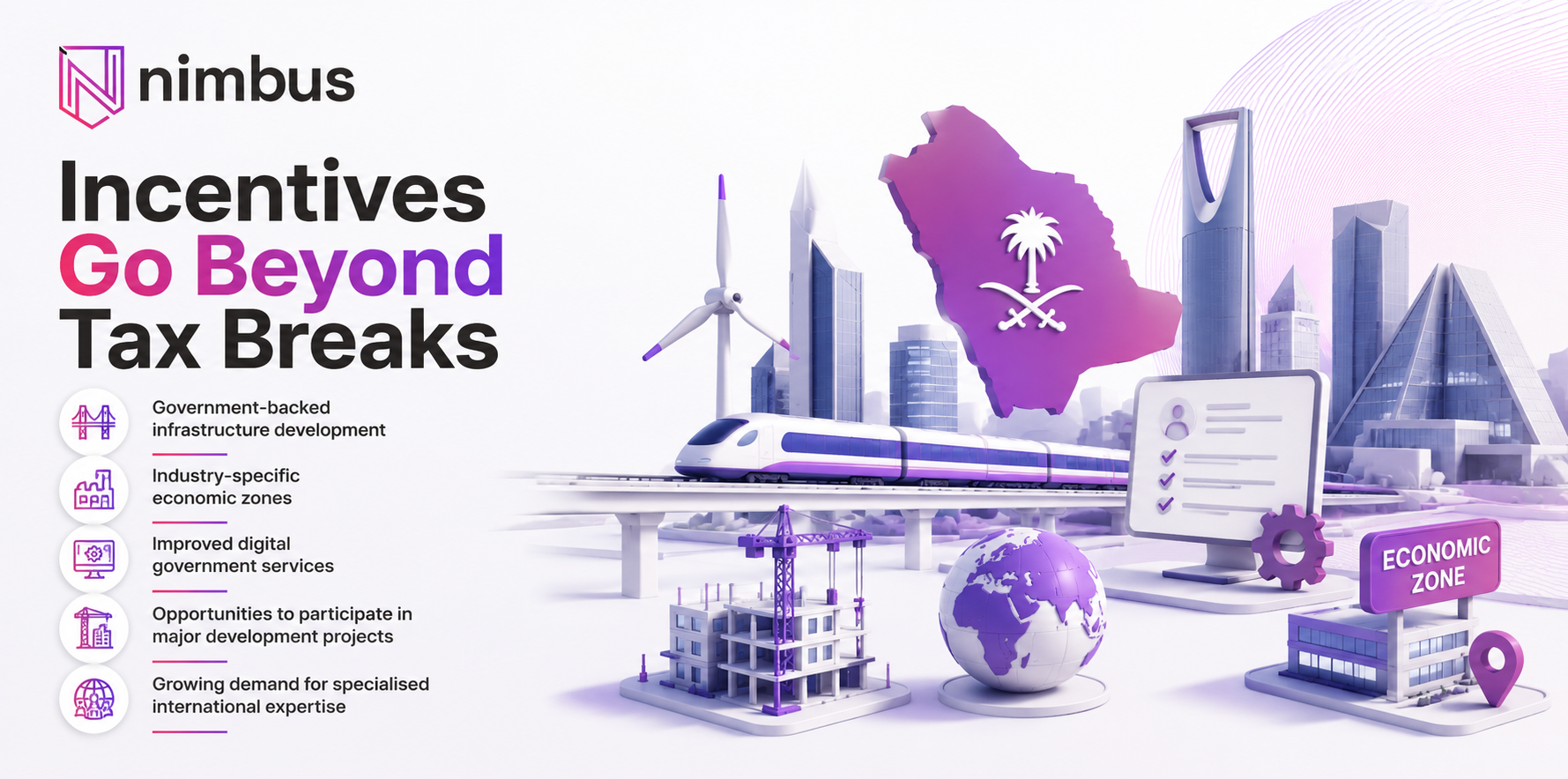
One of the most important things foreign investors should understand is that an investment incentive does not always mean a tax exemption. Saudi Arabia’s investment proposition increasingly includes non-financial advantages such as:
- Government-backed infrastructure development
- Industry-specific economic zones
- Improved digital government services
- Opportunities to participate in major development projects
- Growing demand for specialised international expertise
Checklist for Company Formation and Business Setup in Saudi Arabia
Despite the opportunities, business setup in Saudi Arabia requires careful planning. Foreign investors should begin by determining whether their intended activity is open to foreign investment and whether any additional approvals are required.
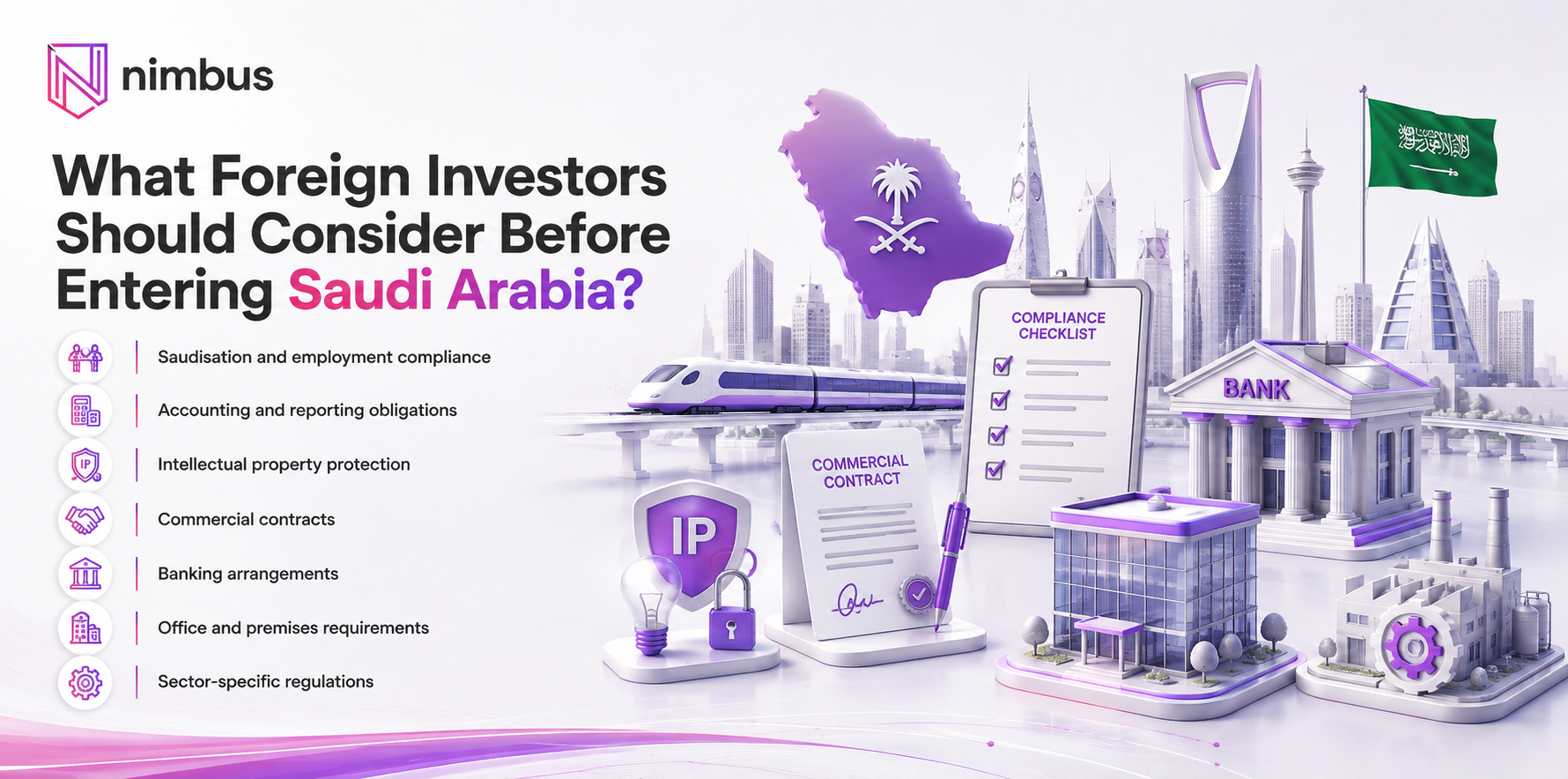
They should then consider the appropriate legal structure, licensing authority, location, and tax obligations. Other important considerations include:
- Saudisation and employment compliance
- Accounting and reporting obligations
- Intellectual property protection
- Commercial contracts
- Banking arrangements
- Office and premises requirements
- Sector-specific regulations
Professional advice can be particularly valuable for investors entering regulated industries or committing substantial capital.
The Future of Foreign Direct Investment (FDI) in KSA
Vision 2030 has provided Saudi Arabia with a clear economic direction, but the country’s investment story is evolving beyond the original slogan. The focus is increasingly on building an economy where international companies can participate in growing industrial verticals, including manufacturing, technology, tourism, and energy.
For foreign investors, this creates an opportunity for a compliant and successful company formation in the KSA. Saudi Arabia’s combination of market size, strategic location, infrastructure investment, regulatory reform and targeted incentives makes it an increasingly important destination for international capital. However, given Saudi Arabia’s strict adherence to regulatory rules, it’s smart to seek professional guidance to avoid costly errors.

Comments are closed