

Saudi Arabia is rapidly transforming into one of the Middle East’s most attractive destinations for financial services firms, investors, fintech innovators, and global financial institutions.
Driven by Vision 2030, regulatory modernization, and significant foreign investment inflows, the Kingdom is creating a dynamic ecosystem that supports asset management, capital markets, and digital finance.
For international investors looking to go for business setup in Saudi Arabia, the region now offers compelling opportunities across multiple financial sectors. Its expanding financial market is increasingly becoming a strategic destination in its own right.
This article explores the opportunities, licensing requirements, regulatory approvals, and operational considerations involved in setting up a financial company in Saudi Arabia.
Saudi Vision 2030 & FSDP: Why Foreign Investors are Targeting KSA
Saudi Arabia’s financial industry has experienced remarkable growth in recent years, supported by government reforms, digital transformation initiatives, and a deliberate effort to reduce reliance on oil revenues. Several indicators highlight the sector’s momentum:
- The sector has recorded an average annual growth rate of around 12% over the past decade.
- The fintech market is projected to grow from approximately USD 2.85 billion in 2025 to over USD 5 billion by 2030.
- Venture capital investment reached USD 860 million during the first half of 2025.
- Non-oil GDP grew by 4.9% during the first half of 2025.
These figures demonstrate the Kingdom’s commitment to creating a diversified economy supported by a modern financial services sector.
Top Opportunities: Fintech, Asset Management & Banking Setup in Saudi Arabia
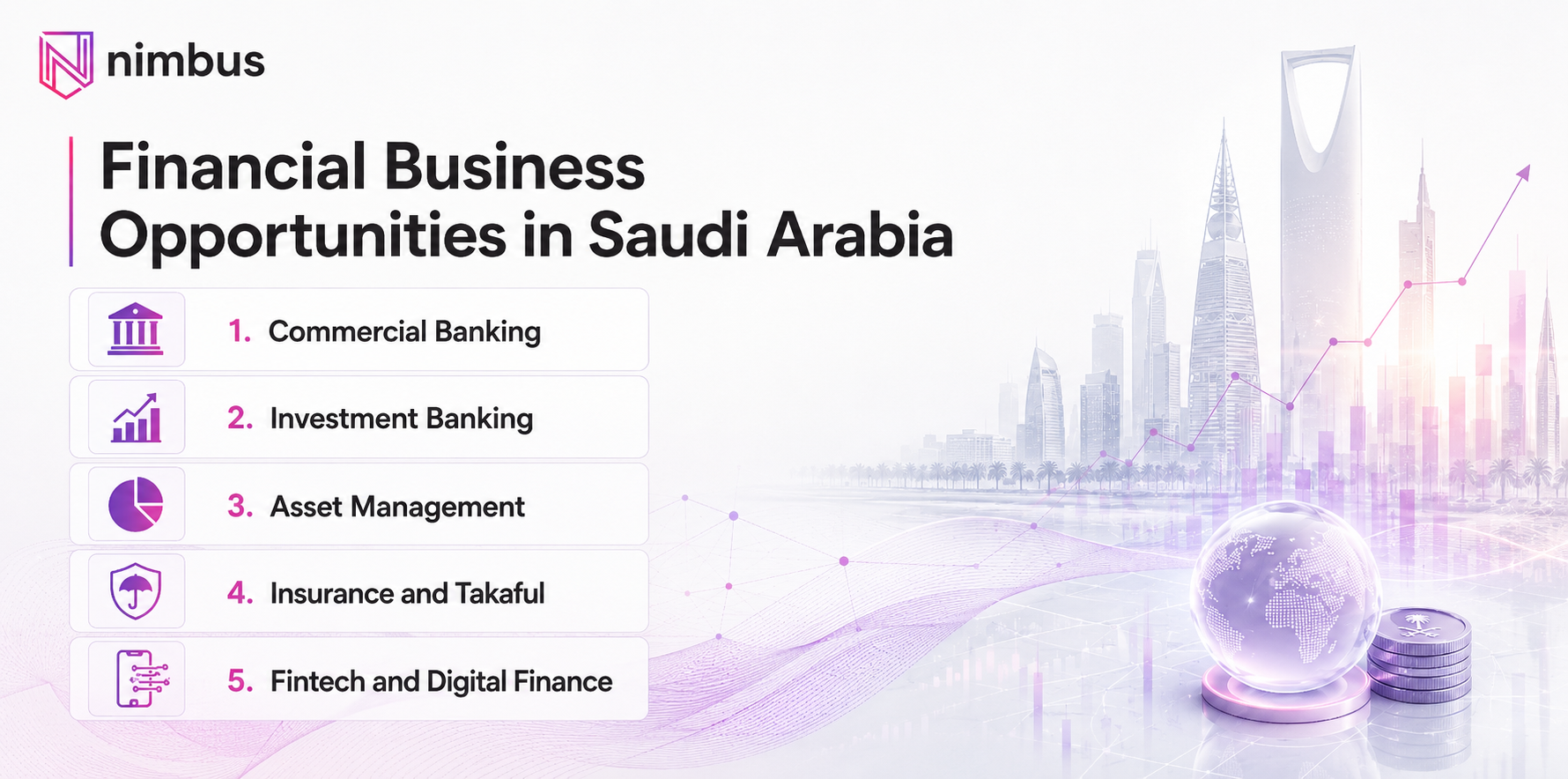
The financial services industry encompasses a wide range of regulated activities. Depending on the business model, investors can establish operations in the following areas for business incorporation in Saudi Arabia.
1. Commercial Banking & Payment Solutions
Commercial banks provide:
- Corporate lending
- Retail banking
- Trade finance
- Foreign exchange services
- Payment solutions
These institutions operate under the supervision of the Saudi Central Bank (SAMA).
2. Investment Banking & Corporate Finance
Investment banks support:
- Capital raising
- Corporate finance
- Mergers and acquisitions
- Financial advisory services
These activities are primarily regulated by the Capital Market Authority (CMA).
3. Asset & Wealth Management Services
Asset management firms can offer:
- Portfolio management
- Investment funds
- Wealth management
- Discretionary investment services
The growing wealth market and institutional investor base continue to drive demand for professional asset management solutions.
4. Insurance & Takaful (Islamic Insurance)
Saudi Arabia’s expanding economy creates strong demand for:
- Health insurance
- General insurance
- Corporate insurance
- Takaful products
- Reinsurance services
5. Fintech Innovation & Digital Finance Platforms
The fintech sector remains one of the fastest-growing segments of the Saudi economy, covering:
- Digital payments
- Lending platforms
- Open banking solutions
- Wealthtech
- Crowdfunding platforms
Vision 2030 aims to support hundreds of fintech companies and establish Saudi Arabia as a regional financial technology hub.
Choosing the Legal Structure for 100% Foreign-Owned Financial Firms
Before pursuing regulatory approvals, investors must determine the appropriate legal structure. The most common options include:
1. Limited Liability Company (LLC) for Foreign Investors
An LLC remains the preferred structure for many foreign investors because it offers:
- Limited liability protection
- Operational flexibility
- Eligibility for most financial activities
2. Branch of a Foreign Company
International financial institutions may establish a branch structure to:
- Extend existing operations
- Maintain direct control from the parent company
- Leverage global licensing and expertise
The choice of structure affects taxation, governance requirements, and regulatory approvals. However, foreign investors must first obtain approval from the Ministry of Investment of Saudi Arabia (MISA) before proceeding with incorporation and sector-specific licensing.
Minimum Capital Requirements for SAMA and CMA-Licensed Entities
Capital requirements vary depending on the type of financial institution being established. Be it a commercial bank, investment firm, or insurance company, regulators may impose higher capital requirements depending on risk exposure, operational scope, and business activities.
Key Regulatory Authorities
Several government agencies oversee Saudi Arabia’s financial sector. The main ones are listed below.
1. Saudi Central Bank (SAMA): Banking & Fintech Regulator
SAMA regulates:
- Commercial banks
- Finance companies
- Payment institutions
- Digital lenders
- Fintech operators
SAMA also manages the Kingdom’s regulatory sandbox, allowing innovative financial products to be tested under controlled conditions.
2. Capital Market Authority (CMA): Investment Firms
The CMA regulates:
- Investment firms
- Brokerage houses
- Asset managers
- Capital market operations
Financial firms conducting investment-related activities must secure CMA approval before commencing operations.
3. Ministry of Investment (MISA): Foreign Entry Licensing
MISA oversees:
- Foreign investment licensing
- Investor approvals
- Foreign ownership applications
- Investment facilitation
Foreign-owned financial companies generally begin their setup process through MISA.
Navigating Key Saudi Regulators: SAMA, CMA, and MISA Guidelines
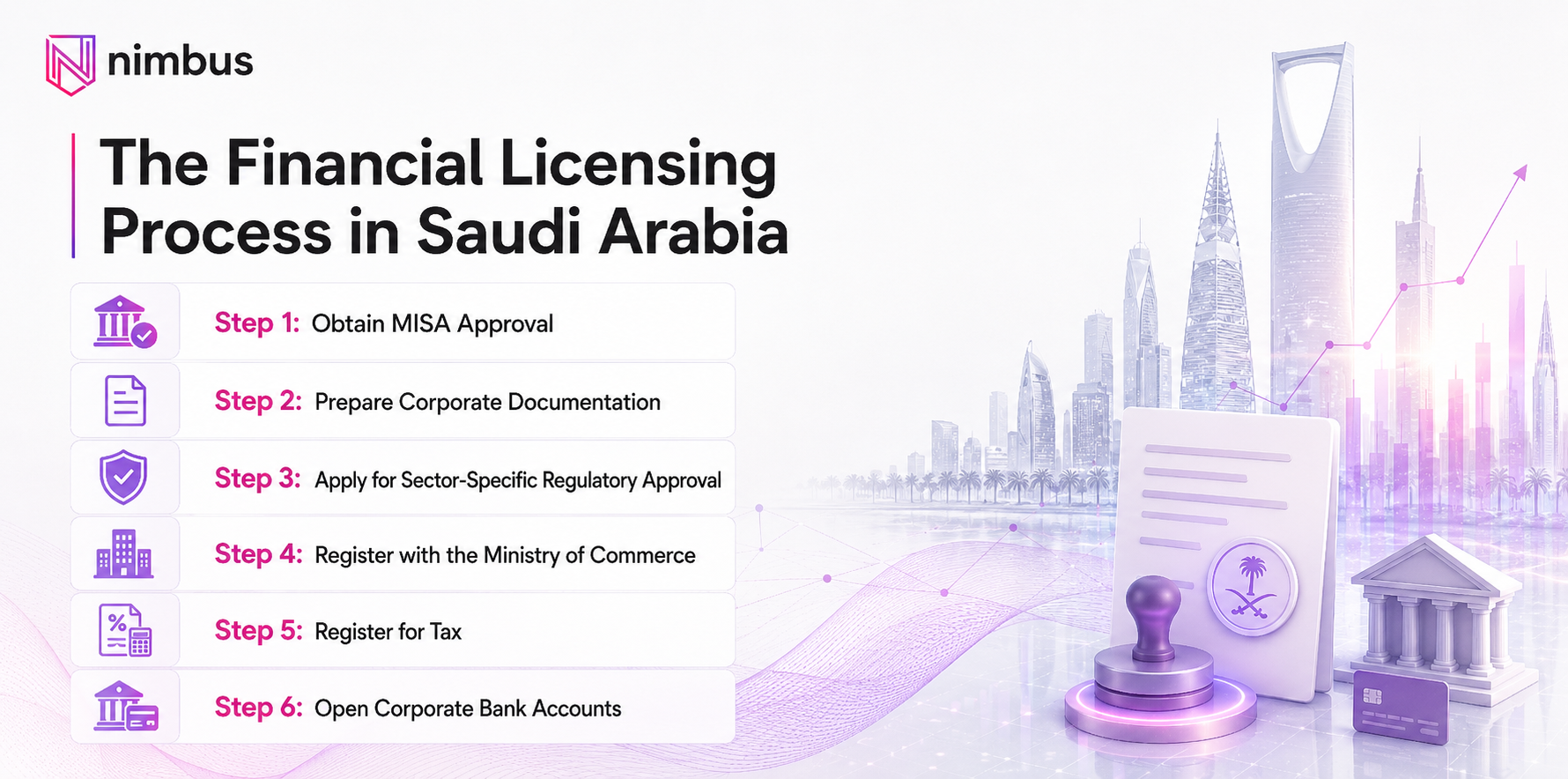
Obtaining authorization to operate a financial institution involves several stages.
Step 1: Obtain MISA Approval
Foreign investors submit:
- Corporate documents
- Audited financial statements
- Business plans
- Board resolutions
- Ownership details
Recent reforms have streamlined MISA licensing procedures and eliminated certain investment license fees.
Step 2: Prepare Corporate Documentation
The Articles of Association must define:
- Shareholding structure
- Capital allocation
- Management authority
- Corporate objectives
- Governance procedures
The documents must be properly notarized and registered.
Step 3: Apply for Sector-Specific Regulatory Approval
Depending on the activity:
- Banks and fintech firms apply through SAMA.
- Investment firms and asset managers apply through the CMA.
- Insurance providers apply through the relevant insurance regulator.
Review periods generally range from three months to twelve months depending on the activity.
Step 4: Register with the Ministry of Commerce
Following regulatory approvals, businesses obtain:
- Commercial Registration (CR)
- Legal incorporation status
- Official operating authority
Step 5: Register for Tax
Companies must register with the Zakat, Tax and Customs Authority (ZATCA). Potential obligations include:
- Corporate income tax
- VAT registration
- Zakat obligations
- E-invoicing compliance
Step 6: Open Corporate Bank Accounts
Saudi banks conduct extensive:
- KYC checks
- AML reviews
- Beneficial ownership verification
- Source-of-funds assessments
Proper preparation can significantly reduce onboarding delays.
Regulatory Compliance: Governance and Risk Management in KSA
Saudi regulators place considerable emphasis on governance and risk management. Financial institutions are expected to implement:
- Internal audit functions
- Risk management frameworks
- AML and counter-terrorism financing controls
- Compliance monitoring systems
Executives and shareholders must meet the requirements relating to integrity, qualifications, experience, and financial standing.
Adhering to the SAMA Cybersecurity Framework and PDPL
As financial services become increasingly digital, cybersecurity compliance has become a major regulatory focus. Financial institutions must comply with:
- SAMA Cybersecurity Framework
- Saudi Personal Data Protection Law (PDPL)
- Data localization requirements
- Incident reporting obligations
Organizations handling customer financial information must maintain robust cybersecurity infrastructure and conduct regular risk assessments.
Saudization in the Financial Sector: Meeting Nitaqat Quotas
Human capital development remains a core element of Vision 2030. Financial institutions must comply with Saudization requirements, including:
- Employment quotas for Saudi nationals
- Localization targets for key positions
- Ongoing workforce reporting
Failure to meet localization requirements may affect visa allocations and operational permissions.
The Future of Fintech and Financial Services in Saudi Arabia (2026 & Beyond)
The long-term outlook for Saudi Arabia’s financial industry remains highly positive. Several trends are expected to drive continued growth, including expansion of fintech and digital banking, increasing foreign direct investment, and expansion of private wealth management.
For international investors evaluating business setup in Saudi Arabia’s financial sector, Saudi Arabia offers a complementary growth market with enormous long-term potential.
Comments are closed