

The UAE labour market is entering a stricter phase of Emiratisation enforcement, and employers operating in the country need to prepare well before the June 30, 2026 compliance deadline.
The Ministry of Human Resources and Emiratisation (MoHRE) has confirmed that the AED 6,000 minimum monthly wage requirement for Emirati employees officially took effect on January 1, 2026.
While companies employing UAE nationals have been granted a transition period to update existing contracts, enforcement measures will begin from July 1, 2026.
For many businesses, this policy introduces a new layer of operational compliance that directly affects hiring capability, work permit approvals, workforce planning, and Emiratisation quota calculations. Companies that fail to comply may face:
- Suspension of new work permits
- Loss of Emiratisation quota recognition
- Regulatory scrutiny
- Payroll audit exposure
For businesses considering business setup in the UAE and the ones already operating in the region, the new wage threshold reinforces the importance of building compliant workforce strategies from the start.
MoHRE’s AED 6,000 Minimum Wage for Emiratis in 2026
The AED 6,000 monthly wage requirement applies to UAE nationals employed in the private sector. The rule affects:
- New Emirati work permits issued from January 1, 2026
- Renewed Emirati permits
- Amended work permits
- Existing Emirati employees under transition arrangements
Companies employing Emirati staff hired before January 1, 2026 have until June 30, 2026 to amend employment contracts and payroll records accordingly.
From July 1, 2026 onward, enforcement will become active. This means employers who fail to meet the salary threshold risk losing Emiratisation quota credit for underpaid employees, even if the company technically employs the required number of Emirati workers.
Why This Rule Matters Beyond Payroll Compliance?
Many employers initially see the policy as a straightforward salary increase requirement. In reality, the rule carries wider operational implications.
The UAE government is using compensation policy as part of a broader workforce localisation strategy designed to:
- Increase Emirati participation in the private sector
- Improve employment quality for UAE nationals
- Reduce artificial quota compliance
- Encourage long-term workforce integration
For companies involved in UAE company formation, workforce localisation planning is becoming a core operational requirement.
Does the AED 6,000 Minimum Apply to Basic Salary or Total Pay?
One of the most important things is understanding what actually counts toward compliance. The AED 6,000 requirement refers specifically to the employee’s base salary paid through the Wage Protection System (WPS). This creates a significant issue for companies that historically structured compensation packages using:
- Housing allowances
- Transport allowances
- Incentive payments
- Other supplementary benefits
In some cases, total compensation may exceed AED 6,000 while the base salary itself remains below the required threshold. That structure will not satisfy compliance requirements after June 30, 2026. Employers therefore need to review employment contracts, payroll records, WPS submissions, and salary component structures before enforcement begins.
WPS Compliance and GPPSA Pension Registration for UAE Nationals
The Wage Protection System plays a central role in enforcement. MoHRE will use WPS data to verify whether employers are paying the required minimum salary to Emirati employees. Employers must also ensure Emirati staff are registered within the UAE pension and social security system within one month of work permit issuance.
Any inconsistency may create compliance risks during inspection or audit reviews. For companies managing large workforces, this increases the importance of integrated HR and payroll systems.
Which Businesses Face the Highest Exposure?
The strongest impact will likely fall on mainland companies subject to Emiratisation quotas. Under existing UAE labour localisation rules:
- Private sector businesses with 50 or more employees must increase Emirati representation by 1 percent every six months
- The target rises to 10 percent by the end of 2026
Even businesses that technically satisfy quota headcount requirements may still face penalties if Emirati employees are paid below AED 6,000 base salary.
High-Risk Sectors for MoHRE Labour Inspections in 2026
MoHRE has identified several sectors with particularly high Emiratisation exposure. These include:
- Financial services
- Business services
- Trade and retail
- Manufacturing
- Construction
Many businesses within these sectors operate through UAE mainland setup structures. As a result, compliance pressure is expected to increase significantly across mainland operations.
Fake Emiratisation and Nafis Support Rules: Common Employer Mistakes
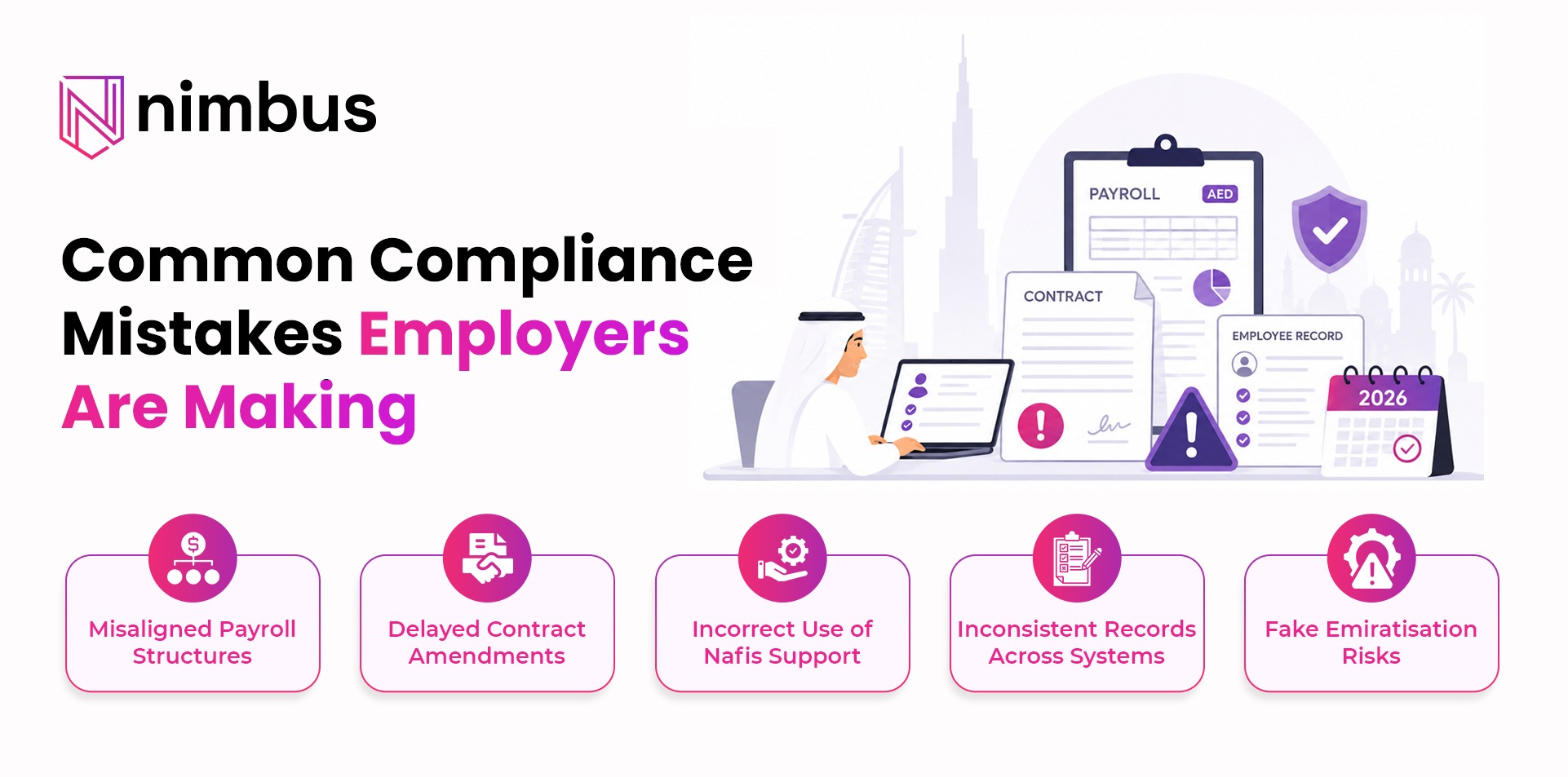
One recurring problem is that some companies still treat Emiratisation as merely an HR function rather than an operational compliance issue. As a result, several common mistakes continue to appear across UAE businesses, and listed below are the most common ones.
- Misaligned Payroll Structures: Many employers still rely on allowance-heavy compensation packages that leave the official base salary below AED 6,000. This structure now creates direct compliance exposure.
- Delayed Contract Amendments: Some companies are postponing contract updates until closer to the deadline. However, processing volumes are expected to increase sharply as June 2026 approaches, potentially creating delays with approvals and payroll adjustments.
- Incorrect Use of Nafis Support: Government-linked support programs such as Nafis cannot be used to offset the employer’s minimum salary obligation. The AED 6,000 threshold must be met through employer-paid base salary.
- Inconsistent Records Across Systems: Discrepancies between employment contracts, WPS records, and labour filings are becoming a major audit concern.
- Fake Emiratisation Risks: MoHRE has also publicly warned against artificial hiring arrangements designed solely to satisfy quota requirements without meaningful workforce integration. This practice carries increasing regulatory risk.
MoHRE Deadlines: How to Update Employment Contracts Before June 30
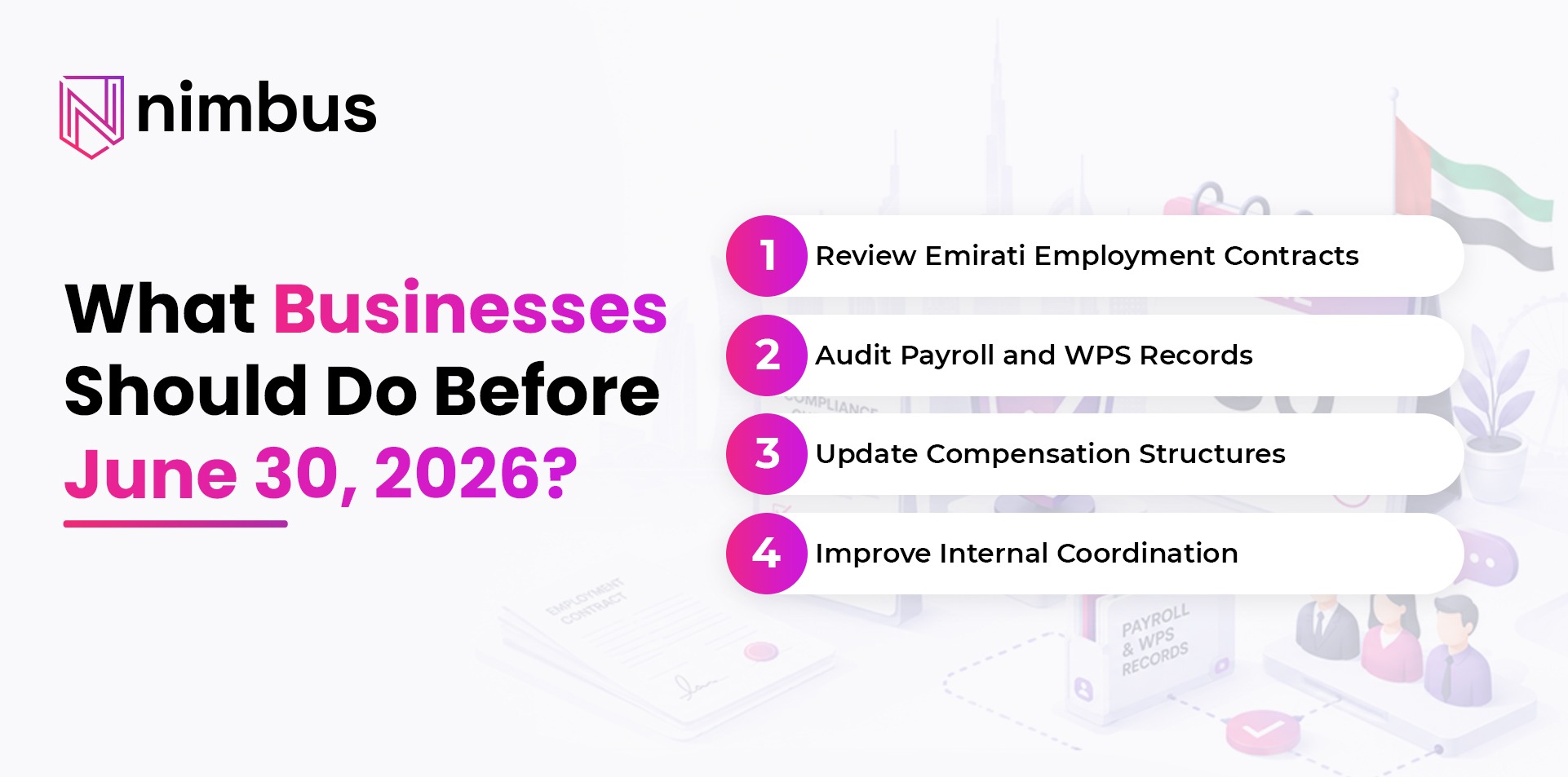
Companies operating in the UAE should begin reviewing their workforce structures well before the deadline. Important action areas include the following.
- Review Emirati Employment Contracts: Employers should identify all UAE national employees and confirm whether current contracts reflect the AED 6,000 base salary requirement.
- Audit Payroll and WPS Records: Payroll systems should align with contract terms, WPS submissions, pension registrations, and internal HR records.
- Update Compensation Structures: Allowance-heavy packages may require restructuring to ensure the required amount is reflected within base salary.
- Improve Internal Coordination: HR, legal, payroll, and finance departments should work together to reduce audit and compliance risks.
Business Setup in Dubai & UAE: Workforce Planning for 2026
The UAE’s AED 6,000 minimum salary rule for Emirati employees represents a major shift in private sector workforce regulation. While the policy officially took effect in January 2026, the real compliance pressure begins on July 1, 2026 when enforcement measures start.
The rule affects hiring strategy, WPS compliance, Emiratisation quotas, and operational continuity across the business. Companies that delay action may face permit suspensions, quota penalties, and increased regulatory scrutiny.
Businesses that prepare early and integrate Emiratisation into broader workforce planning will be better positioned for long-term operational stability. Early planning can help businesses build compliant payroll systems, reduce regulatory risk, and improve long-term workforce stability.
Comments are closed