

The Gulf Cooperation Council (GCC) countries have become one of the most important regions for companies looking to build an international presence between Europe, Asia, and Africa.
But entering the GCC is no longer simply a question of choosing a country, registering a company, and opening a bank account. Businesses now have more options, more specialised jurisdictions, and more regulatory considerations than ever before, especially for business setup in the UAE and KSA.
The right structure depends on where customers are located, what activities the business will conduct, how contracts will be signed, and how the company expects to expand in the future.
The economic picture also needs to be viewed realistically. The IMF’s April 2026 regional outlook projected GCC real GDP growth of 2.0% for 2026, with significant differences between individual economies.
It projected 3.1% growth for the UAE and 3.1% for Saudi Arabia. For companies considering GCC expansion, the more useful takeaway is that these two regions remain a collection of distinct markets rather than one uniform business environment.
That makes the structure of your GCC expansion particularly important.
How to Choose the Right Business Model for GCC Expansion
Before beginning business setup in Saudi Arabia or the UAE, companies should map their expected activities. For example, a technology company selling software will have different requirements from a financial services company or a company establishing a regional headquarters.
The business activity can influence licensing, office requirements, tax treatment, employee requirements and other regulatory approvals. This is why jurisdiction selection should happen after the operating model has been defined.
Benefits of Business Setup in the UAE for Foreign Investors
The UAE remains an important base for international businesses because it combines established infrastructure with a wide range of mainland and free-zone options. The country currently has over 40 free zones, covering sectors including technology, healthcare, financial services, and other specialised activities.
For some companies, a UAE free zone even offers a relatively focused way to establish a regional operation. However, “free zone” should not automatically mean “better.” The right choice depends on what the company needs to do.
UAE Free Zone Company Formation: Is It Right for You?
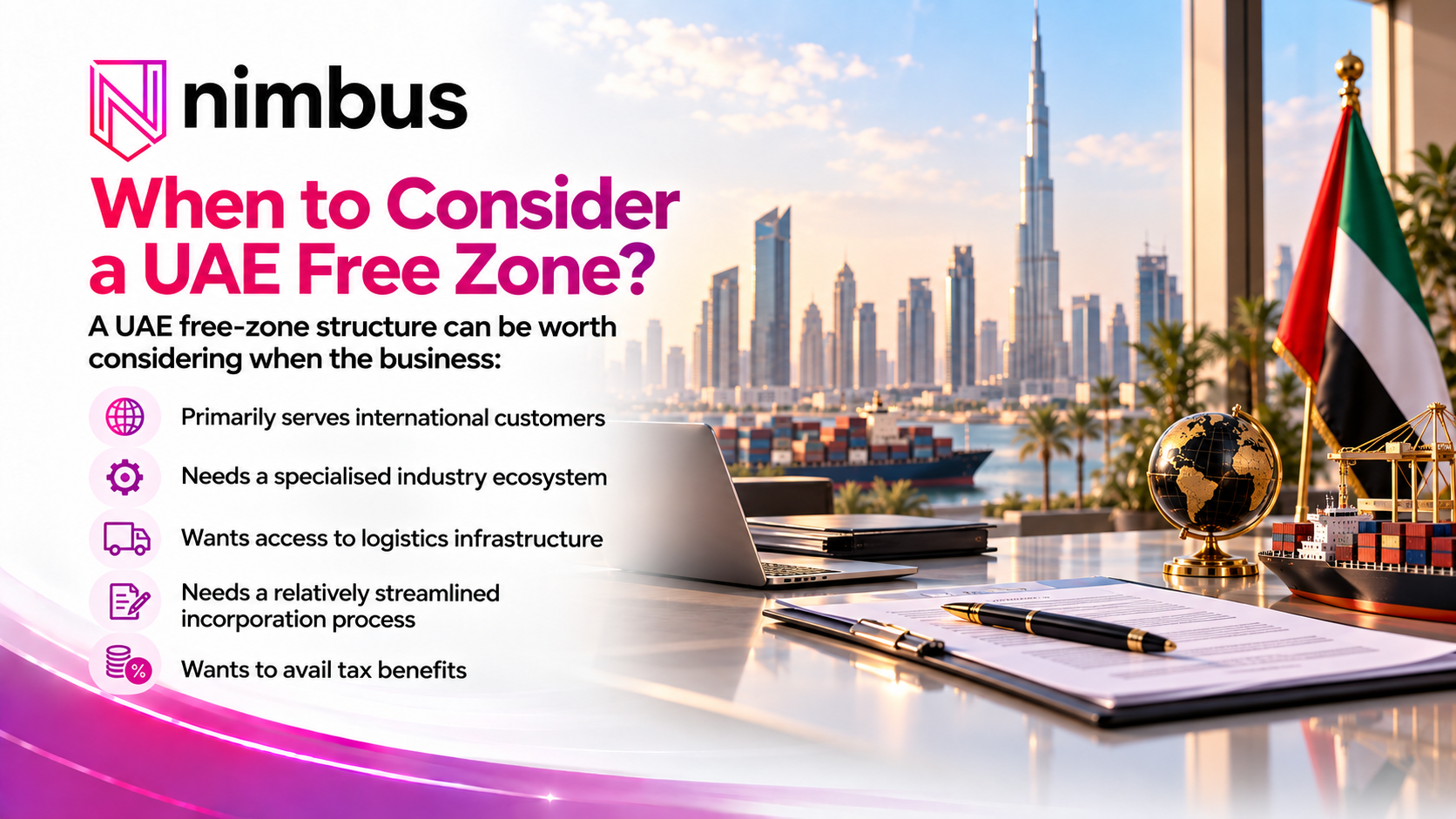
A UAE free-zone structure can be worth considering when the business:
- Primarily serves international customers
- Needs a specialised industry ecosystem
- Wants access to logistics infrastructure
- Needs a relatively streamlined incorporation process
- Wants to avail tax benefits
There are many different free zones, and their licensing, office, visa and regulatory requirements can vary. That makes UAE freezone setup a strategic decision rather than a simple cost comparison.
However, a UAE freezone setup does not automatically mean zero tax. A qualifying free-zone person can benefit from a 0% Corporate Tax rate on qualifying income, while taxable income that does not qualify is generally subject to the 9% rate.
The 0% treatment therefore depends on meeting the applicable requirements and does not mean every type of income earned by a free-zone company is automatically taxed at zero.
UAE Mainland Setup: Accessing the Local Market
For companies intending to build a substantial customer base, UAE mainland setup can offer a different operating model. The UAE’s Commercial Companies framework permits 100% foreign ownership for many mainland activities, although certain regulated sectors remain subject to restrictions.
Mainland businesses can operate under the licensing framework of the relevant emirate and can be more suitable where direct participation in the local UAE market is central to the business. This can be particularly relevant for companies that expect to work with government or regulated customers and build a substantial domestic presence.
Key Requirements for Business Setup in Saudi Arabia
When it comes to business incorporation in Saudi Arabia, investors have to face an entirely different investment framework, regulatory requirements, and localisation policies.
The updated Saudi Investment Law represents an important change in the investment environment. It adopts a general principle of freedom of investment while maintaining a list of excluded activities that may require approval.
Step-by-Step Guide to Company Formation in KSA & MISA Licensing
Businesses planning company formation in the KSA should map their structure around the full operating cycle. This includes the following points:
- Defining the commercial activity.
- Checking whether the activity is open to foreign investment.
- Reviewing any sector-specific approvals.
- Completing the applicable investment registration process.
- Establishing the appropriate legal entity.
- Obtaining the relevant commercial and activity licences.
- Setting up banking and accounting processes.
- Registering for applicable tax and statutory requirements.
- Planning recruitment and Saudization requirements.
- Establishing compliant payroll and employment processes.
MISA’s current investor guidance confirms that investment registration is available for approved economic activities and that requirements can vary according to the activity category. Its 2026 investor guide also identifies a range of supporting documentation and activity-specific conditions.
UAE vs. Saudi Arabia: Structuring Your Regional Headquarters
A GCC expansion does not necessarily require choosing one country and ignoring the other. For some international businesses, the UAE and Saudi Arabia can serve different purposes within the same regional structure.
The UAE can provide:
- Multiple free-zone options
- Mature business infrastructure
- Access to global investors and service providers
- A broad ecosystem for technology, finance, and trade
Saudi Arabia can act as a major operating market by offering:
- Opportunities connected to Vision 2030 programmes
- Large-scale infrastructure and development activity
- Profitable ventures across technology, manufacturing, and logistics
- A strong base for regional headquarters
The two structures do not need to compete with each other. A business might maintain its regional headquarters in the UAE while establishing a Saudi subsidiary for activities that require a local Saudi presence. The correct approach depends on the business model.
A Practical Roadmap for Business Expansion in the Middle East
For companies preparing for regional expansion, the following sequence can provide a useful starting point. The steps here are common to the UAE and the KSA. However, specifics may differ based on the regulatory requirements of the regions.
- Step 1: Define the regional objective
Decide whether the purpose is regional headquarters, sales, or wealth preservation. - Step 2: Map the GCC markets
Assess each target country based on crucial factors, such as customer demand, tax, localisation, and infrastructure among others. - Step 3: Select the initial jurisdiction
Choose the jurisdiction that matches the first stage of the business rather than trying to build the entire regional structure immediately. - Step 4: Design the legal structure
Consider whether you need a freezone or a mainland setup, a Saudi subsidiary or regional headquarters, or multiple operating entities. - Step 5: Plan tax and compliance
Review corporate tax, VAT, withholding taxes where applicable, economic substance, and beneficial ownership requirements. - Step 6: Build the workforce model
Identify employees, localisation requirements, visas, payroll, and professional licences. - Step 7: Review the structure regularly
The right structure at the start may not remain the right structure after significant growth.
Top Mistakes to Avoid When Starting a Business in the GCC
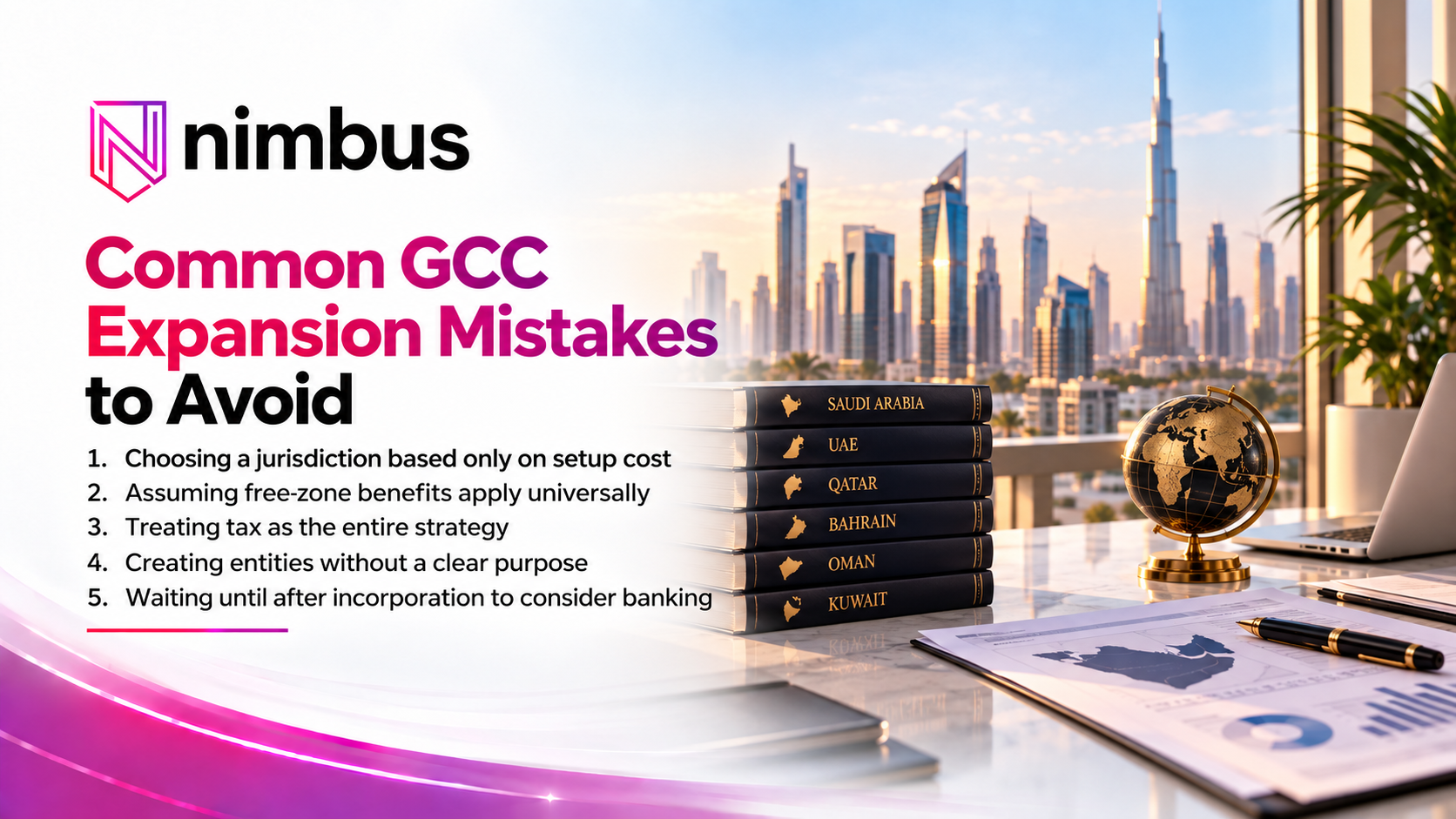
Businesses can reduce unnecessary costs and delays by avoiding several common mistakes. Here are a few common ones to avoid.
- Choosing a jurisdiction based only on setup cost
- Assuming free-zone benefits apply universally
- Treating tax as the entire strategy
- Creating entities without a clear purpose
- Waiting until after incorporation to consider banking
GCC expansion is becoming more sophisticated. The UAE offers a mature ecosystem with both free-zone and mainland structures, while Saudi Arabia is continuing to develop its investment environment and attract international companies across a broad range of sectors.
For companies considering either or both markets, the objective should be to build a structure that can expand without repeatedly rebuilding the corporate framework. That means thinking about ownership, licensing, tax, people, substance, and future growth before the first entity is registered.
Comments are closed