

For years, sustainability in the UAE was seen as a progressive choice rather than a regulatory necessity. Many international firms approached ESG as a way to enhance brand reputation or align with global investor expectations. That landscape has now changed.
Understanding the UAE’s Climate Law
The UAE’s sustainability journey has been evolving for over a decade, supported by initiatives such as the UAE Green Agenda 2030 and reinforced by global events like COP28 hosted in Dubai in 2023. However, the new climate law marks a major shift because ESG obligations are now legally enforceable across the economy.
The law applies broadly to:
- Private sector companies
- Free zone entities
- Government-related organizations
At its core, the law introduces a simple but powerful change: climate responsibility is now directly tied to business operations.
Core ESG Obligations Businesses Must Meet
The new framework introduces three primary responsibilities that companies should address before the compliance deadline of 30 May 2026.
1. Emissions Measurement and Reporting
Businesses are required to:
- Track greenhouse gas emissions using standardized methodologies
- Maintain accurate and auditable data systems
- Submit reports aligned with national regulatory frameworks
This is particularly relevant for UK firms already familiar with carbon reporting under UK and EU regulations, although local UAE alignment will still be necessary.
2. Implementation of Mitigation Strategies
Companies must go beyond reporting and actively reduce their environmental impact. This includes:
- Improving energy efficiency
- Reducing operational emissions
- Aligning with national climate targets
3. Participation in Climate Initiatives
The law also supports broader sustainability mechanisms such as:
- Carbon credit programs
- Climate adaptation initiatives
- Collaborative sustainability projects
Non-compliance can result in penalties, making ESG a legal and operational priority rather than a reputational one.
Why This Matters for UK Business Setup in the UAE
For UK companies entering the UAE market, ESG compliance is now directly linked to market entry strategy. Whether pursuing company formation in the UAE for regional expansion or establishing a holding structure, sustainability considerations must be integrated from the outset.
Key implications include:
- ESG frameworks must be built into corporate structures during UAE company formation.
- Operational models must account for emissions tracking and reporting.
- Investment decisions must consider long-term sustainability risks and opportunities.
This is particularly important when choosing between a UAE mainland setup and a UAE free zone setup, as regulatory expectations may vary depending on the nature of operations and sector exposure.
- Industrial and logistics firms may face higher scrutiny due to emissions intensity.
- Service-based businesses may focus more on governance and reporting standards.
- Free zone entities must still comply if operating within the UAE’s economic ecosystem.

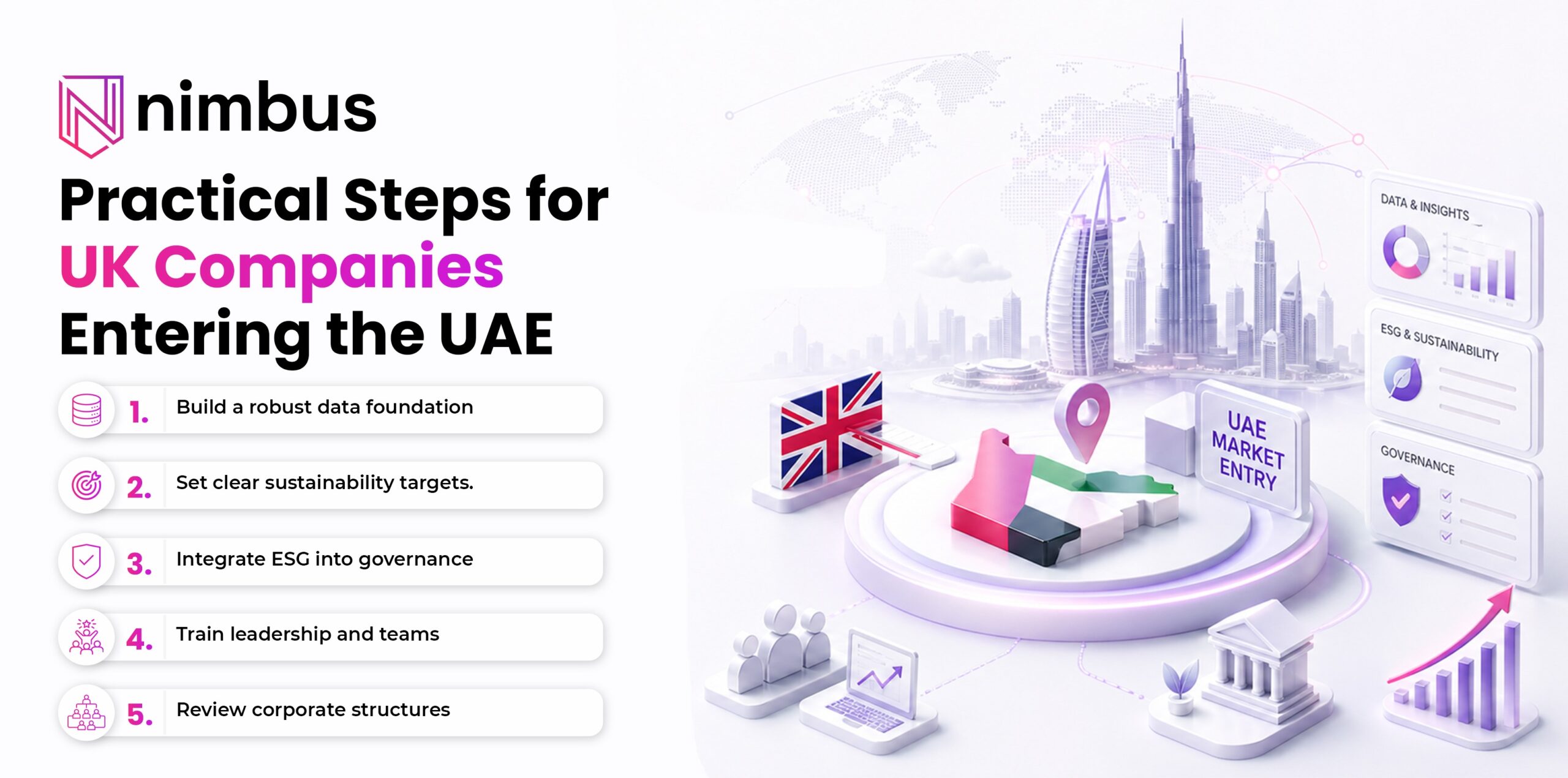
Practical Steps for UK Companies Entering the UAE
With the 2026 compliance deadline approaching, businesses should begin preparing immediately. A structured approach will help ensure both compliance and long-term value creation.
1. Build a Robust Data Foundation
Accurate emissions data is critical. Companies should implement systems to track energy use and emissions and align reporting with UAE standards.
2. Set Clear Sustainability Targets
Businesses should define measurable goals that align with national climate objectives and global ESG benchmarks.
3. Integrate ESG Into Governance
Sustainability should not sit within a single department. Instead:
- Board-level oversight should be established.
- ESG risks should be included in enterprise risk management.
- Clear accountability should be assigned across teams.
4. Train Leadership and Teams
Building internal capability is essential. Senior leadership must understand ESG requirements and their strategic implications.
5. Review Corporate Structures
During business setup in the UAE, companies should evaluate whether their chosen structure supports ESG compliance efficiently. This includes considering reporting requirements and regulatory exposure.
The Bigger Picture: UAE’s Vision for Sustainable Growth
The UAE’s climate law is part of a broader strategy to position the country as a global leader in sustainable economic development. With ambitious targets for clean energy and carbon reduction, the UAE creates a favorable environment for UK companies specializing in:
- Renewable energy
- Clean technology
- Sustainable finance
- Environmental consulting
For these sectors, the UAE represents not just a compliance challenge but a growth opportunity.
Conclusion: ESG as a Foundation for Future Success
The introduction of the UAE’s climate law marks a defining moment for businesses operating in the region. For UK investors and companies, it signals a shift toward a more structured, accountable, and sustainability-driven market.
Business setup in the UAE is no longer just about market access or tax efficiency. It now requires a clear commitment to ESG principles and climate responsibility. Companies that act early and integrate sustainability into their core strategy will be better positioned to succeed.
Those that delay may face not only regulatory challenges but also missed opportunities in a rapidly evolving market. The key is to approach ESG not as a compliance burden, but as a strategic advantage that shapes long-term success.

Comments are closed