


The UAE has taken another major step toward strengthening its corporate environment through the introduction of Federal Decree-Law No. 20 of 2025. The updated legislation modernizes the country’s Commercial Companies Law and introduces structural reforms that affect businesses operating in the region.
For companies considering business setup in the UAE, these reforms offer a more investor-friendly corporate framework. The amendments introduce expanded structuring options for limited liability companies (LLCs), clearer investor exit mechanisms, and new procedures for moving businesses between jurisdictions such as free zones and mainland licensing systems.
The reforms also place greater emphasis on governance transparency, capital structuring discipline, and shareholder protections.
This article details the main structural reforms introduced by the 2025 amendments and explains how they may influence corporate structuring, investment strategies, and regulatory compliance for companies operating across the UAE.
Why the UAE Is Updating Its Commercial Companies Legal Framework?
Over the past two decades, the UAE has positioned itself as one of the world’s most business-friendly destinations for international investors. Strong infrastructure, investor-friendly tax policies, and simplified licensing processes have gained attention of investors.
However, with the growing ecosystem, investors demand stronger legal certainty, and so, regulatory frameworks must evolve accordingly. The 2025 amendments to the Commercial Companies Law aim to align the UAE’s corporate regulations with international governance standards while maintaining operational flexibility.
For companies exploring business setup in the UAE today, the new framework offers better options for investment, clearer governance mechanisms, and improved legal tools for corporate restructuring.
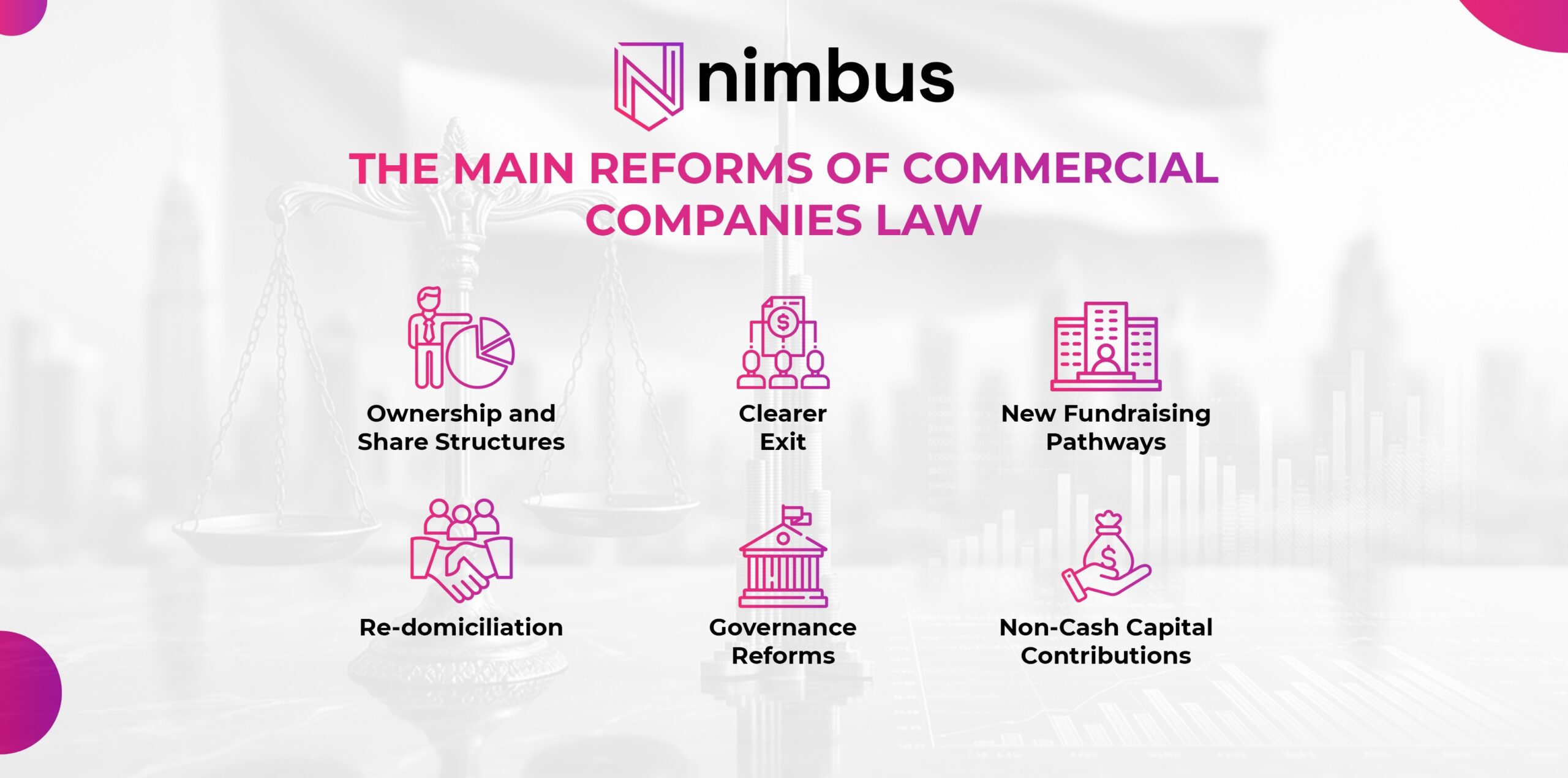
The Main Reforms of Commercial Companies Law
1. More Flexibility for LLC Ownership and Share Structures
One of the most important reforms introduced by the updated legislation is the ability for mainland LLCs to create multiple classes of shares. Previously, many mainland companies operated under relatively uniform ownership structures.
The new framework allows LLCs to issue share classes with different economic and governance rights. Companies can now design ownership structures that separate control rights from economic participation.
Founders may retain voting authority while external investors participate in dividend or liquidation distributions. Venture capital investors can negotiate preference rights or structured exit mechanisms that previously required more complex offshore arrangements.
The introduction of differentiated share classes also strengthens the UAE mainland setup as a platform for venture investment and private equity transactions. Many global investors prefer structures where voting, dividend, and liquidation rights can be tailored to investment risk and exit timelines.
2. Clearer Exit Rights for Investors and Shareholders
Another major reform of the updated Commercial Companies Law is the formal recognition of drag-along and tag-along rights within corporate constitutional documents.
Drag-along rights allow majority shareholders to require minority investors to participate in a company sale, ensuring that potential acquisitions are not blocked by small minority positions.
Tag-along rights allow minority shareholders to sell their shares under the same conditions as majority investors when ownership changes occur.
By embedding these rights directly into the legal framework, the amendments improve the enforceability of shareholder agreements and strengthen exit planning for investors.
Clear exit rights help investors evaluate risk and structure transactions more confidently, especially in early-stage companies where governance and ownership dynamics can evolve quickly.
3. New Fundraising Pathways for Private Companies
The reforms also introduce expanded capital-raising opportunities for private joint stock companies. Under the revised framework, private joint stock companies may raise capital through private placements in the UAE financial markets, subject to regulatory approval and oversight by the Securities and Commodities Authority.
This change provides companies with an alternative funding pathway that previously required more complex international structuring. Instead of relying exclusively on offshore holding companies or financial freezone structures, businesses can now access domestic private investment markets more efficiently.
For companies pursuing business setup in the UAE, the ability to raise funds through private placements could significantly improve capital access and investment flexibility.
4. Re-domiciliation Between Mainland and Free Zone Jurisdictions
One of the most transformative reforms is the creation of a statutory framework for corporate re-domiciliation. Previously, companies wishing to move between mainland and free zone jurisdictions often needed to dissolve and recreate legal entities. This process could disrupt contracts and operational continuity.
The updated law allows companies to transfer their registration between jurisdictions while preserving legal identity, contractual obligations, and corporate history. This means corporate groups can now restructure their regional operations more efficiently when business priorities change.
This means a company operating in a UAE free zone may relocate to a mainland license for expanding into the domestic market. Conversely, a mainland entity may move into a free zone if tax structuring or sector-specific regulatory frameworks make it more suitable.
5. Governance Reforms and Director Responsibilities
Beyond ownership and operational flexibility, the amendments also introduce several governance reforms to strengthen corporate accountability. The updated law addresses issues that previously caused operational uncertainty, such as board resignations and manager replacements.
Clear procedures will now ensure business continuity when leadership positions become vacant or shareholder disagreements prevent governance appointments. Directors and company managers also face expanded legal responsibilities under the updated framework. These responsibilities include:
- duties of care
- obligations to act in the best interest of the company, and
- stricter disclosure requirements for related-party transactions.
Certain companies may also be required to appoint independent directors or maintain detailed corporate records documenting board decisions, conflict-of-interest disclosures, and governance procedures.
6. Valuation Rules for Non-Cash Capital Contributions
The amendments also introduce clearer requirements for in-kind capital contributions. When investors contribute assets instead of cash, those assets must now be valued by accredited valuation professionals.
If assets are not properly valued according to regulatory standards, they may not qualify as valid capital contributions. This requirement offers more transparency in capital structuring and protects investors from inflated asset valuations that could distort ownership distribution.
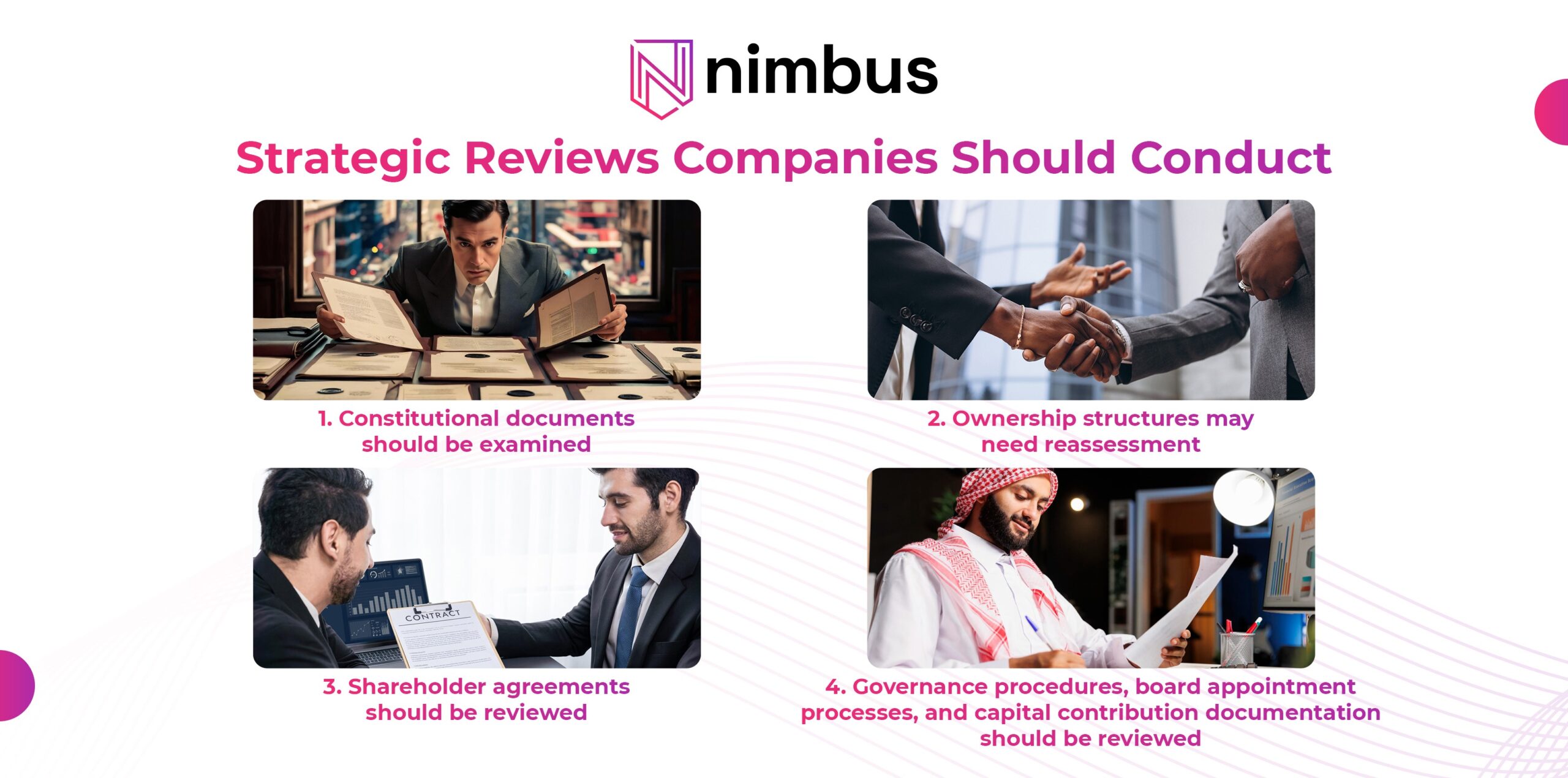
Strategic Reviews Companies Should Conduct Under UAE Commercial Companies Law Reforms
Companies already operating in the UAE should consider reviewing their corporate structure in light of the new legal framework. The main parts that need reviewing are listed as follows:
1. Constitutional documents should be examined to determine whether they allow flexible share structures or investor exit rights introduced by the amendments.
2. Ownership structures may need reassessment to ensure they align with current funding plans and succession planning strategies.
3. Shareholder agreements should be reviewed to ensure drag-along rights, tag-along rights, and transfer provisions remain consistent with the updated law.
4. Governance procedures, board appointment processes, and capital contribution documentation should be reviewed to ensure compliance with the updated requirements.
A More Sophisticated Corporate Landscape in the UAE
The amendments to the Commercial Companies Law reflect the UAE’s broader strategy of shaping a more matured international corporate ecosystem. For investors, this evolution creates both opportunity and responsibility.
The expanded structuring tools allow companies to design investment arrangements more effectively, while the enhanced governance rules ensure that corporate accountability remains strong.
Companies that review their legal structures early and align governance frameworks with the updated law will stand to benefit from the next phase of the UAE’s corporate growth.

Comments are closed