


Expanding across the Gulf is an attractive move for many investors. The UAE and the KSA are two of the region’s most powerful economic engines, offering infrastructure, access to capital, and strategic geographic positioning.
However, one of the most common misconceptions encountered is the assumption that both markets operate as “low-tax” jurisdictions with similar systems. In reality, while both economies are pro-business, their tax frameworks differ significantly.
For companies operating across borders, whether startups or multinational entities, understanding the structural and compliance differences between the UAE and KSA is essential for sustainable growth.
This guide breaks down key differences in corporate tax, Zakat, VAT, withholding tax, and entity structuring, and explains how to build an efficient cross-border tax strategy.
Why Understanding Both Tax Systems Is Critical?
Although both countries have introduced modern tax regimes, their foundations are different. The UAE implemented Corporate Tax (CT) at 9% on profits exceeding AED 375,000, effective from June 2023. Saudi Arabia, however, operates under a dual system:
- Zakat (2.5%) applies to Saudi and GCC-owned entities.
- Corporate Income Tax (20%) applies to foreign-owned or mixed-ownership companies.
- VAT at 15% applies broadly to goods and services.
- Withholding Tax (5–20%) applies to certain cross-border payments to non-residents.
These differences mean that a structure optimized for a business setup in the UAE won’t be compliant for Saudi Arabia. Common cross-border traps include:
- Misclassifying income between Zakat and Corporate Tax in KSA
- Ignoring Permanent Establishment (PE) risks
- Failing to manage withholding tax exposure
- Overlooking VAT registration requirements in both jurisdictions
While the UAE remains attractive due to its relatively low CT rate and Free Zone incentives, KSA’s system requires more layered compliance and longer documentation retention. Businesses operating in both jurisdictions must prepare for different enforcement approaches.
The UAE’s Federal Tax Authority (FTA) emphasizes Corporate Tax alignment and VAT documentation, while Saudi Arabia’s ZATCA focuses heavily on Zakat calculations, e-invoicing compliance, and withholding tax accuracy.
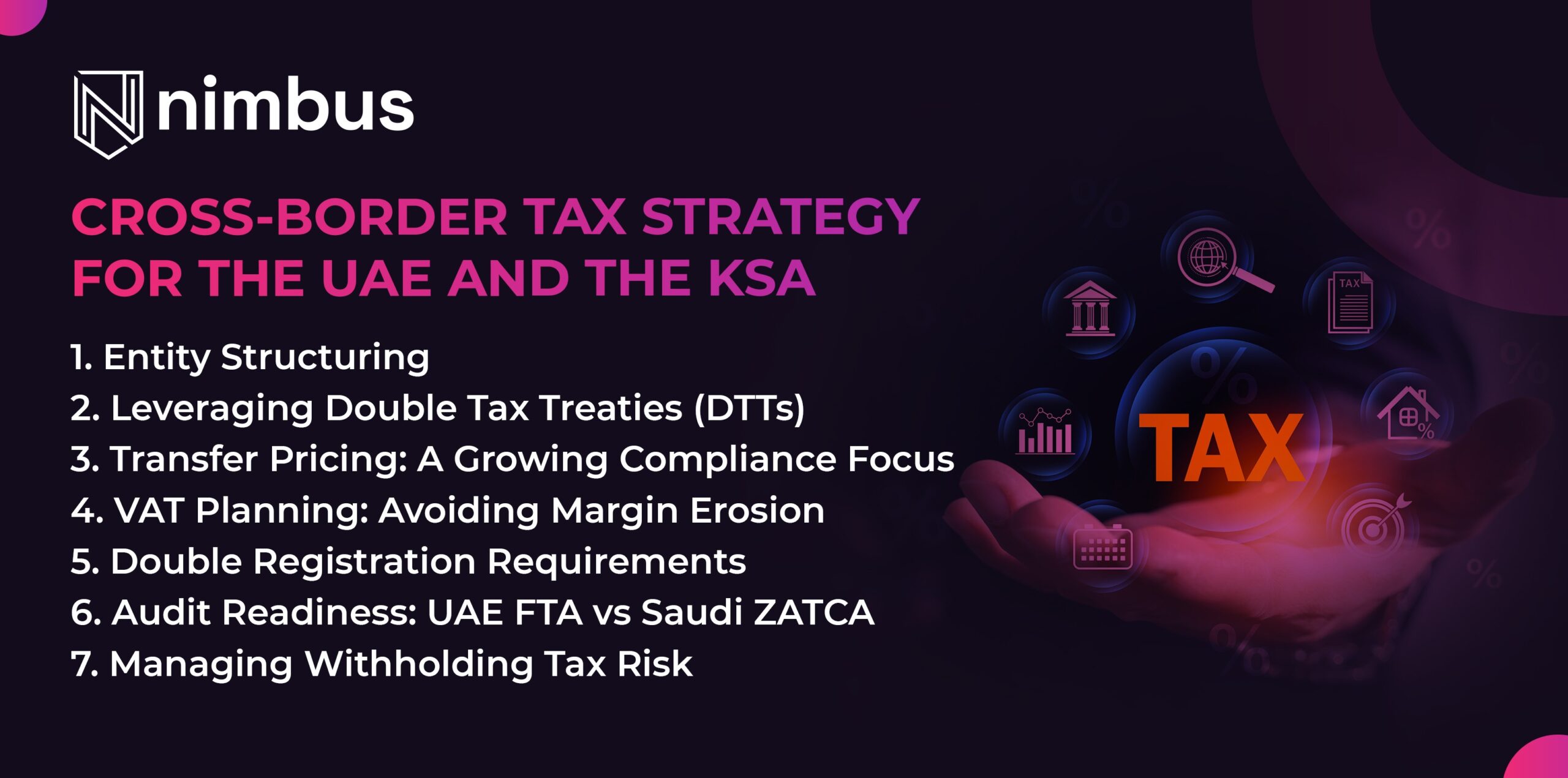
CROSS-BORDER TAX STRATEGY FOR THE UAE AND THE KSA
1. Entity Structuring
Entity structuring is one of the most important strategic decisions for regional operations.
UAE Holding Company Model
Many investors establish a UAE holding company, often in DIFC or another Free Zone, to manage dividends and reinvoicing across the group. Advantages may include:
- 0% Corporate Tax on qualifying Free Zone income
- Access to the UAE – KSA Double Tax Treaty (DTT)
- Potential reduction of withholding tax on dividends
Saudi Branch vs Subsidiary
Ownership structure directly affects tax exposure. Foreign companies entering KSA must choose between:
a) KSA Branch
- Subject to 20% Corporate Tax
- No separate legal personality
- Operationally direct but offers less liability protection
b) KSA LLC Subsidiary
- May trigger Zakat or Corporate Tax depending on ownership
- Offers stronger liability protection
- Suitable for larger projects and long-term contracts
2. Leveraging Double Tax Treaties (DTTs)
The UAE–KSA Double Taxation Agreement can help:
- Reduce or eliminate withholding tax
- Prevent double taxation of profits
- Clarify taxing rights between jurisdictions
3. Transfer Pricing: A Growing Compliance Focus
Both the UAE and KSA have implemented Transfer Pricing (TP) regulations aligned with OECD standards. Any intercompany transactions, such as management fees, licensing, or financing arrangements, must meet arm’s length principles. Regulators increasingly examine:
- Pricing consistency
- Supporting documentation
- Intercompany agreements
Penalties for non-compliance can be significant in both countries.
Businesses must prepare:
- Master Files
- Local Files
- Transfer Pricing disclosures
4. VAT Planning: Avoiding Margin Erosion
VAT differences present one of the biggest operational challenges. With UAE VAT at 5% and KSA VAT at 15%, poor structuring can lead to:
- Non-recoverable input VAT
- Double VAT exposure
- Incorrect reverse charge application
- Penalties for misclassification
5. Double Registration Requirements
If a company supplies goods or services in both countries and exceeds taxation thresholds, it must register in both jurisdictions. Common errors include:
- Misclassifying zero-rated exports
- Incorrect invoicing format (KSA e-invoicing mandatory since 2021)
- Failing to apply reverse charge mechanisms correctly
6. Audit Readiness: UAE FTA vs Saudi ZATCA
a) UAE Audit Triggers
- Incomplete Corporate Tax filings
- Transfer Pricing documentation gaps
- Economic Substance misalignment
- VAT reporting inconsistencies
Records must be retained for 7 years.
b) KSA Audit Focus
- Zakat miscalculations
- Withholding tax errors
- E-invoicing compliance
- Arabic documentation requirements
Records must be retained for 10 years. Saudi authorities are particularly strict regarding documentation in Arabic. Businesses relying solely on English records risk compliance issues.
7. Managing Withholding Tax Risk
Unlike the UAE, KSA imposes withholding tax on payments to non-residents, including:
- Royalties
- Technical service fees
- Management fees
- Dividends
Improper structuring can reduce profit margins significantly. Strategic planning through treaty application and contract structuring is essential to mitigate exposure.
Building an Integrated UAE–KSA Tax Strategy
Successful regional expansion requires:
- Clear entity structuring aligned with ownership objectives
- Early Transfer Pricing documentation
- Integrated VAT compliance systems
- Proper use of Double Tax Treaties
- Audit-ready recordkeeping in both jurisdictions
Turning Complexity into Competitive Advantage
The UAE offers a relatively low Corporate Tax environment with Free Zone incentives and no withholding tax. Saudi Arabia, on the other hand, combines Zakat, Corporate Tax, VAT at 15%, and withholding tax within a more documentation-intensive compliance system.
Each demands a tailored approach. Companies that understand these distinctions and proactively align their structures will:
- Reduce unnecessary tax leakage
- Avoid regulatory penalties
- Strengthen audit defensibility
- Improve cross-border profitability
Because in regional expansion, structure determines sustainability.