


The UAE remains one of the world’s most dynamic commercial environments. From startups to multinational groups expanding operations via business setup in the UAE, companies rarely remain static for long and yet, many business owners underestimate how technical and regulated the changes can be.
Regulatory reforms, rebranding, and operational expansion all trigger one inevitable requirement: corporate updates. Amending a trade license in the UAE is not a simple administrative formality.
It is a legal process governed by the Department of Economy & Tourism (DET/DED) for mainland entities and more than 40 individual Free Zone authorities across the country. Each authority has its own procedures, documentation standards, approval timelines, and compliance obligations.
In 2026, with corporate tax, AML compliance, and Ultimate Beneficial Owner (UBO) regulations firmly in place, managing amendments correctly has become more critical than ever.
When Does a Company Need a License Amendment?
Any structural, operational, or governance change typically requires formal registration with the relevant authority. Common triggers include:
- Adding or removing business activities
- Changing shareholders or ownership percentages
- Appointing or removing directors and authorised signatories
- Increasing or reducing share capital
- Changing the company’s legal name
- Relocating office premises
- Updating UBO information
Whether your business is established in a UAE Free Zone or under a mainland structure, these updates are mandatory. Failing to update records can lead to serious consequences, including:
- Regulatory fines reaching AED 300,000
- Suspension of corporate bank accounts
- Delays or rejection of visa applications
- UBO penalties up to AED 100,000
Compliance today is interconnected. Banks, immigration authorities, tax regulators, and Free Zone authorities share visibility. A single outdated record can trigger multiple operational disruptions.
Understanding the Regulatory Landscape: Free Zone vs Mainland
One of the most important distinctions when planning amendments is whether your entity operates under a UAE freezone business setup or a UAE mainland setup.
1. Free Zone Companies
- Regulated by individual Free Zone authorities (e.g., DMCC, DIFC)
- Must comply with Free Zone-specific office and reporting requirements
- Often benefit from streamlined internal approvals
- Activity changes may be restricted to the Free Zone’s permitted list
2. Mainland Companies
- Regulated by DET/DED in the respective Emirate
- May require approvals from additional ministries depending on the sector
- Must maintain a valid commercial lease (Ejari)
- Often face broader activity options but more layered approvals
The type of structure chosen during business setup in the UAE directly impacts how amendments are processed later. For example, adding a healthcare activity in mainland Dubai may require MOHAP approval, while education-related services may require KHDA authorization. The amendment pathway must match both the jurisdiction and the sector.
Categories of License Amendments Explained
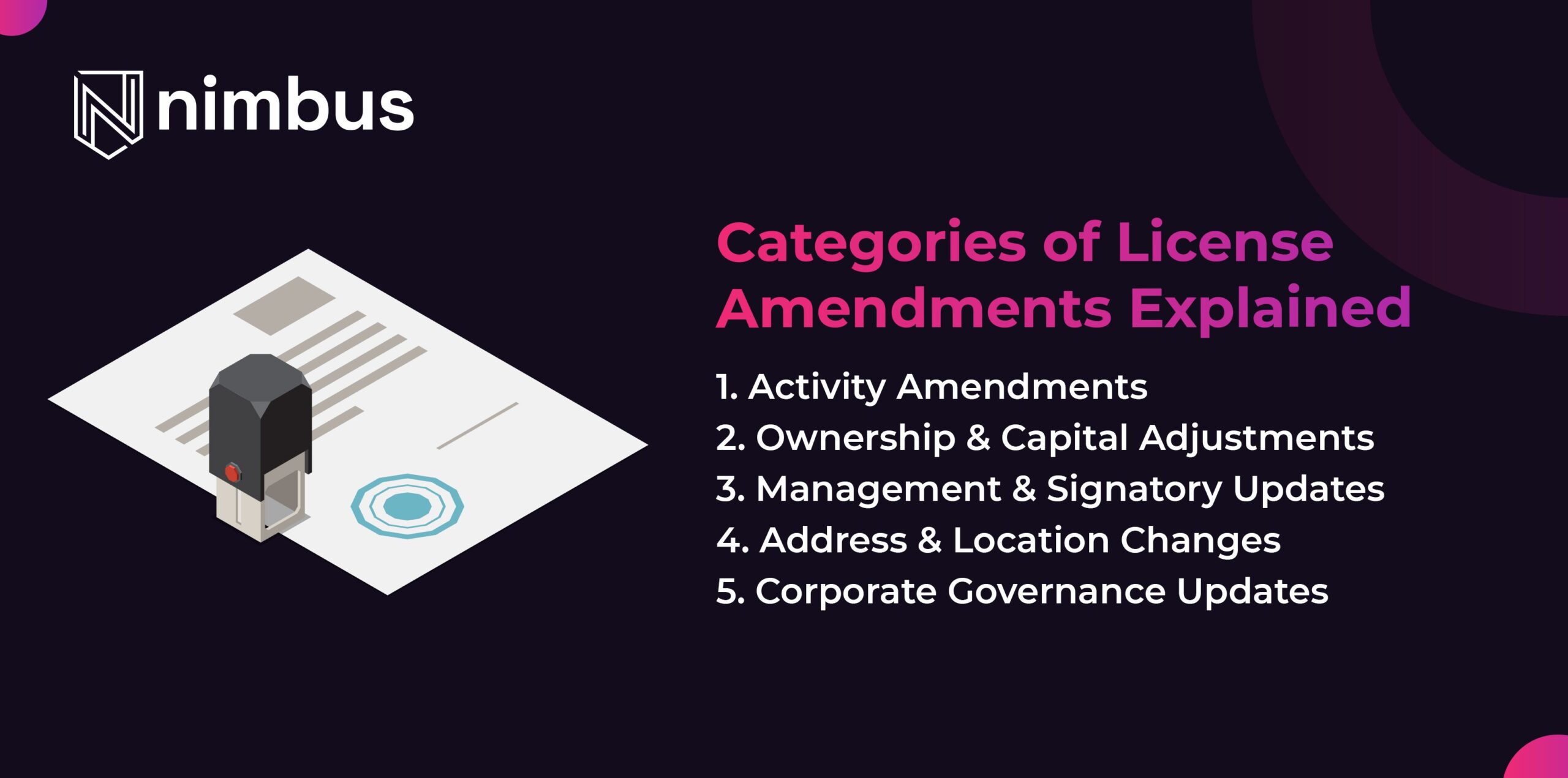
Not all amendments are the same. They typically fall into five core categories listed below.
1. Activity Amendments
This involves adding or removing business activities on the trade license. If your company provides services outside its licensed scope, contracts may be unenforceable, VAT treatment may be challenged, and insurance coverage may be invalid. Businesses expanding operations must update activities before invoicing new services.
2. Ownership & Capital Adjustments
Share transfers, new investors, capital increases, or restructuring ownership percentages require formal filings. These changes impact:
- UBO disclosures
- Corporate tax alignment
- Banking authority recognition
- Shareholder agreement validity
For companies raising funding rounds, precise sequencing of ownership amendments is essential to avoid compliance conflicts.
3. Management & Signatory Updates
Changes in directors, managers, or authorised signatories must be reflected in:
- Trade licenses
- MOA amendments
- Bank mandates
- Visa files
Failure to update these records can freeze accounts and invalidate signed contracts.
4. Address & Location Changes
Office relocation requires updated lease registration, inspection approvals (in some Free Zones), and visa quota alignment. Ignoring this step can result in visa suspensions or municipal penalties.
5. Corporate Governance Updates
This includes MOA revisions, UBO filings, and board resolution updates.
Under current AML and corporate governance rules, documentation must reflect actual control and ownership structures.
The Amendment Process: A Structured Approach
Although procedures differ by authority, most amendments follow three key stages.
Stage #1: Planning & Documentation
Planning is essential during amendments because errors at this stage often cause rejection or invalidation of contracts. This phase determines:
- The type of amendment required
- Necessary approvals
- Correct sequencing
- Required corporate resolutions
Stage #2: Authority Submission & Approval
Applications are submitted to the relevant Free Zone authority or DET/DED. Certain sectors require additional regulatory approvals. Delays or incomplete documentation can result in:
- Account restrictions
- Visa suspensions
- Operational downtime
Stage 3: Post-Amendment Compliance
Approval is not the end of the process. Overlooking the compliance stage often triggers penalties despite the amendment being approved. Businesses must update:
- FTA records (corporate tax and VAT)
- UBO filings within 60 days
- Banking mandates
- Contracts, invoices, and official letterheads
- Chamber of Commerce registrations
Common Pitfalls Businesses Face
Even experienced companies encounter challenges. Some of the most common pitfalls include the following:
1. Incorrect Sequencing
For example, adding activities before updating ownership may create tax inconsistencies.
2. Incomplete Documentation
Expired MOAs, incorrect shareholder details, or missing notarizations cause delays.
3. Ignoring Sector-Specific Requirements
Industries like healthcare, finance, and education require additional regulatory clearance.
4. Underestimating Compliance Interconnections
A simple name change affects banking, VAT registration, contracts, visas, and branding simultaneously.
When a Simple Amendment Is Not Enough
In some cases, restructuring is more appropriate than a basic license update. Examples include:
- Converting legal form (LLC to PJSC)
- Expanding via branch registration
- Full ownership restructuring under new tax frameworks
- Mergers and acquisitions
- Liquidation and new entity formation under bankruptcy law
Why Proper Amendments Drive Growth?
Businesses that manage amendments proactively experience:
- Reduced risk of regulatory fines
- Faster investment onboarding
- Smooth banking relationships
- Clear tax alignment
In a regulatory environment that increasingly emphasizes transparency and compliance, proactive corporate governance is a strategic move.
Treat Amendments as Strategic Milestones
For a successful establishment of business setup in the UAE, staying compliant with evolving regulations is essential for sustainable growth. In 2026 and beyond, companies that treat license amendments as strategic milestones will be better positioned to scale and operate with confidence in the UAE’s competitive market.