
Expanding into Saudi Arabia is a strategic milestone for many international businesses. With regulatory modernization and rising foreign investment, Saudi Arabia continues to position itself as the MENA region’s primary commercial hub.
However, one of the most critical and often underestimated stages of business setup in Saudi Arabia is the General Manager’s (GM) first in-person visit. This visit is operationally essential.
Without the GM’s physical presence to activate residency, government portals, and compliance registrations, the company cannot function fully on the ground. This guide outlines a practical, step-by-step checklist covering pre-arrival preparation, arrival procedures, and post-registration obligations to ensure a smooth business setup process in Saudi Arabia.
Why the General Manager Role Is Structurally Critical?
Saudi regulations require every foreign company to appoint a locally resident General Manager to oversee operations and represent the company before government authorities. The GM acts as the legal face of the company and is responsible for:
- Regulatory compliance
- Government coordination
- Signing contracts and official documents
- Managing workforce and Saudization obligations
To formally assume this role, the GM must:
- Obtain a work visa
- Enter Saudi Arabia
- Secure an Iqama (residency permit)
Only after completing these steps can the GM activate the company’s operational infrastructure.
Stage 1: Pre-Arrival List – What Must Be Prepared Before Travel?
1. Secure the Work Visa
The GM visa is typically valid for entry within three months of issuance and allows an initial stay of at least 90 days.
Important:
If the GM does not enter Saudi Arabia within three months, the visa is automatically canceled. Restarting the process can delay operations by two months or more and may involve additional penalties. It’s better to plan entry within two weeks of visa issuance to safeguard timelines.
2. Gather Required Documentation
Before initiating the visa process, ensure the following documents are prepared correctly:
- Valid passport copy
- Passport-sized photographs (Saudi-compliant format)
- Medical examination report (valid for three months)
- Police clearance certificate from the home country
- Notarized and apostilled corporate documents (as required by the Saudi embassy)
Improper notarization or incorrect apostille formatting is one of the most common reasons for visa rejection.
3. Complete Qualification Verification (If needed)
Certain roles may require a Qualification Verification Program (QVP) review. Failing to complete this early can result in visa rejection and significant delays. Prioritize this step during planning.
Stage 2: Key Activation Steps Upon Arrival
Step #1: Visa Stamping Confirmation
Upon entry, confirm that immigration authorities have properly stamped the visa. Ensure:
- Medical reports remain valid
- Police clearance remains valid for at least three months
Step #2: Complete Medical Examination
A medical checkup at an approved facility is mandatory for Iqama issuance. Without medical clearance, residency cannot proceed.
Step 3: Obtain Health Insurance
Health insurance is compulsory for residency processing. It must comply with Saudi regulatory standards and be active before final Iqama issuance.
Step 4: Secure a Saudi SIM Card
Without a Saudi number, digital registrations will stall. A local mobile number is essential for:
- Banking OTP verification
- Government portal access
- Absher registration
- Daily business operations
Step 5: Issue the Iqama
The Iqama is the official residency permit, typically valid for 12 months.
It enables the GM to:
- Open bank accounts
- Register on government platforms
- Sign legally binding contracts
- Conduct full business operations
Once issued, the Iqama becomes the central identifier across all government systems.
Stage 3: Government Portal Activation – Digital Infrastructure Setup
Saudi Arabia operates through interconnected digital government systems. After receiving the Iqama, the GM must register and activate key platforms. Failure to do so will halt hiring, payroll, and visa management. The main government platforms are listed below.
a) Muqeem
Manages employee residency data, visa issuance, renewals, and exit/re-entry permits; needed for managing workforce mobility.
b) Absher
Provides individual e-services for residency, visa tracking, and government transactions.
c) Qiwa
Handles employment contracts, Saudization compliance, workforce records, and labor services; mandatory for all employment management.
d) Mudad
Oversees payroll compliance and Wage Protection System (WPS) reporting; essential to avoid labor penalties.
e) Saudi Business Center
This platform centralizes corporate documentation and is used to manage Commercial Registration, Articles of Association, and licensing updates.
Post-Registration Responsibilities of the GM
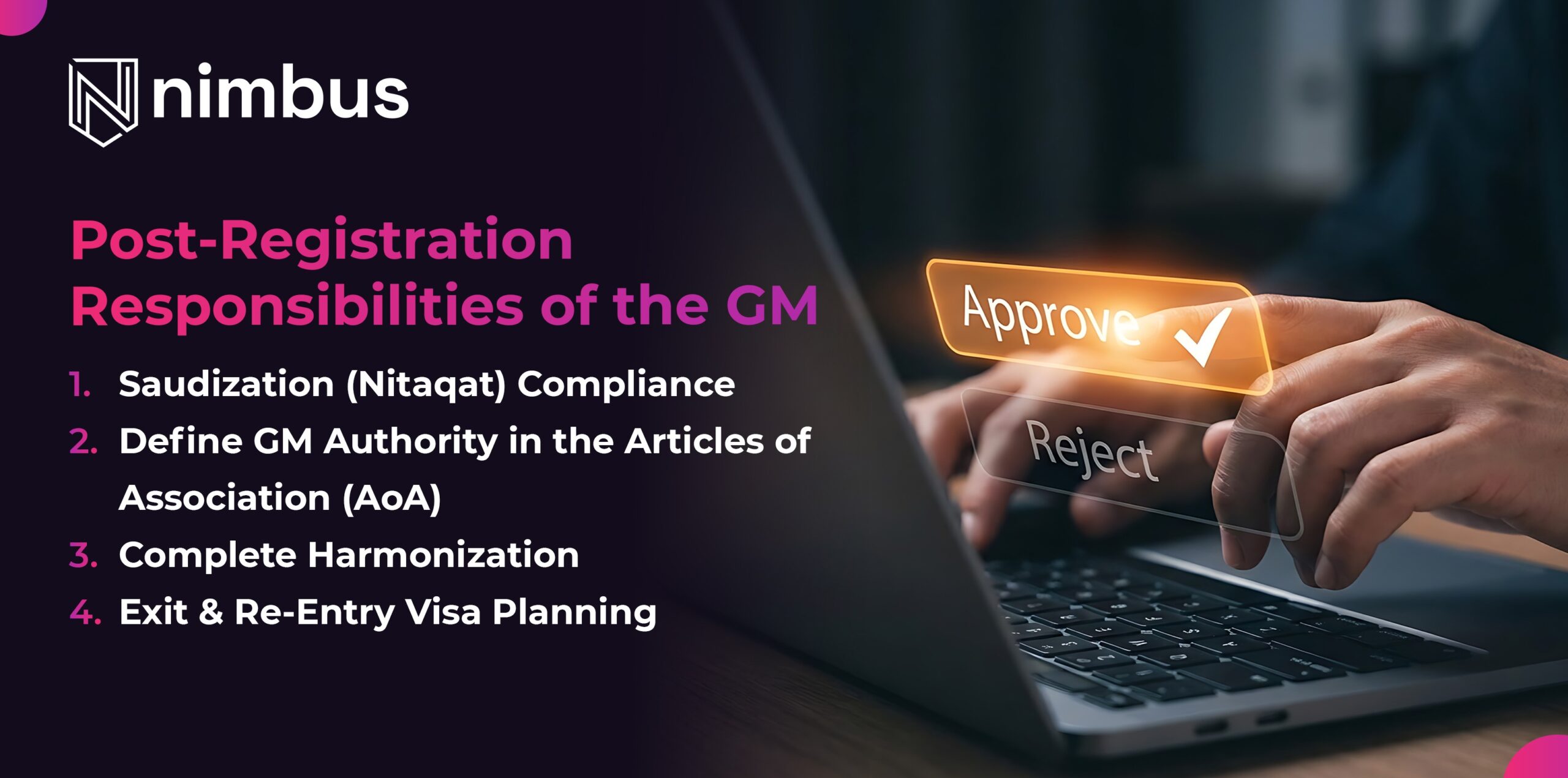
Once the business incorporation in the KSA is done, compliance responsibilities begin immediately.
1. Saudization (Nitaqat) Compliance
Saudization requirements apply from early stages of operation. So its planning must begin during company formation process, not after. If the company has fewer than six employees:
- At least one must be resident in Saudi Arabia (often the GM)
- A Saudi employee must typically be hired before renewing the GM’s Iqama after the first year
Non-compliance can result in:
- Visa renewal blocks
- Hiring restrictions
- Government penalties
2. Define GM Authority in the Articles of Association (AoA)
The AoA should clearly outline the GM’s authority. Overly restrictive powers can create operational bottlenecks. Key powers should include:
- Signing contracts and commercial agreements
- Opening and managing bank accounts
- Handling lease agreements and property matters
- Recruiting staff and managing HR processes
- Representing the company before courts and authorities
3. Complete Harmonization
After receiving the Iqama, the GM must update the AoA by replacing the passport number with the Iqama number. This process, known as harmonization, links the GM’s identity across government systems. This step is mandatory for seamless compliance. Without harmonization:
- Portal access may fail
- Banking systems may not sync
- Administrative complications can arise
4. Exit & Re-Entry Visa Planning
To travel outside Saudi Arabia, the GM must obtain an Exit Re-Entry Visa via Muqeem. A multiple-entry visa is highly recommended to prevent operational disruptions. Many companies overlook this until urgent travel is required, causing unnecessary delays.
Common Risks That Disrupt Company Formation Process
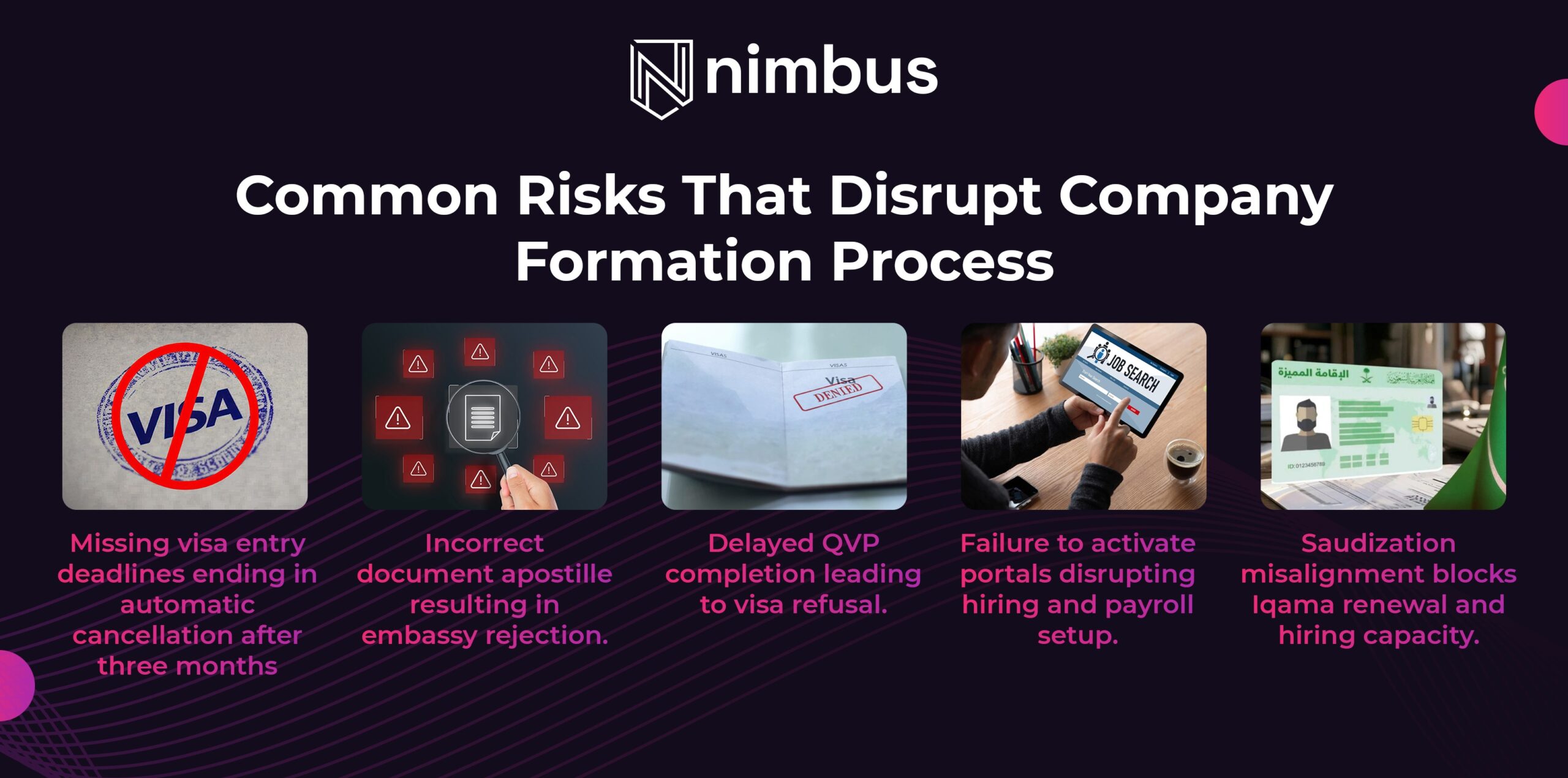
- Missingvisa entry deadlines ending inautomatic cancellation after three months
- Incorrectdocumentapostille resulting in embassy rejection.
- Delayed QVPcompletionleading to visa refusal.
- Failure toactivate portals disruptinghiring and payroll setup.
- Saudizationmisalignmentblocks Iqama renewal and hiring capacity.
The GM Visit Is Operational
The General Manager’s first visit to Saudi Arabia is the foundation of:
- Legal activation
- Regulatory compliance
- Workforce management
- Banking setup
- Government integration
A well-planned visit accelerates business setup in Saudi Arabia. A poorly coordinated one can delay operations for months.