
Saudi Arabia’s transformation journey continued at full pace in 2025. The year was marked by resilient economic expansion, labor reforms, Saudization mandates, and record-breaking foreign investment activity, including business setup in Saudi Arabia.
Commercial registrations surged, regional headquarters (RHQ) licenses reached new highs, and non-oil sector investment strengthened significantly. For global investors, 2025 was a year of structural reset that is shaping the Kingdom’s investment climate heading into 2026.
As Saudi Arabia advances toward its Vision 2030 objectives, understanding the regulatory, workforce, and economic shifts of 2025 is essential for strategic positioning in the year ahead.
SUMMARIZING KEY REFORMS OF THE KSA IN 2025
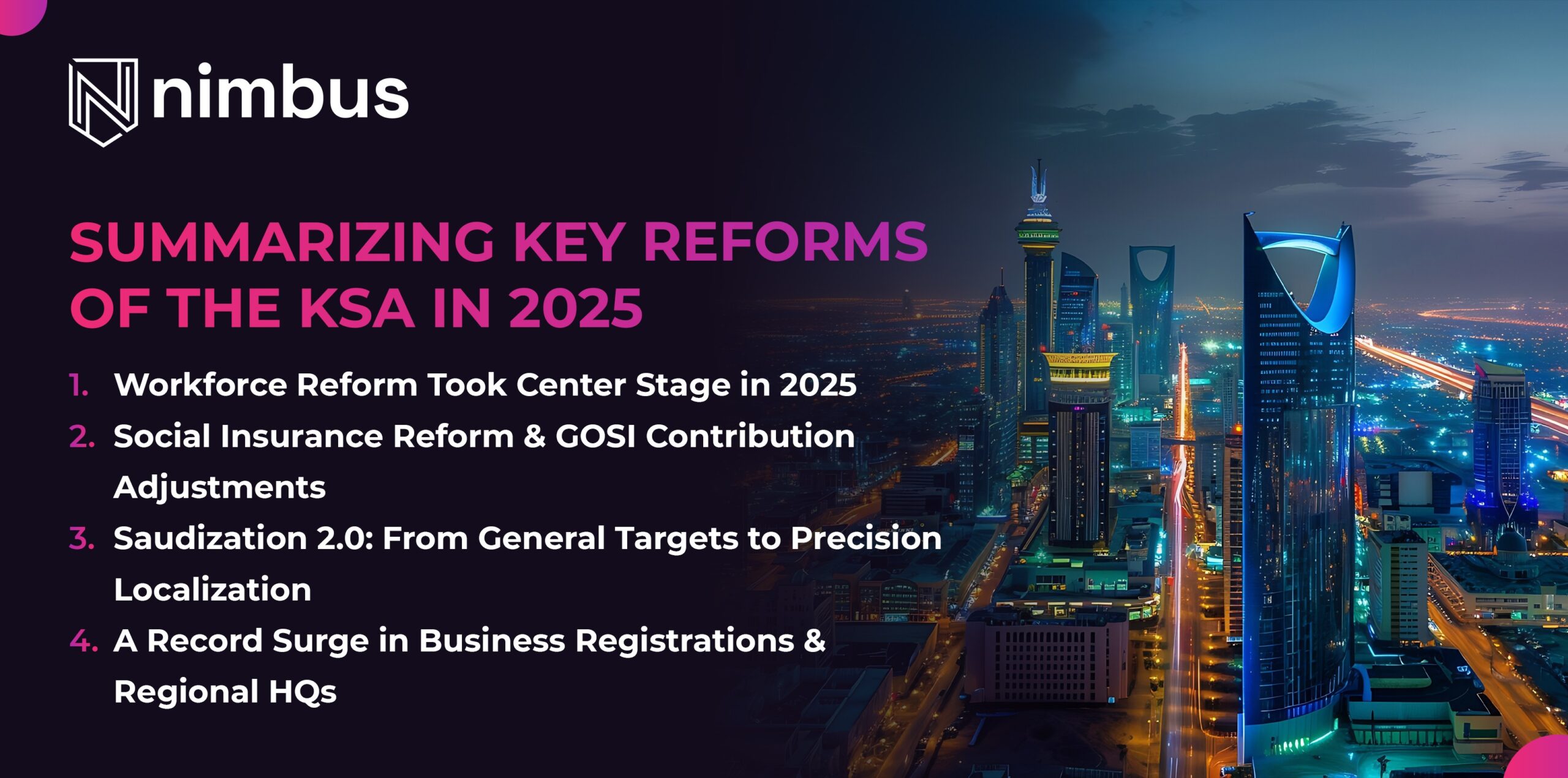
1. Workforce Reform Took Center Stage in 2025
One of the defining features of 2025 was the continued modernization of Saudi Arabia’s employment framework. Regulatory changes emphasized transparency, worker protection, and accountability, aligning the KSA more closely with global labor standards.
Contract Transparency & Wage Protection Enhancements
Employers are now required to clearly specify salary payment dates in all employment contracts registered through Qiwa. Employees may file wage claims directly through the platform within 30 days of non-payment, a move that significantly strengthens enforcement mechanisms.
This shift improves payroll transparency and reduces disputes while aligning practices with regional benchmarks. Additionally, employment contracts must separately itemize:
- Base salary
- Housing allowance
- Transportation allowance
- Other benefits
Resignation & Termination Framework Reforms
Resignation procedures were streamlined to prevent procedural delays and ensure fairness. Key changes include:
- Automatic acceptance of resignation if the employer fails to respond within 30 days
- The option for employers to delay acceptance for up to 60 days, but only with written justification
- The employee’s right to withdraw a resignation within seven days (if not yet accepted)
Expanded Family-Friendly Policies
Saudi Arabia also reinforced its commitment to workforce inclusivity:
- Maternity leave increased from 10 to 12 weeks
- Paternity leave now allows three days within seven days of childbirth
- Bereavement leave provides three days for immediate family loss
Such measures reflect the Kingdom’s broader objective of enhancing workforce participation and retention.
2. Social Insurance Reform & GOSI Contribution Adjustments
Amendments to the Social Insurance Law, effective from July 2025, reshaped retirement and contribution structures.
New Retirement Framework
The statutory retirement age now ranges between 58 and 65, depending on the contributor’s age as of July 3, 2024. For new entrants, 65 becomes the standard retirement age.
Early retirement remains available up to 10 years earlier, provided 360 months (30 years) of contributions are completed. Notably, the required contribution period for early retirement gradually increased from 25 to 30 years.
Contribution Rate Increases
Employee and employer contribution rates will rise incrementally from 9% to 11% of contributory wages, increasing by 0.5% annually from July 2025 through 2028. For investors and HR departments, workforce cost modeling must now incorporate long-term contribution increases and evolving pension obligations.
3. Saudization 2.0: From General Targets to Precision Localization
Localization requirements expanded significantly in 2025, signaling a shift from broad quotas to more targeted professional mandates. New localization measures focused on:
- Healthcare professions (pharmacy and dentistry)
- Accounting and financial services
- Engineering roles
- Sports and fitness sectors
Sports & Fitness Sector Quotas
Effective November 18, 2026, establishments with four or more employees must localize 15% of selected roles across 12 job categories in gyms and sports centers. Roles include:
- Sports coach
- Professional football coach
- Personal trainer
- Athletics coach
- Sports supervisor
Looking ahead to 2026, additional professions are likely to receive defined quotas, and enforcement is expected to intensify through digital monitoring systems. For foreign investors aiming for company formation in the KSA, Saudization planning must now be embedded into the business setup phase.
4. A Record Surge in Business Registrations & Regional HQs
Saudi Arabia’s commercial activity reached historic levels in 2025. By Q3, total commercial registrations surpassed 1.7 million. LLC registrations alone reached 502,000, representing a 158% increase since 2020. This growth reflects a fundamental shift: Saudi Arabia is no longer seen solely as a market entry point but as a core operational hub.
More than 760 RHQ licenses were issued by 2025, with projections exceeding 1,000 in the coming years. All in all, the steady influx positions the Kingdom as the MENA region’s emerging command center for global business operations.
What Investors Should Expect in 2026?
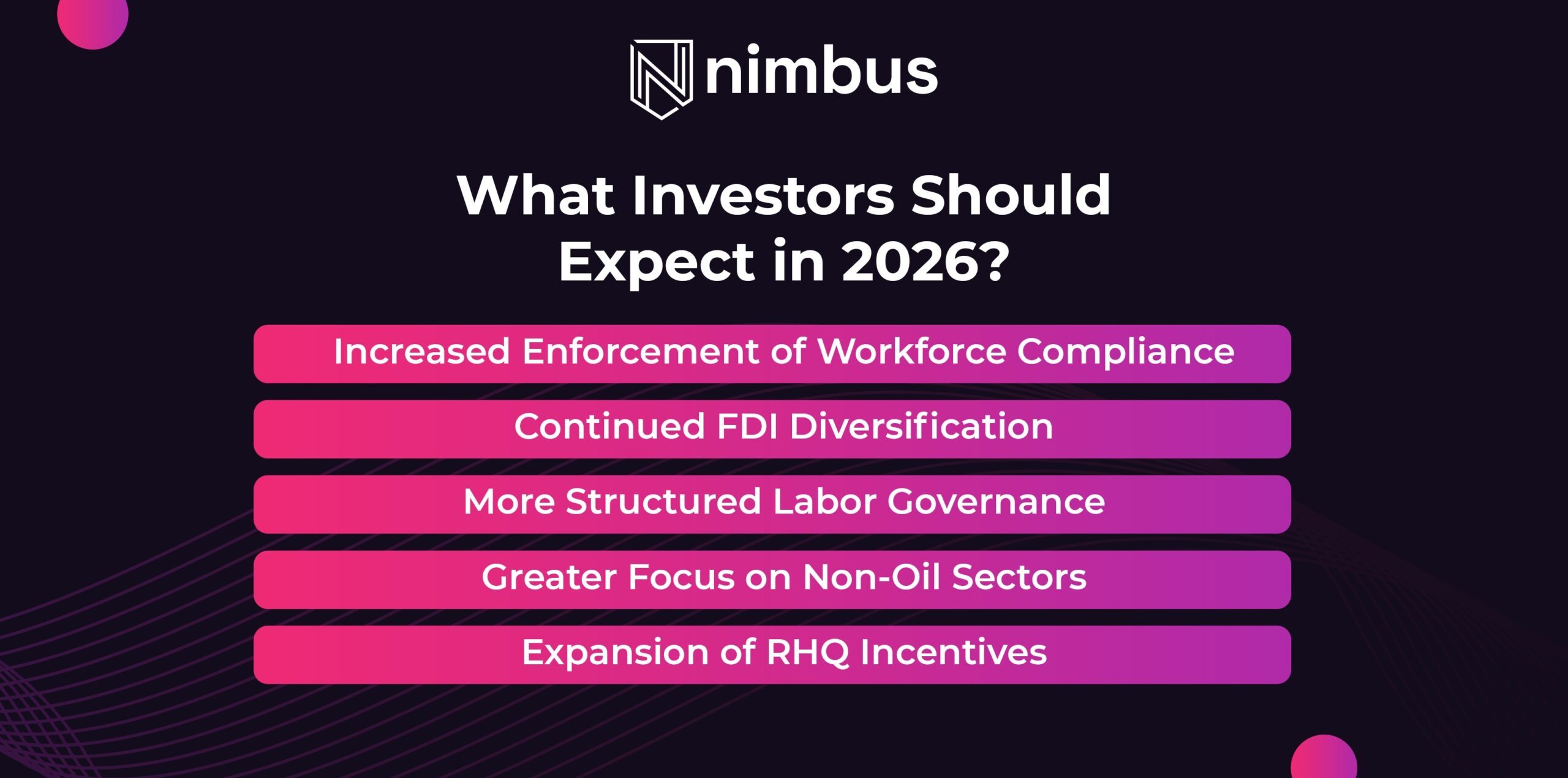
As Saudi Arabia enters 2026, several trends are likely to define the next phase and some important ones are listed below.
1. Increased Enforcement of Workforce Compliance
Saudization quotas will likely expand into additional professional categories, with stronger digital compliance monitoring.
2. Continued FDI Diversification
Trade corridors with the United States, Asia, and Europe are expected to deepen, reinforcing private-sector contribution targets of 65% of GDP by 2030.
3. More Structured Labor Governance
Further refinements to employment contracts, digital filings, and wage monitoring systems may be introduced to enhance regulatory clarity.
4. Greater Focus on Non-Oil Sectors
Investment into healthcare, technology, logistics, tourism, and sports infrastructure is expected to accelerate.
5. Expansion of RHQ Incentive
Saudi Arabia’s ambition to serve as the regional headquarters capital of MENA will likely drive further policy incentives and regulatory enhancements.
Final Reflection: 2025 as a Structural Inflection Point
Saudi Arabia’s progress in 2025 was not merely incremental. It was foundational. Labor reforms increased transparency and worker protections. Social insurance changes modernized retirement structures.
Saudization policies evolved into precision mandates. Business registrations reached record highs, and RHQ momentum accelerated. For investors, Saudi Arabia is becoming a highly structured, compliance-driven, globally integrated economic powerhouse.
As the Kingdom moves into 2026, success will depend on proactive regulatory alignment, early workforce planning, and strategic positioning within priority sectors.
Comments are closed